Edge Computing in Industrial Automation

Industrial automation is changing and factories are becoming smarter. They are using more connected devices than ever before. These devices are not only sensors and machines, but also advanced controllers, cameras, and industrial robots. 

Each device generates large amounts of valuable data. Edge computing is a key part of this change because it processes data closer to its source.

This is at the “edge” of the network. In factories, this means the shop floor, production line, or even individual machines. 

Processing data locally instead of sending it far away creates faster responses, which brings many benefits for industrial automation.

It reduces delays and improves reliability. It also supports modern applications like predictive maintenance, robotics, and energy efficiency.

This article explains what edge computing is, its role in industrial automation, benefits, challenges, and finally, its future.


Evolution from traditional automation → cloud computing → edge computing.

The shift from cloud to edge

Traditionally, data from factory sensors was sent to a central data center. This was for storage, processing, and analysis. Engineers would collect data, send it to the cloud, and wait for results.

But this can cause delays, called latency. Latency is a big problem for real-time automation.

Even a small delay of a few milliseconds can stop a robot arm from reacting correctly.

It can cause defects on a fast-moving assembly line. It can even affect safety systems that need instant action.

Cloud computing also has high costs for bandwidth. Industrial Internet of Things (IIoT) devices may produce gigabytes of data every second. Sending everything to the cloud wastes resources and money.

Edge computing offers a different approach. It puts processing power near the data source.

Devices like edge gateways, rugged servers, or intelligent PLCs do the work. These devices are installed directly in factories.

This local processing reduces latency. It improves responsiveness. It allows for real-time decision-making.

Operators and machines can act immediately based on local insights. At the same time, only important summaries or trends are sent to the cloud for higher-level use.

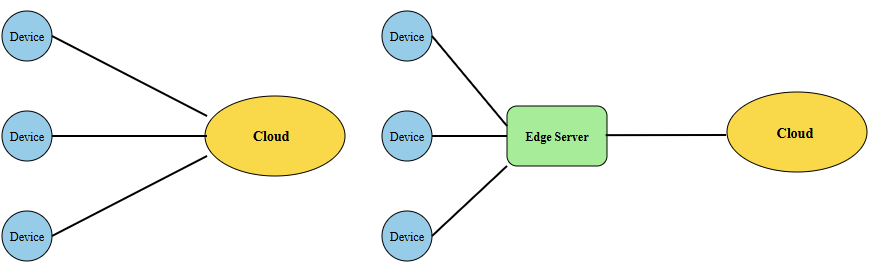
Cloud-Centric vs. Edge-Centric architectures

Architecture of industrial edge computing

The architecture of industrial edge computing can be thought of in layers. Each layer has its own role and purpose.

Device layer

This is the base layer. It includes all the devices that generate data. Examples are sensors, robots, and programmable logic controllers (PLCs). These devices collect huge amounts of data every second.

In a smart factory, hundreds of devices may be connected. They measure temperature, vibration, pressure, energy use, or product quality.

Without processing, this raw data is too large to handle. That is why the next layer is important.

Edge layer

This layer is right above the device layer. It contains edge servers and gateways. These process data locally and in real-time.

They filter out unnecessary or repetitive information. Only critical information is forwarded to the cloud.

For example, an edge device can check vibration data from a motor. If it detects an unusual pattern, it can send an alert instantly.

It does not need to wait for cloud approval. This layer is key for low-latency actions.

Cloud layer

This is the highest layer. It receives aggregated and analyzed data from the edge layer.

It is used for long-term storage, big data analytics, and historical insights. It helps with higher-level business decisions.

Managers can use this information for planning, forecasting, and improving efficiency. While the edge ensures fast responses, the cloud provides the big picture.

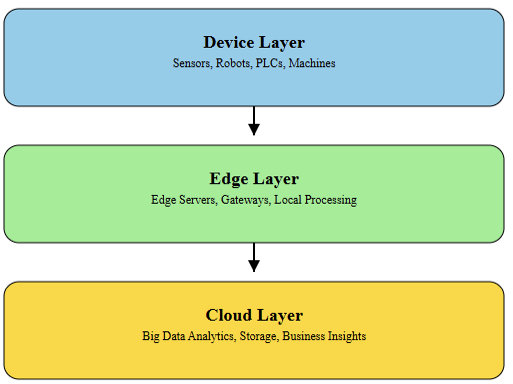
A three-layer architecture diagram: Device Layer → Edge Layer → Cloud Layer.

Benefits of edge computing

Low latency and real-time control

Speed is vital in industrial settings. Edge computing eliminates the delay of sending data to the cloud. Machines can react instantly.

For example, a robot can stop when a worker enters its zone. A conveyor belt can pause when a defective product is detected. This is crucial for safety-critical systems.

Optimized bandwidth

Industrial IoT devices produce massive amounts of data. Sending all this raw data to the cloud consumes bandwidth.

Edge computing processes data locally. It sends only relevant insights, like alarms or performance summaries, to the cloud. This reduces bandwidth usage and costs significantly.

Enhanced security

Processing sensitive data locally keeps it more secure. It reduces the risk of data being intercepted during transit to the cloud.

Many factories handle confidential production processes. Keeping this information on-site helps with data privacy and compliance with regulations.

Improved operational efficiency

Real-time insights on the factory floor help optimize processes. Machines can adjust automatically.

Operators can make faster decisions. This increases productivity and reduces waste.

High reliability

Edge systems can function even when cloud connectivity is lost. This is vital for remote sites or areas with poor internet.

For example, a mining site or offshore platform can still operate locally. This ensures operational continuity and safety.


Use cases in industrial automation

Predictive maintenance

Sensors on machines monitor performance. Edge devices analyze this data in real-time. They can detect early signs of a potential failure.

For instance, vibration data may show that a motor bearing is wearing out. This allows maintenance to be scheduled before a breakdown occurs. The result is less downtime and lower costs.

Automated quality control

High-speed cameras and sensors inspect products on the assembly line. An edge device processes the images instantly.

If it sees a defect, it can reject the product in milliseconds. This improves product quality, reduces waste, and maintains consistency.

Robotics and autonomous systems

Autonomous robots need to make split-second decisions. They process data from their sensors locally.

This allows them to navigate safely and perform tasks in real-time. Without edge processing, delays could cause collisions or inefficiency.

Supply chain optimization

Edge devices track inventory and monitor vehicles in real-time. For example, smart tags can report stock levels instantly.

Processing this data on-site allows for immediate adjustments. This helps optimize logistics and respond quickly to disruptions.

Energy management

Edge systems can monitor energy usage across a plant. They identify energy-intensive processes.

They can automatically turn off idle machines or adjust settings to save power. This reduces energy costs and supports sustainability goals.

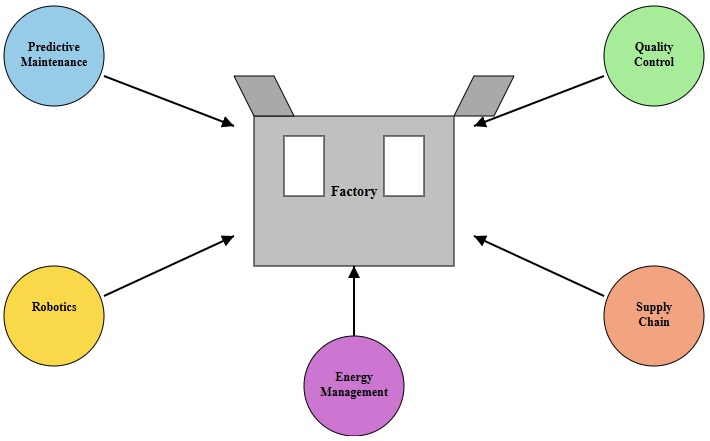
Challenges of industrial edge computing

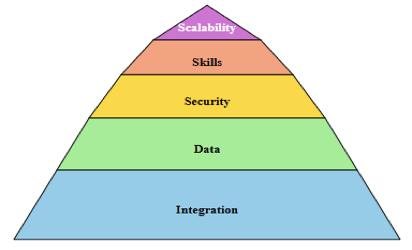
Integration with legacy systems

Many factories use older equipment. This equipment was not designed for modern digital architectures.

Integrating edge solutions with these machines can be complex and expensive. Custom adapters or upgrades may be needed.

Data management

Factories generate huge volumes of data. Managing and storing this data locally requires robust infrastructure.

If not planned well, local systems can become overwhelmed. Companies must design scalable storage and processing solutions.

Security concerns

Edge computing increases the number of potential entry points for cyberattacks. Each edge device can be a vulnerability.

Hackers may target gateways or servers. Strong security protocols and constant monitoring are necessary.

Skilled workforce

Managing edge infrastructure needs specialized skills. Workers must understand networking, cybersecurity, and industrial systems.

Many companies must invest in training or hire new personnel. Without skilled staff, projects may fail.

Scalability

Edge solutions must be able to grow with the business. Starting with pilot projects and planning for expansion is important.

Companies should design architectures that can scale easily without replacing everything.

The future of industrial edge computing

Convergence with 5G

5G networks offer high bandwidth and low latency. They enable seamless machine-to-machine communication.

With 5G, mobile robots and wireless sensors can exchange data instantly. This will further enhance industrial edge applications and expand flexibility on the factory floor.

Advancements in AI

AI models are becoming more powerful and efficient. They can be deployed directly on edge devices.

This will enable more intelligent and automated decision-making. For example, AI at the edge can predict quality issues, optimize robot movements, or adjust production schedules in real-time.

Standardization

Currently, the market has many different solutions. Each vendor provides its own hardware and software.

Standardization is needed for easier implementation. Open standards will simplify integration, reduce costs, and accelerate adoption of edge computing.

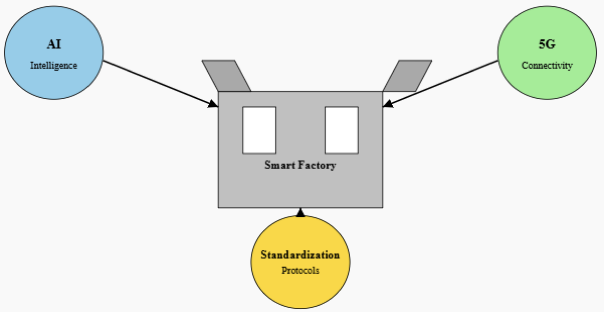
Key takeaways: Edge Computing in Industrial Automation

The present article detailed what edge computing is, its role in industrial automation, benefits, challenges, and finally, the future of this edge computing.

From this discussion, and without hesitation, we can say that edge computing is driving the next industrial revolution.

It moves data processing closer to the source and reduces latency and improves efficiency. It also enhances security and reliability.

Furthermore, challenges like legacy system integration and security must be addressed.

Skilled staff and strong planning are essential. But with careful preparation, the benefits are immense.

In addition, the future of manufacturing is autonomous and intelligent. Edge computing is a key enabler of this future. It bridges the gap between devices, people, and the cloud. It empowers industries to be faster, smarter, and more sustainable.

FAQ: Edge Computing in Industrial Automation

What is edge computing and how is it different from cloud computing?

Edge computing means processing data close to where it is generated (machines, sensors, etc.), instead of sending everything to a distant cloud. This reduces latency, bandwidth usage, and often improves reliability. 

Why is low latency important in industrial automation?

Many industrial tasks require instant or near-instant responses — e.g. safety systems, robotics, real-time quality control.

Delays (latency) can lead to defects, safety hazards, and inefficiencies. Edge computing helps by processing data locally so decisions happen quickly. 

What kinds of use cases are there for edge computing in factories?

Some common ones:

  • Predictive maintenance (monitoring machine health and detecting failures early). 
  • Quality control / visual inspection using computer vision. 
  • Robotics and autonomous systems (robots that need fast sensor feedback). 
  • Supply chain or warehouse optimization (inventory tracking, real-time visibility). 
  • Energy management (monitoring usage, shutting off idle machines, optimizing consumption). 

What benefits can companies expect from deploying edge computing?

  • Faster response times and real-time control. 
  • Reduced bandwidth costs and lower cloud storage/transfer fees, since not all data is sent offsite. 
  • Enhanced security and data privacy (sensitive data can remain local). 
  • Improved operational resilience (able to operate even with unreliable internet). 
  • Better cost efficiency in the long run, especially when many devices are involved. 

What are the challenges or drawbacks of edge computing in industrial settings?

  • Integration with legacy systems (older machines not built for modern connectivity) can be difficult. 
  • Limited computing resources on edge devices: less CPU, memory, storage than cloud data centers. 
  • Security risks: each edge device can be a potential attack surface. Maintaining updates, ensuring encryption, securing physical access all matter. 
  • Hardware management and maintenance are more complex when many edge devices are deployed. 
  • Scalability: ensuring solutions grow well without overhauling everything. 

How does edge computing help with security and compliance?

Because data can be processed locally, there is less data in transit over external networks.

That reduces exposure to interception or external threats. It helps with data sovereignty rules, privacy laws, or industry-specific compliance.

Is internet connectivity still needed? What happens when connectivity fails?

Yes, connectivity helps for sending aggregated data, updates, or for cloud-based analytics.

But edge systems are designed to continue functioning even with intermittent or no internet. They carry out local control, safety, and monitoring even when disconnected. 

What role do AI and machine learning play at the edge?

AI/ML enable more intelligent analytics, anomaly detection, predictive models, and automation.

When deployed at the edge, they can act immediately on sensor data. For example, image recognition on defect detection, or anomaly detection in vibrations. 

How does 5G interact with edge computing?

5G offers high bandwidth and low latency wireless connectivity. It allows edge devices and sensors to communicate more reliably.

It enables you to place edge nodes further from wired infrastructure. It also supports mobile or moving devices.

When is edge computing not the best solution?

  • When latency is not critical and cloud-based solutions are already meeting needs.
  • When the cost of deploying and maintaining many edge devices outweighs the benefits.
  • If infrastructure (power, cooling, environmental protection) is not sufficient for edge hardware.
  • When data volumes aren’t large or when connectivity is reliable and affordable, so that cloud approaches make more sense. (In short: it depends on the use-case.) 

How should companies plan for scaling edge computing deployments?

  • Start with pilot projects to validate use-cases.
  • Use modular, flexible architectures so you can expand.
  • Ensure hardware, software, and network standardization for interoperability.
  • Plan for device lifecycle: updates, security, maintenance.
  • Monitor total cost of ownership (TCO) including hardware, operations, and staff training. 

What hardware is needed for edge computing in industrial automation?

Edge computers, gateways, ruggedized servers, sensors with computing capability, PLCs with more advanced functionality.

They often need to be durable, able to handle vibration, temperature extremes, dust, etc. Also good networking (wired and/or wireless) and sometimes specialized accelerators (GPUs, TPUs) for AI workloads.

What standards or interoperability issues exist?

The market has many vendors, many proprietary systems. Standards like OPC UA, TSN (Time Sensitive Networking), and cross-vendor frameworks are becoming more important. Interoperability helps reduce integration costs


Ladder logic vs Python for Automation

Traditionally, automation control was achieved using relay logic, which relied on physical relays wired together to make decisions. Today, this job is handled by Programmable Logic Controllers (PLCs).

These are specialized industrial computers built for real-time control. PLCs are programmed using specific languages that allow engineers to create control logic. The most famous of these languages is Ladder Logic (LD). 

It is a graphical way of programming that looks like old relay circuits. This makes it intuitive for electricians and technicians. Another option is Python. Python is a high-level, general-purpose language.

 It was not originally designed for PLCs, but it has become extremely popular thanks to its flexibility. Python usually runs on a PC or industrial computer instead of a PLC.

This article will carefully examine both approaches by highlighting their strengths and weaknesses.

It will also show their differences and explain where each language works best. Finally, it will explore hybrid approaches, which combine the best of both worlds.

Ladder Logic: The Traditional Workhorse

Ladder Logic has a long and respected history in automation. It was specifically designed for electricians, who were already familiar with the wiring of relays and contactors.

Instead of forcing them to learn programming from scratch, Ladder Logic gave them a visual language they could immediately understand.

This visual nature remains its main strength. It allows people to read, follow, and troubleshoot logic without needing deep programming knowledge.

What is Ladder Logic?

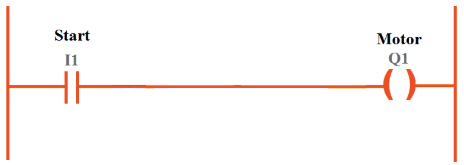
A Ladder Logic program is structured like a ladder. On the left and right sides are two vertical rails, just like in an electrical diagram. Horizontal rungs connect these rails, and each rung represents one piece of logic.

Every rung is a logical statement. It contains contacts and coils. Contacts represent conditions or inputs (such as a button being pressed). Coils represent actions or outputs (such as a motor starting).

The PLC scans these rungs continuously in a loop. It reads the state of the inputs, evaluates the logic, and updates the outputs in a fraction of a second.

Simple LD rung: Contact energizes coil

Advantages of Ladder Logic

Intuitive for electricians

The graphical format is extremely familiar to anyone with an electrical background. Electricians and technicians can quickly see the logic flow without needing long explanations.

Easy troubleshooting

One of the biggest strengths is real-time monitoring. When a program runs, you can see which contacts are “on” and which are “off.” This helps technicians diagnose faults quickly and safely.

High reliability and stability

PLCs running Ladder Logic are robust. They are designed to survive harsh industrial environments like heat, dust, vibration, and electrical noise.

They are also deterministic, meaning they execute tasks on a strict schedule — vital for safety-critical systems.

Wide industry acceptance

Ladder Logic is an industry standard. It is widely taught in schools, and almost all industrial hardware supports it.

This ensures broad compatibility and makes it easier to hire skilled workers.

Suitable for discrete logic

Ladder Logic shines in applications with many on/off decisions, such as conveyor belts, packaging machines, or motor control circuits.

Disadvantages of Ladder Logic

Poor for complex tasks

Handling advanced math, data manipulation, or algorithms is cumbersome. Loops are difficult to implement, leading to long, bloated code.

In such cases, Structured Text or Function Block Diagram might be better choices.

Limited functionality

Ladder Logic was never intended as a general-purpose language. It struggles with advanced networking, string handling, or data analysis.

Can be vendor-specific

While Ladder Logic is standardized under IEC 61131-3, many vendors add their own features. This can lead to vendor lock-in, making it hard to switch platforms.

Less intuitive for software developers

People trained in computer science often find Ladder Logic inefficient. They are more comfortable with text-based coding.

Large programs become complex

As systems grow, so does the ladder diagram size. Large projects can span hundreds of rungs, which makes the program harder to read and maintain.

Python: The Flexible Disruptor

Python is a general-purpose programming language. It was not built for industrial automation, yet its simplicity and versatility have made it extremely attractive in the field.

Today, Python is commonly used on industrial PCs, Raspberry Pi boards, or servers that work alongside PLCs. It is not meant to replace PLCs in safety-critical tasks, but it offers incredible value in handling complex or higher-level processes.

How Python is Used in Automation

Python does not completely replace the PLC. Instead, it often works side by side with it.

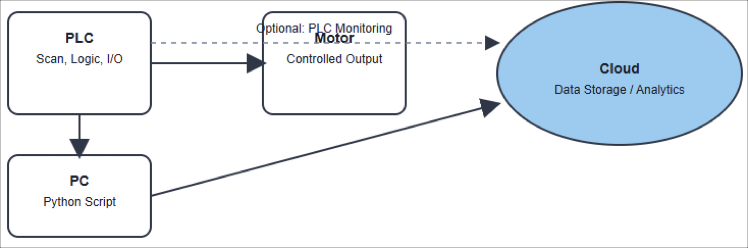
The PLC takes care of real-time control, such as turning motors on and off. Python handles higher-level tasks, such as data logging, analysis, and communication.

This creates what is called a hybrid automation system, where each technology does what it does best.

Advantages of Python

Extensive libraries and capabilities

Python has thousands of ready-made libraries for almost any task. From machine learning to web servers, it has tools that Ladder Logic lacks.

Excellent for complex logic and data

Python handles math, algorithms, and data structures easily. It can process huge datasets, which is difficult in Ladder Logic.

Rapid development and prototyping

Python’s simple syntax makes it quick to learn and fast to write. Prototypes can be built in hours instead of weeks.

Better for connectivity

Python integrates seamlessly with databases, APIs, and cloud services. This is essential for IIoT and Industry 4.0 projects.

Object-oriented capabilities

Python allows code to be modular and reusable. This modern approach makes maintaining large projects easier.

Open-source and cross-platform

Python is free, open-source, and runs on many platforms. This avoids vendor lock-in.

Disadvantages of Python

Not real-time by default

Python is an interpreted language. It is slower and not deterministic, making it unsuitable for safety-critical timing tasks.

Troubleshooting can be harder

Unlike Ladder Logic, Python does not show live “contact status.” Maintenance personnel may struggle with text-based debugging.

Requires programming expertise

Traditional electricians may need extra training to use Python effectively.

Potential for dependency issues

Python projects often rely on third-party libraries, which can create maintenance problems if those libraries stop being supported.

Memory usage

Python consumes more memory compared to PLC code. This is a limitation for embedded devices.

Hybrid Approaches and the Future

The discussion is not about choosing only one. In reality, most modern factories use a hybrid approach.

The PLC remains responsible for mission-critical, real-time control, ensuring machine safety and reliability. Python is used in parallel to manage complex, high-level tasks.

How a Hybrid System Works

In such systems, Python usually runs on a PC or industrial server. It communicates with the PLC through standard industrial protocols such as Modbus TCP or OPC UA.

For example, Python scripts can:

  • Collect and analyze data from the PLC.
  • Push this data to a central database or the cloud.
  • Apply machine learning to predict failures before they happen.
  • Generate custom reports and dashboards.
  • Connect the automation layer with enterprise systems like ERP or MES.

Evolution and Training

The industrial world is evolving quickly. New software practices like version control, DevOps, and continuous integration are entering automation.

This shift means that companies must train their staff. Maintenance teams who are used to Ladder Logic need exposure to programming concepts.

At the same time, programmers skilled in Python must learn the basics of PLC operation and industrial safety. 

This combination of skills is becoming more valuable than ever.

Key Takeaways: Ladder logic vs Python for Automation

Ladder Logic continues to be a dominant force in industrial automation. It is reliable, robust, and easy to troubleshoot for everyday tasks.

Its graphical nature is a huge advantage for technicians working on the factory floor.

However, modern automation now requires much more. Tasks such as data analytics, IIoT integration, and AI-driven insights are common.

These are areas where Ladder Logic struggles. Python, with its flexibility and libraries, provides the necessary power.

The future lies in combining these tools. A hybrid approach provides the reliability of Ladder Logic for machine-level control and the intelligence of Python for higher-level connectivity and analysis. Together, they enable more powerful, smarter, and future-ready automation systems.

FAQ: Ladder logic vs Python for Automation

Can Python replace Ladder Logic completely?

No. Python is not designed for hard real-time control. PLCs with Ladder Logic remain the safest and most reliable option for machine-level operations.

Why do companies still prefer Ladder Logic?

Because it is intuitive, proven, and supported by nearly all industrial hardware. It also matches the skillset of electricians.

Where does Python shine the most?

Python is excellent in data analysis, cloud connectivity, reporting, and advanced features like predictive maintenance or AI.

Do technicians need to learn Python now?

Yes, at least at a basic level. Industry is moving toward digitalization, and Python is a key tool in that journey.

Will hybrid systems become the standard?

Yes. Most factories are already moving in that direction. Hybrid setups give the best balance of safety, reliability, and flexibility.

PLC in Conveyor Systems

Programmable Logic Controllers (PLCs) are the brains of modern conveyor systems, replacing older, bulky relay logic that once dominated industrial automation.

Unlike simple relay panels, a PLC is a robust industrial computer that uses a customizable program to monitor inputs and control outputs, enabling precise, repeatable, and efficient automation.

From simple start-and-stop operations to complex sorting, counting, and product tracking, PLCs offer a reliable, flexible, and scalable solution for material handling across different industries.

Conveyor systems powered by PLCs are now found in manufacturing, warehousing, mining, logistics, food processing, and packaging plants. 

Their adaptability ensures they can handle everything from light consumer goods to heavy industrial components.

This article explains the role of PLCs in conveyor, the core components for PLC to drive conveyors and PLC operation cycle.

It further details how to program a conveyor, the benefits of PLC controlled conveyors and the future of PLC in conveyors.

The Evolution of Conveyor Control

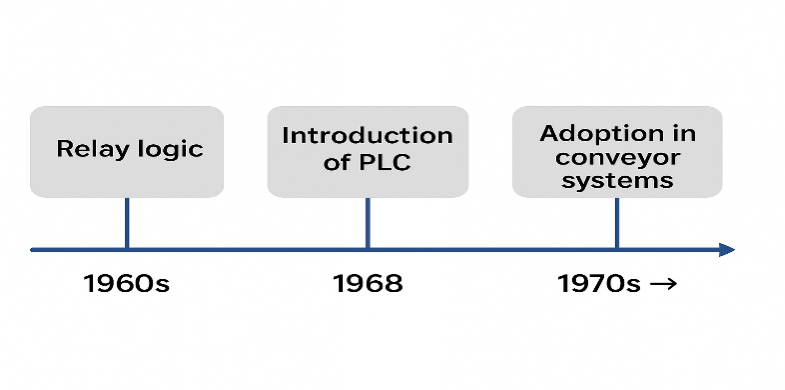
Before PLCs, conveyor systems were controlled by complex arrangements of relays, contactors, and timers.

This hardwired relay logic was not only bulky but also prone to frequent failure due to worn contacts, dust accumulation, or overheating. 

It was incredibly difficult to modify or troubleshoot, especially when hundreds of relays were wired together in large panels.

Changing an operation or adding a new feature required extensive rewiring, which often led to long and costly periods of downtime.

The invention of the PLC in the late 1960s revolutionized industrial control. By using a software-based program, manufacturers could change or replicate operations simply by reprogramming the PLC, drastically reducing time and engineering costs. 

PLCs brought unprecedented flexibility, faster troubleshooting, and greater reliability to conveyor control.

What once took days of rewiring could now be accomplished in minutes with a simple logic change.

The Core Components of a PLC-Driven Conveyor System

A PLC-controlled conveyor system relies on a seamless interaction between several components that work together as a closed-loop control system.

PLC Unit

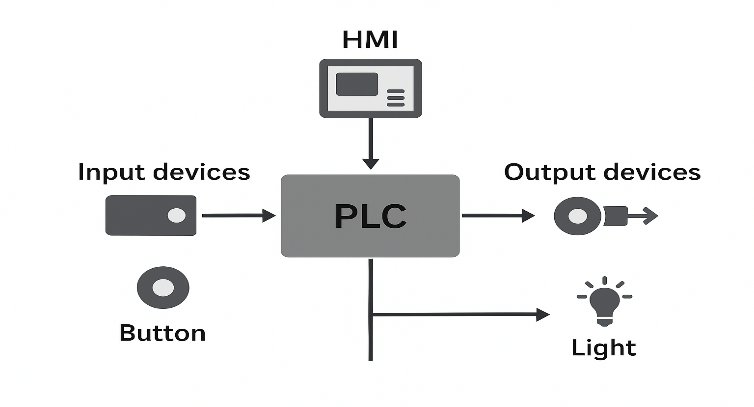
The central processor runs the control program. It executes logic instructions, makes decisions based on input data, and sends commands to output devices.

Modern PLCs also support communication protocols like Ethernet/IP or Modbus for integration with higher-level systems.

Sensors

These devices provide real-time information to the PLC. Common types used in conveyors include:

Photoelectric sensors

Use a beam of light to detect the presence or absence of a product on the belt, widely used in packaging lines.

Proximity sensors

Detect objects without physical contact. Inductive models sense metals, while capacitive models can detect both metallic and non-metallic items like plastic or glass.

Limit switches

Triggered by physical contact with a product or diverter arm, often used in positioning.

Encoders

Measure the rotational speed and angular position of conveyor rollers, enabling precise control of product movement.

Load cells

Weigh items on the conveyor belt, ensuring quality control or accurate batching.

Motors and Variable Frequency Drives (VFDs)

An electric motor powers the conveyor belt. VFDs are often used to control the motor’s speed, allowing for smooth acceleration, controlled deceleration, energy savings, and precise speed adjustments during different stages of production.

Actuators

Devices that perform physical actions, controlled by the PLC. Examples include pneumatic cylinders for pushing or sorting products, solenoid valves for directing compressed air, or stepper motors for precision positioning in automated assembly lines.

Human-Machine Interface (HMI)

A touchscreen or display panel that allows operators to monitor the system’s status.

Operators can adjust conveyor speed, acknowledge alarms, view production statistics, and switch between manual or automatic modes.

Safety Devices

Components like emergency stop buttons, safety pull cords along conveyor lines, and safety gates are wired to the PLC to ensure safe operation.

Modern systems may use a dedicated Safety PLC or safety relays for critical functions, meeting international safety standards such as ISO 13849 or IEC 61508.

The PLC Operational Cycle

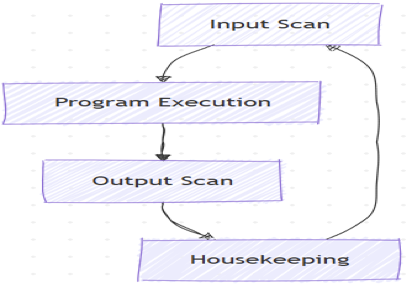
The PLC operates in a continuous loop called a scan cycle, which ensures fast and consistent responses to changing system conditions.

Input Scan

The PLC checks the status of all input devices, such as sensors, push buttons, and switches. This data is stored in memory for processing.

Program Execution

The PLC runs its stored program logic line by line. It processes the input data and makes logical decisions based on the defined instructions.

Output Scan

The PLC updates the status of all output devices, such as motors, actuators, and indicator lights, according to the program’s decisions.

Housekeeping

The PLC performs internal tasks such as communication with other PLCs, diagnostic checks, and self-monitoring.

This rapid, repetitive process enables real-time control of the conveyor system, with scan times often measured in milliseconds.

Programming a Basic Conveyor System

PLC programming languages have evolved over time to make system development easier and more powerful.

The most common is Ladder Logic, a graphical language that mimics the appearance of a relay logic diagram, making it easy for electricians and engineers to understand. 

Other languages include Function Block Diagram (FBD) for modular design, Structured Text (ST) for advanced algorithms, and Sequential Function Chart (SFC) for step-by-step processes.

A simple “start-stop” conveyor system illustrates basic PLC programming principles:

  • A normally open (NO) start button is wired to a digital input on the PLC.
  • A normally closed (NC) stop button is wired to another digital input.
  • The conveyor motor starter is wired to a digital output.
  • The Ladder Logic program has a “rung” that latches the motor starter on when the start button is pressed. The motor is de-energized if the stop button is pressed or if a safety interlock is activated.

This simple design ensures reliable operation while protecting the conveyor from accidental restarts.

Advanced PLC Control Applications

Modern conveyor systems go far beyond simple start-stop functions, thanks to the flexibility and power of PLCs.

Automated Sorting

The PLC can use input from sensors, barcode scanners, or vision systems to direct products to different lanes.

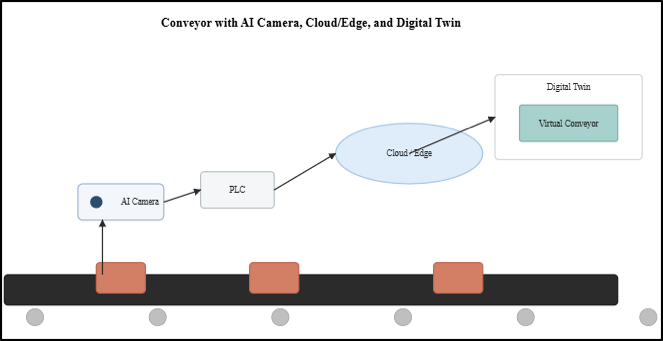
In a waste sorting system, an AI-driven camera can identify recyclable materials, and the PLC can activate a diverter arm or air jet to push the product into the correct bin.

Variable Speed Control

By controlling a VFD, the PLC can adjust conveyor speed in real time. This is crucial for synchronizing multiple conveyor sections or for precise positioning of products before packaging or labeling.

Robotic Integration

In automated assembly lines, the PLC coordinates conveyor movement with robotic arms.

It ensures products arrive at the correct pick-up points exactly when the robot is ready.

Tracking and Monitoring

Using encoders, load cells, and RFID tags, the PLC can track products along the conveyor.

This enables functions such as product counting, batch control, weight verification, or rejection of defective items.

Predictive Maintenance

PLCs can collect vibration, temperature, and current data from motors and sensors to monitor equipment health.

This allows maintenance teams to anticipate failures before they occur, significantly reducing unexpected downtime.

Networking and SCADA Integration

Multiple PLCs can communicate with each other over industrial networks. They can also send data to a higher-level SCADA (Supervisory Control and Data Acquisition) system for plant-wide monitoring and decision-making.

The Benefits of PLC-Controlled Conveyors

The adoption of PLC technology offers a wide range of advantages over older relay-based methods.

Increased Efficiency and Throughput

PLCs operate with high speed and precision, minimizing errors, reducing downtime, and maximizing the number of products moved per hour.

Enhanced Flexibility and Scalability

PLCs can be reprogrammed quickly to accommodate new product lines or processes. Modular PLCs allow for easy expansion by adding additional I/O modules.

Improved Safety

PLCs can be integrated with safety interlocks, light curtains, emergency stops, and safety relays to ensure worker protection and prevent equipment damage.

Reduced Operational Costs

Automation reduces the need for manual labor, while simplified troubleshooting, remote monitoring, and predictive maintenance cut maintenance costs.

Better Data Collection and Analysis

PLCs provide valuable production and diagnostic data that can be used for process optimization, quality assurance, and continuous improvement.

Future Trends

The role of PLCs in conveyor systems continues to evolve with modern digital technologies.

Integration with AI

As seen in waste sorting and logistics, AI-driven vision systems are being integrated with PLCs to enhance accuracy and efficiency.

Edge Computing

PLCs with built-in edge computing capabilities can process large amounts of data locally, reducing latency and enabling smarter decision-making on the factory floor.

Enhanced Cybersecurity

As PLCs become more connected to networks and cloud platforms, cybersecurity is a growing priority.

Future systems will feature secure communication protocols, firewalls, and multi-level authentication.

Digital Twins

The PLC can be linked to a digital twin—a virtual model of the conveyor system. This allows engineers to test, simulate, and optimize control strategies before deploying them in the real world.

Conclusion

The present article detailed the role of PLCs in conveyor, the core components for PLC to drive conveyors and PLC operation cycle.

It also explained how to program a conveyor, the benefits of PLC controlled conveyors and the future of PLC in conveyors.

So, from the discussion we can add that, PLs have fundamentally transformed how conveyor systems operate.

They have replaced outdated relay logic with flexible, reliable, and powerful software-based control. 

From managing simple belt movement to orchestrating complex sorting, tracking, and predictive maintenance, PLCs are at the heart of modern material handling.

Their ability to increase efficiency, enhance safety, and adapt to changing production requirements makes them an indispensable part of industrial automation. 

As technology continues to advance, the integration of PLCs with AI, edge computing, and digital twins will drive even greater innovation in conveyor systems, ensuring smarter, faster, and safer factories for the future.

FAQ: PLC in Conveyor Systems

What are the advantages of using a PLC instead of traditional relay‐logic for conveyor control?

PLCs offer much more flexibility: logic can be changed, expanded or replicated via software rather than rewiring; They provide real‐time monitoring, diagnostics, and improved safety (interlocks, emergency stops) that relay systems typically lack or have in more complex/harder to maintain arrangements; PLCs can integrate better with modern systems (HMI, SCADA, cloud/edge computing) to enable remote monitoring and predictive maintenance. 

What PLC programming languages are common, and which are best for conveyors?

The IEC 61131-3 standard defines several languages: Ladder Diagram (LD), Function Block Diagram (FBD), Structured Text (ST), Sequential Function Chart (SFC), and Instruction List (IL); For many conveyor systems, Ladder Logic (LD) is often preferred since it’s intuitive for relay logic designers and maintenance staff; For more complex sequencing, tracking, or mathematical/logical processing, Structured Text (ST) or Function Block Diagram might be used. 

How is PLC integrated with sensors, actuators, and other devices in a conveyor system?

Sensors (photoelectric, proximity, load cells, encoders, etc.) feed inputs to the PLC.

The PLC reads these sensors during its input scan to decide when to activate outputs; Outputs from the PLC can command motors (via starters or VFDs), actuators, indicator lights, diverters, gates, etc; Safety devices (emergency stops, safety gates) are usually wired in, sometimes via a safety PLC or safety-rated modules. 

What kind of PLC scan cycle or timing issues affect conveyor systems?

The scan cycle is the core loop in which the PLC reads inputs, executes the user program logic, updates outputs, and performs internal housekeeping.

If the cycle time is too long, fast events (e.g. high‐speed sensors detecting an object) may be missed or delayed; Conveyor systems with high speed, lots of sensors and tight timing (for accurate stopping, diverter activation, etc.), require careful tuning of scan time and priority of tasks.

Can I use a single PLC for large conveyor systems, or do I need multiple PLCs?

In many systems, a single PLC is sufficient to manage a conveyor system, especially if the system is not extremely large or complex; Multiple PLCs are used when there are modular sections that are physically distant, for redundancy, easier maintenance, or when different subsystems need different performance or I/O counts.

What safety features are necessary when using PLCs in conveyor systems?

Emergency‐stop buttons, safety pull cords, safety gates, and interlock switches must be integrated.

These should be wired such that they override other logic; Safety PLCs or safety modules are used for functions where failure could seriously risk personnel or equipment. These are designed to standard safety categories/PL/SL levels.

How do PLCs handle varying conveyor speeds or synchronization between conveyor sections?

Variable Frequency Drives (VFDs) are often controlled by the PLC, allowing precise acceleration, deceleration, and speed synchronization; PLC logic may coordinate multiple sections so products transfer smoothly from one section to another without collisions or excessive gaps.

What is predictive maintenance in the context of PLC‐controlled conveyors, and how is it done?

PLCs can collect data: motor currents, vibration (if sensors added), runtime, number of starts/stops, errors; This data can be analyzed (locally or via cloud/edge) to predict component wear, detect abnormal behavior, and schedule maintenance before failures.

What are common problems people face when implementing PLCs on conveyors?

Underspecified sensors or choosing sensors that don’t suit the environment (e.g. dust, moisture, high vibration); Delays or errors due to poor logic timing or scan cycle too slow; Synchronization problems between conveyor sections, especially during changes in direction or speed; Safety interlocks not properly designed or tested, leading to false trips or unsafe behavior; Insufficient diagnostics or logging, making troubleshooting difficult.

How do costs compare (initial, maintenance, operational) when using PLCs vs older relay logic?

Upfront cost of PLC hardware (CPU, I/O modules, power supply), plus programming, integration, sometimes network/HMI/SCADA setup is higher than simple relay panels; But lifecycle cost savings tend to be significant: lower maintenance, easier upgrades, less downtime, more efficient operation.

How do I choose the right PLC size or model for my conveyor system?

Consider number of inputs/outputs needed (digital, analog), size/complexity of logic, speed requirements; Environmental factors: temperature, dust, moisture, electrical noise; Require capacity for expansion or extra features (networking, safety I/O, vision/camera input) if future growth is expected.

How is PLC connected/interfaced with modern technologies (vision systems, cloud, digital twins)?

PLCs can receive input from vision systems / barcode scanners / AI systems; process or forward that data to make decisions (e.g., diverters, reject stations);

Connectivity to edge/cloud allows remote monitoring, analytics, and model‐based control; Digital Twins (virtual models) can mirror the physical conveyor system; PLC data (status, sensor readings) feed the twin to simulate, troubleshoot, predict behavior under different conditions.