A circuit breaker is a small device with a very crucial functionality. It keeps electrical systems safe.
It stops electricity when something dangerous happens. It protects people, buildings, and equipment. It reacts when the current becomes too high.
It also responds when a short circuit occurs. Unlike a fuse, it can be reset. You simply switch it back on.
This function makes it practical and convenient. Without circuit breakers, electrical systems would be unsafe. Fires would be common.
Damage would be serious. So, it is vital to have knowledge of how a circuit breaker works.
This helps understand electrical safety better. This article studies how circuit breakers work, their importance, and where they are used.
Importance of Breakers
Essentially, it acts as an automatic safety switch that trips (cuts power) when the current exceeds safe limits and can be reset after the problem is resolved (unlike a fuse, which must be replaced).
Circuit breakers exist for one main purpose. Protection. To control electricity is essential because it is powerful and dangerous.
Every circuit can handle only a specific amount of current. When that limit is exceeded, problems occur.
This situation is called an overload. Overloads create heat that damages insulation. Damaged insulation can start a fire.
A circuit breaker senses this condition and then quickly cuts the power. Quick action prevents accidents, preserves equipment, and ensures people’s safety.
Causes of Overloads
Overloads happen for many reasons.
- Too many appliances can be plugged in.
- A motor may draw more current than expected.
- A loose wire may increase resistance.
- These problems cause heat.
The breaker feels this heat and responds using a thermal mechanism. This process takes seconds, but that is enough time to detect danger. The breaker then opens the circuit; as a result, the power stops flowing.
Short Circuits
Short circuits are different. They happen very fast and occur when two conductors touch each other.
A hot wire may touch a neutral wire. A tool may hit a conductor accidentally, or a damaged cable may expose copper.
This creates a direct, low-resistance path caused current to spike instantly. The breaker senses this huge surge. It reacts in milliseconds and opens the circuit immediately. The action prevents explosions, fire, and severe damage.
Component of Circuit Breaker
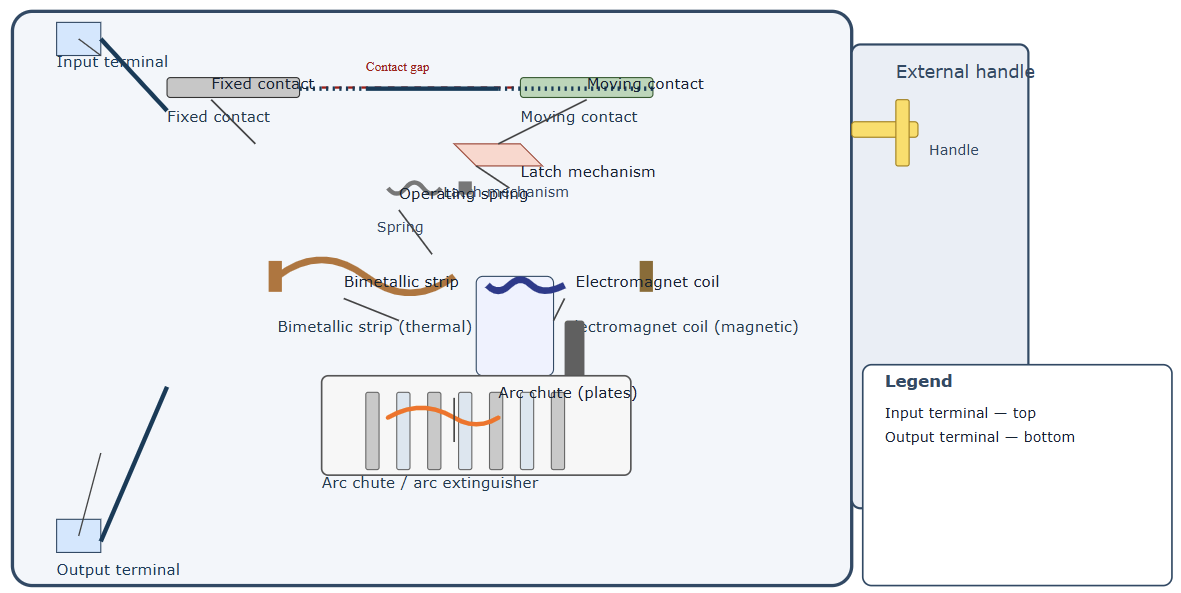
A circuit breaker has several internal parts. Each one has a role, and these parts work together. The main components are simple.
They include fixed contacts and moving contacts. They include a latch, a spring, and a handle.
They include a thermal element. They include a magnetic coil. The parts are small, but they act with precision.
When everything works together, they protect the system. The next figure shows a cutaway diagram of a circuit breaker’s internal components.

The Operating Mechanism
The operating mechanism keeps the contacts closed. It uses a latch and also employs a spring.
When the breaker is ON, the contacts touch. Electricity flows freely. The latch holds everything in place, but it is fragile by design.
It releases instantly when triggered. As soon as the latch is pushed, the spring snaps open. The contacts separate, and the power stops.
Thermal Trip Mechanism
The thermal trip uses a bimetallic strip. It is made of two metals. They expand differently with heat. Under normal current, the strip is straight. When the current increases, it warms. The metals expand unevenly.
The strip bends, and this bending pushes on the latch. The latch releases, and the breaker trips. This method detects slow overloads; it is reliable. It reacts to real heat, not just current flow.
Magnetic Trip Mechanism
The magnetic trip reacts to short circuits. It uses a coil. The coil becomes a magnet when a huge current flows. This magnetic force pulls a metal plunger. The plunger hits the latch, and the latch releases.
The contacts snap open. This action is very fast, and it happens in milliseconds. It saves the system from extreme damage. No heat buildup is needed; just high current triggers it.
Formation of Electric Arc
When contacts open, electricity does not stop instantly. An arc forms. This arc is bright, and it is hot and dangerous.
The arc can melt metals, so it must be controlled immediately. Circuit breakers are designed for this because they use an arc chute.
The arc chute divides the arc and breaks it into small parts. These parts cool down fast, so the arc disappears. After this process, everything becomes safe again.
Arc Quenching
Arcs occur at every interruption and even in small circuits arc. If the arc is not extinguished, the breaker will burn, and the contacts will wear out.
Furthermore, fires may start. The arc chute prevents this by managing the heat and light, and keeps the breaker healthy. This procedure makes breakers last longer and ensures safe disconnection.
Miniature Circuit Breakers
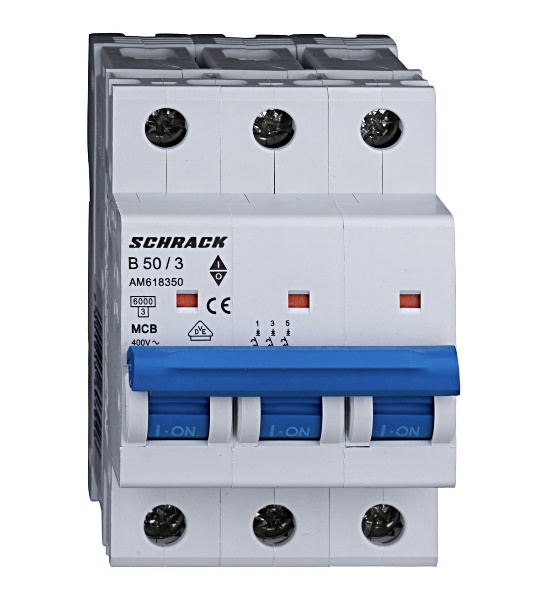
Miniature circuit breakers (MCBs) are common (figure below). They are found in homes, protecting small circuits.
They are compact and easy to use. They also protect against overloads and short circuits.
They can use both thermal and magnetic trip systems. They are installed in distribution boards.

Ground Fault Breakers
Ground Fault Circuit Breakers (GFCI/RCCB). These breakers protect people by detecting imbalances in electrical current.
This imbalance means current is leaking. The leak may be going through a person. It may be going into the ground.
The breaker senses the difference and trips instantly, so this prevents electrocution. These breakers are important in bathrooms. They are also required outdoors since they save lives.
Arc Fault Breakers
Arc Fault Breakers (AFCI/AFDD). These breakers are designed to detect arcs. Arcs are dangerous, and they occur in damaged wires.
They can also appear in loose connections. They can start fires inside walls. Unfortunately, a regular breaker cannot detect them, but AFCIs can.
They analyze waveforms to sense arc patterns, and they trip before a fire starts. So, they add important protection.
Molded Case Circuit Breakers
Without a doubt, Molded Case Circuit Breakers (MCCBs) are larger in size. They are used in commercial buildings since they can handle higher currents.
They allow adjustable trip settings, which makes protection more precise. They serve machinery and large distribution panels. They have strong housing because they are built for tough conditions.
Air Circuit Breakers
Air Circuit Breakers (ACBs) are used in heavy systems. They control the main feeders and handle very high currents.
They use air to extinguish arcs. They are common in switchgear and are used in large industrial facilities. They offer reliable protection for big loads.
Vacuum Circuit Breakers
For medium-voltage systems, Vacuum Circuit Breakers (VCBs) VCBs are the best choices. They extinguish arcs in a vacuum. A vacuum has no air, so it stops arcs instantly.
VCBs last a long time because their contacts experience very little wear. They are popular in utility networks.
Oil Circuit Breakers
Oil Circuit Breakers (OCBs) use oil to cool the arc. It also insulates the contacts. High-voltage systems always prefer this kind of breaker.
They handle very strong arcs. They are older technology, but many are still in service.
Resetting a Circuit Breaker
A breaker must be reset after a trip. It cannot simply be pushed ON. First, it must be fully turned off to reset the latch.
It can then be turned back on. If it trips again, something is wrong. If the overload remains, the short circuit is still present. The breaker is giving a warning, and this means it works perfectly.
Signs of Breaker Problems
Like any other electrical device, breakers can fail. They may feel hot and may trip often. They may not stay ON and may sometimes buzz.
They may also smell burnt from time to time. These signs mean trouble. If the breaker appears worn and faulty, it requires immediate attention. A qualified person should inspect the system.
Why Maintenance Matters
Breakers need care because dust can build up, contacts can age, and screws can loosen. In addition, heat can damage insulation.
So, regular maintenance prevents failures. It ensures breakers work when needed, keeps systems safe, and reduces risk.
Breaker Ratings
Breakers have ratings. These include current ratings such as the maximum normal current. They have an interrupting rating.
This is the highest fault current they can stop. They have voltage ratings, and they have trip curves. All of these factors are important, so choosing the wrong breaker can be dangerous.
Choosing the Right Breaker
Each application needs a specific breaker. Homes use MCBs; workshops use MCCBs; and high-voltage systems use VCBs, or OCBs.
Wet areas need GFCIs, while bedrooms may need AFCIs. Engineers or technicians choose based on load classification and environmental conditions. They consider fault level and safety codes, so proper selection prevents accidents.
Conclusion
This article reviewed the role, operation, and importance of circuit breakers in modern electrical systems.
Circuit breakers protect everything around us. They react to overloads and short circuits as well.
They can stop arcs and keep wires safe. More importantly, they keep people safe. They use thermal and magnetic technology.
They function quickly and also work reliably. From small MCBs to large ACBs and VCBs, they protect every type of electrical system.
Electricity would be hazardous without them. Breakers make our modern world safe, stable, and efficient.
FAQ: What Is a Circuit Breaker?
What is a circuit breaker?
A circuit breaker is a device designed to automatically stop electricity when a fault or overload occurs.
Why is it important?
It prevents fires, equipment damage, and electrical hazards.
How does it work?
It opens its internal contacts when it detects too much current.
What faults does it protect against?
Overloads and short circuits.
How does it sense overloads?
A bimetallic strip bends when heated and triggers the trip.
How does it sense short circuits?
An electromagnet activates instantly when current spikes.
What happens when it trips?
The contacts open and stop the flow of electricity.
Can you reset a circuit breaker?
Yes. You simply switch it back on after fixing the problem.
Where are circuit breakers used?
Circuit breakers find their application in homes, offices, factories, and power distribution systems.
How is a breaker different from a fuse?
A fuse must be replaced; a breaker can be reused.
Are all breakers the same?
No. They come in many ratings and types for different applications.
Do breakers stop every type of fault?
No. Some faults require GFCIs or AFCIs for extra protection.
