Industrial, business, and residential systems often employ pressure switches as their primary control elements.
Their primary purpose is to monitor pressure. They cause an electric response once a preset value is reached.
Pressure switches operate discretely, unlike pressure sensors or transmitters, which provide continuous measurement.
They only switch a circuit ON or OFF. This basic habit makes them both extremely dependable and cheap.
Pressure switches are regularly employed in pumps as well as in compressors. In addition, they are certainly useful in boilers, hydraulic systems, and safety interlocks.
Knowledge of the many kinds of pressure switches and how they operate assists engineers and technicians.
Especially in choosing the appropriate equipment for performance, safety, and longevity in demanding situations.
This paper discusses the primary kinds of pressure switches. It also explains their operational mechanisms and typical uses.
What is a pressure switch?
An electromechanical or electronic device called a pressure switch answers fluid pressure variations. The switch activates internal contacts once the pressure hits a specific threshold.
These connections may either open or close an electrical circuit. The regulated circuit can begin or halt equipment.
It can activate alarms. It can also guard systems from excessive or under-pressure conditions.


Basic block diagram of a pressure switch indicating pressure inlet, sensor element, mechanical linkage, and electrical contacts
Fundamental Working Mechanism of Pressure Switches
Force balance underlies all pressure switch systems. Mechanical force results from pressure exerted on a sensor element. This power is contrasted with a reference or preloaded spring.
The switch switches state when the pressure force surpasses or falls below the established threshold.
Mechanical pressure switches directly use this action to engage electrical contacts. The pressure in electronic pressure switches is first transformed into an electrical signal. It is subsequently processed by circuits to power a solid-state or relay output.
Mechanical Pressure Switches
The most conventional and often used type of mechanical pressure switch is one. Mechanical movement and electrical contacts are all they depend on.
Diaphragm
The diaphragm is the core mechanical element. It is part of a pressure transmitter. It is designed to flex under pressure. This diversion activates a linkage attached to a snap-action contact or microswitch.
Typically constructed of metal or elastomer, the diaphragm varies depending on the fluid and pressure range.
Commonly used in air, gas, and water systems, low to medium pressures make these switches fit.

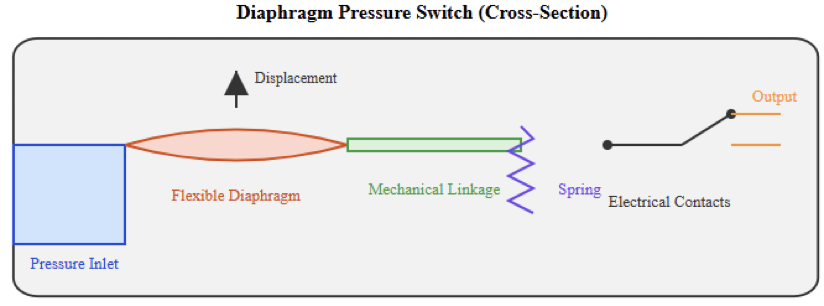
Cross-sectional diaphragm pressure switch diagram with diaphragm displacement and contact actuation
Piston
Pressure in piston pressure switches presses a small piston rather than a diaphragm. The piston travels linearly against a spring. The pistons activate the electrical contacts when the force balance shifts.
High-pressure applications benefit from sturdy piston switches. Common applications for them are hydraulic systems. Pressures there are much greater than in pneumatic systems.

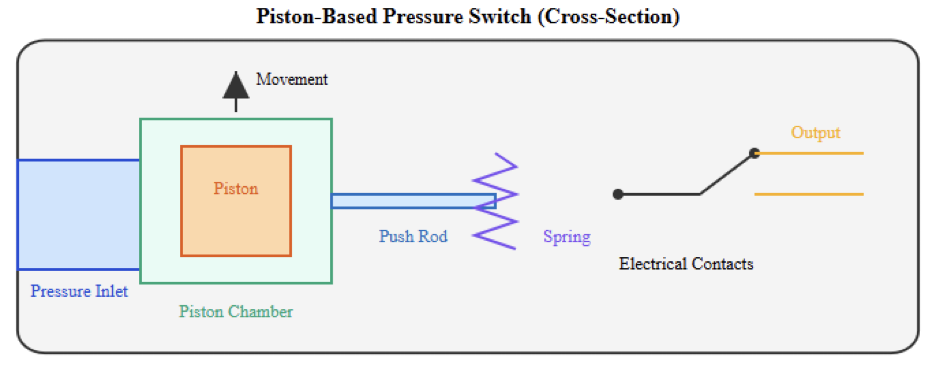
Piston-based pressure switch highlighting spring mechanism and piston movement
Bourdon Tube
Bourdon tubes are the pressure-sensing components in this design. Pressure straightens when it enters the curved tube. Links transfer the mechanical motion to trigger the contact switches.
Usually found in high-pressure steam or gas situations, Bourdon tube pressure switches are robust.
They can tolerate severe conditions. Their reaction time is usually slower than that of diaphragm-based designs.

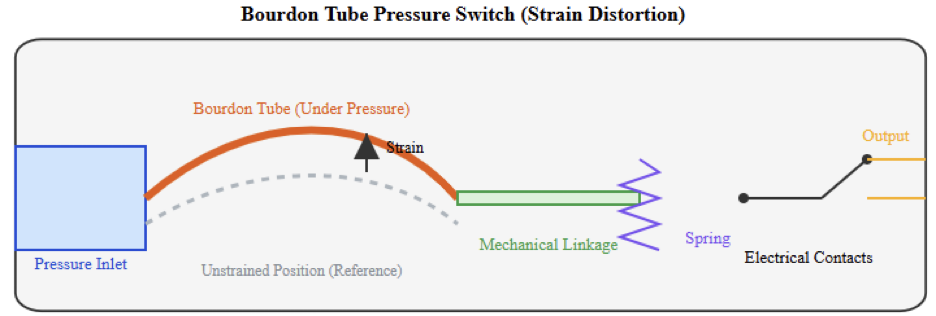
Bourdon tube pressure switch shows the tube under strain distortion
Switches with differential pressure
Differential pressure switches actually detect the difference. This difference is between two pressure points rather than absolute pressure. Two pressure ports joined to opposite sides of a piston or diaphragm are employed here.
The switch triggers when the pressure differential goes beyond the set point. Filter monitoring, flow verification, and ventilation systems usually make use of these switches.
A blocked filter, for instance, raises differential pressure across it. This state is discovered by the pressure switch. It then activates an alarm or maintenance indicator.
Vacuum Pressure Switches
At pressures less than those of the atmosphere, vacuum pressure switches work. Though their calibration range is calibrated for vacuum circumstances, their operating principle is comparable to that of standard pressure switches.
Packaging machines, medical devices, and vacuum pumps all include these switches extensively. Before a process starts, they help to guarantee enough suction.
Electronic Pressures Switches
Sensors and electronic circuits in electronic pressure switches take the place of mechanical links. Pressure is transformed into an electrical signal by a pressure sensor.
A piezoresistive or capacitive element is commonly used. A comparator or microcontroller handles this signal.
The output changes state when the measured pressure passes the configured threshold. The output could be a transistor signal, a solid-state relay, or an electromechanical relay.
Higher precision, better repeatability, and digital configurability are offered by electronic pressure switches.
Solid-State Pressure Switches
Without moving components, solid-state pressure switches are a sort of electronic switch. Semiconductor sensors and electronic outputs make up the whole.
These switches provide a long service life and a high switching frequency since there are no mechanical contacts.
They are perfect for applications requiring dependable, quick reactions. Although they typically need an external power supply. They could also be more prone to electrical noise.
Fixed vs Adjustable Pressure Switches
Pressure switches can be factory-set or configurable. Adjustable switches let the consumer use a screw or digital interface to alter the setpoint. During commissioning or system adjustment, this freedom comes in handy.
Fixed pressure switches have manufacturer-defined switching points. Usually employed in safety-critical situations. Tampering has to be avoided.
Normal Open and Normal Closed Contacts
Normal open (NO), normally closed (NC), or changeover (SPDT) contacts are possible on pressure switches. The decision is influenced by safety requirements and system logic.
Normally, closed contacts are frequently utilized in safety systems, for instance. A power failure or a damaged wire activates a fault state.
Applications for Pressure Switches
Widely used in systems requiring pressure monitoring to guarantee dependable and safe operation are pressure switches. Often used to provide safety interlocks under unusual pressure circumstances.
They automate machinery and guard equipment from damage. Because of their straightforward structure and reliable switching performance, pressure switches fit several sectors.
They serve both protection and control applications. They are found in many different industrial and commercial sectors.
- Manage water pumps’ automatic beginning and stopping depending on system pressure.
- Overpressure damage in air and gas compressors should be avoided.
- Serve as safety interlocks in steam systems and boilers.
- Check HVAC system airflow and filter integrity
- Because of their straightforward construction, they offer dependable operation for both control and protection systems.
Conclusion
This article examined the fundamental forms of pressure switches in contemporary systems. It also reviewed their functioning mechanisms.
Monitoring and regulation of pressure in many different uses depend critically on pressure switches.
Each kind works on the same basic principle of pressure-induced force, resulting in an electrical action.
This applies from basic diaphragm switches to complex electronic and solid-state designs.
Pressure range, fluid type, precision, response time, and ambient circumstances will all influence the choice of a pressure switch. Knowing how every kind of function helps engineers and technicians.
It enables them to create more dependable, more effective, and safer systems. Though digital sensing has improved, pressure switches are still vital elements in contemporary industrial control and automation.
FAQs: Types of Pressure Switches
A pressure switch is what?
Once the preset pressure level is met, the switch changes the circuit state.
Which pressure switch varieties predominate?
The common ones are mechanical pressure switches. Also, there is the existence of electronic (solid-state) pressure switches.
Mechanical pressure switches employ what kind of sensing elements?
Common sensing elements include diaphragms and pistons. Without forgetting the Bourdon tubes.
What is a diaphragm pressure switch?
It activates contacts using a flexible diaphragm acting under pressure.
What is the purpose of a piston pressure switch?
Piston pressure switches are generally used in high-pressure hydraulic situations.
Bourdon tube pressure switch definition?
It employs a bent tube that straightens under pressure to set off switching.
A differential pressure switch is which?
It runs on the pressure difference between two pressure locations.
