In internal combustion engine systems, the starter motor is a crucial device. It is responsible for initiating engine operation by cranking the crankshaft. The action persists until the engine can maintain combustion on its own.
Despite being frequently underestimated, the starter motor must generate high torque rapidly. It must also operate reliably under harsh electrical and thermal conditions.
Furthermore, under severe mechanical circumstances. Several starter motor designs have been developed.
These designs aim to improve efficiency and reduce size. Furthermore, dealing with enhancing durability. Knowledge of different starter motor types is critical.
This knowledge benefits engineers involved in automotive, industrial, or power systems. Furthermore, it is useful for technicians and students of the equivalent areas.
This article explains three common types of starter motors. It covers their construction and working principles.
Furthermore, it deals with advantages and limitations. Finally, it mentions the typical applications.
Before discussing specific types, it is useful to pause. Understanding the basic operation of a starter motor provides the necessary foundation.
To supply electrical energy, the ignition switch is initially turned to the START position. The latter comes from the battery and flows to the starter solenoid.
The solenoid performs two key functions. First, it is to ensure engagement of the starter pinion gear and engine flywheel.
It also closes a high-current circuit to power the motor. The motor then produces high torque at low speed.
The flywheel and crankshaft then start to rotate. Once the engine starts, the starter is disengaged to prevent damage caused by overspeed.
The following figure indicates a basic starter motor system showing the battery, ignition switch, and solenoid. Furthermore, it illustrates the pinion gear, flywheel, and engine crankshaft.


Direct Drive Starter Motor
Construction and Design
The direct drive starter motor is the oldest and simplest starter motor design.
The primary distinction lies in the direct engagement of the motor shaft with the pinion gear. There is no intermediate gear reduction.
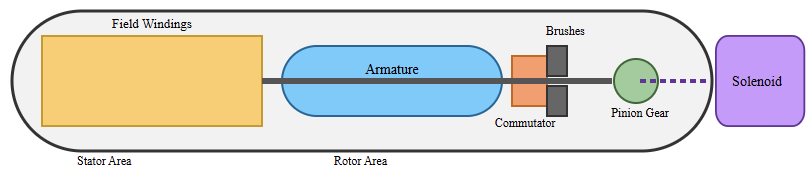
The armature, field windings (or permanent magnets), commutator, and brushes are housed together.
The robust cylindrical casing is used to enclose them. The pinion gear is mounted on the armature shaft.
It is engaged with the flywheel via a solenoid-operated mechanism. Because there is no gear reduction, the motor itself must be relatively large. It must also be powerful to produce the required high torque.
This torque is needed to crank the engine directly. The next figure depicts a cross-sectional diagram of a direct drive starter motor. It shows the armature, field windings, brushes, solenoid, and pinion gear.

Working Principle
The ignition key is turned to the START position to enable current to flow through the solenoid.
Then the solenoid pushes the pinion gear into mesh with the flywheel. High current flows through the motor windings simultaneously. This creates a strong magnetic field.
When the magnetic field interacts with armature conductors, torque is produced. The armature rotates at a relatively low speed. Nevertheless, high torque is produced, which turns the engine flywheel.
The ignition key is released as soon as the engine starts and the solenoid de-energizes. The pinion gear then disengages from the flywheel.
Advantages
Direct drive starter motors have a simple and rugged construction. Their mechanical simplicity makes them relatively straightforward to manufacture and repair. They are also highly durable.
They can tolerate harsh operating conditions. This may include high temperatures and vibration.
For many years, they were the standard choice. This was especially true in older vehicles and industrial engines.
Limitations
The main disadvantage of direct drive starter motors is their size and weight. Because torque is produced directly by the motor without gearing, the motor must be large. It must also draw a very high current from the battery.
This results in greater electrical stress. The stress affects both the battery and the cables. Additionally, direct drive starters are generally less efficient. They perform worse compared to modern designs.
Typical Applications
Direct drive starter motors are commonly found in older vehicles. They are also used in heavy-duty machinery. In addition, they are applied in tractors and stationary engines.
They are still used in applications where simplicity and robustness are priorities. In these cases, compactness or efficiency is less important.
Gear Reduction Starter Motor
Construction and Design
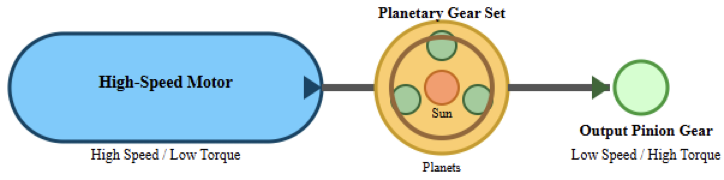
The starter motor with gear reduction is also known as a reduction gear starter. It incorporates a gear train between the motor shaft and the pinion gear. Typically, a small high-speed motor drives a set of reduction gears.
These gears may include planetary gears. The gears increase torque while reducing output speed.
The motor itself is often smaller and lighter. It is lighter than the motor used in direct drive designs. Permanent magnets are frequently used instead of field windings.
This further reduces size and improves efficiency. The upcoming figure indicates a diagram of a gear reduction starter motor showing a high-speed motor, a planetary gear set, and an output pinion gear.

Working Principle
When energized, the starter motor rotates at high speed. However, higher speed results in lower available torque.
The reduction gear train converts this high-speed, low-torque output. It becomes a low-speed, high-torque motion at the pinion gear.
This amplified torque is sufficient to crank the engine effectively. It works even under cold-start conditions.
The solenoid mechanism functions similarly to that of a direct drive starter. It engages the pinion gear with the flywheel. This step occurs before power is applied to the motor.
Advantages
Starter motors with gear reduction offer several significant advantages. They are lighter and more compact than direct drive starters.
This helps reduce overall vehicle weight. As mentioned above, these types of starter motors contain higher efficiency. They use less battery current as a result.
At the same time, they deliver equal or greater cranking torque. This improves battery life. It also enhances cold-start performance. Another benefit is improved reliability.
Because the motor operates at a higher speed with lower torque stress, mechanical wear is reduced. This applies to internal components.
Limitations
The primary drawback of gear reduction starters is increased mechanical complexity. The inclusion of a gear train introduces additional components. These components can wear over time.
Manufacturing costs are also slightly higher. They are higher compared to direct drive starters. However, modern materials and lubrication methods have minimized these concerns.
Typical Applications
Starter motors with gear reduction are widely used in modern passenger vehicles. They are also common in light trucks and motorcycles.
They are frequently used in hybrid vehicles. Small industrial engines also benefit from their efficiency and compactness.
Permanent Magnet Starter Motor
Construction and Design
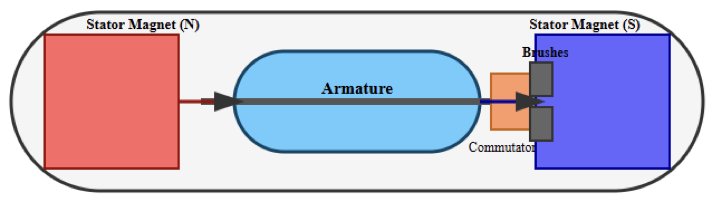
The permanent magnet starter motor uses permanent magnets mounted on the stator. These replace traditional field windings; hence, there is no need for field coils. This effect leads to a reduction in weight, size, and electrical losses.
Permanent magnet starter motors are often combined with gear reduction mechanisms. However, they can also exist in direct drive configurations. The armature, commutator, brushes, solenoid, and pinion gear are similar.
They resemble those found in other starter motor types. However, the magnetic field is provided entirely by permanent magnets.
The figure below shows the internal layout of a permanent magnet starter motor, highlighting stator magnets, armature, and brush assembly.

Working Principle
When current flows through the armature windings, interaction occurs. It happens between the armature magnetic field and the fixed magnetic field.
This interaction produces torque. The fixed field comes from the permanent magnets.
Since the magnetic field does not rely on current flowing through field windings, efficiency improves. Electrical efficiency is therefore higher.
In many designs, the permanent magnet motor drives the pinion through a gear reduction system. This further increases torque output. At the same time, the motor remains compact.
Advantages
Permanent magnet starter motors are highly efficient and lightweight. The elimination of field windings reduces copper losses.
It also reduces heat generation. This allows for faster cranking speeds. It also improves cold-start performance.
Their compact size makes them ideal for modern vehicles. This is especially true where engine bay space is limited.
Another advantage is reduced current consumption. For this reason, the battery and charging systems experience less stress.
Limitations
Environmental conditions, such as high temperatures, affect starter motors. In this case, a permanent magnet is not an exception.
Mechanical shock can also impact these magnets. Excessive heat can weaken the magnets over time. Such damage reduces motor performance.
Additionally, permanent magnet starter motors may be less suitable for huge engines. Huge engines require extremely high torque. Magnet size and strength impose practical limits.
Typical Applications
Permanent magnet starter motors are commonly used in modern passenger cars. They are also found in compact vehicles and motorcycles.
They are popular in small engines as well. Examples include generators, lawn equipment, and light industrial machinery.
Comparison of the Three Starter Motor Types
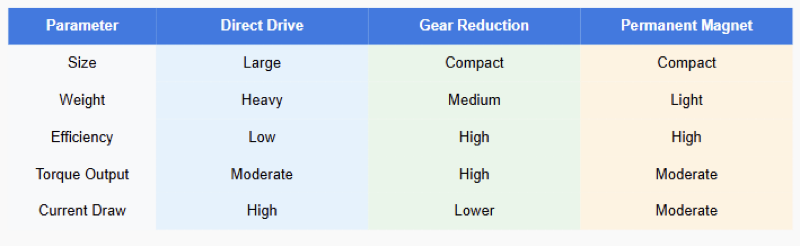
Each starter motor type offers a different balance of performance factors. These include torque, efficiency, size, and durability.
While direct drive starters offer a simple and robust design, they tend to be heavy and inefficient.
Gear reduction starters provide higher efficiency and torque density. As a result, modern vehicles make them the preferred choice.
Permanent magnet starters further improve efficiency and compactness. This is especially true when combined with reduction gears.
The following table shows a comparison between starter motors. It indicates size, weight, efficiency, torque output, and current draw for direct drive, gear reduction, and permanent magnet starter motors.

Conclusion: Types of Starter Motor
Reliable engine operation depends heavily on the starter motor. Their design has evolved significantly to meet modern demands. These demands include efficiency and performance.
The three main types include direct drive, gear reduction, and permanent magnet starter motors.
Each type has distinct construction features. Each also has unique operating principles and application areas.
Direct drive starters offer simplicity and durability. Gear reduction starters provide superior torque-to-size ratios. Permanent magnet starters deliver excellent efficiency and compactness.
By understanding these differences, engineers can make informed decisions. It is also applied to technicians as well as students.
These decisions apply to designing, selecting, or maintaining engine starting systems. This leads to an improvement in reliability, efficiency, and overall system performance.
FAQ: Types of Starter Motor
What are the main types of starter motors used in engines?
The main types include Direct Drive, Planetary/Gear Reduction, and Permanent Magnet starter motors.
Other variants, such as Permanent Magnet Direct Drive (PMDD) and Off-Set Gear Reduction (OSGR), also exist, but the three above are the most widely referenced.
What is a Direct Drive starter motor?
A Direct Drive starter motor is a traditional design in which the motor shaft is directly coupled to the pinion gear without reduction gearing.
When energized, the solenoid pushes the pinion to engage the flywheel, causing the engine to crank.
What is a gear-reduction starter motor?
A gear-reduction starter motor uses a high-speed, compact motor coupled to a set of reduction gears (often planetary gears). These gears increase torque while reducing current demand.
This results in a smaller, lighter starter with comparable or better cranking power than direct drive designs.
What is a Permanent Magnet starter motor?
A Permanent Magnet starter motor replaces traditional field windings with permanent magnets in the stator. This reduces size and weight and typically improves electrical efficiency.
These can exist with or without reduction gears, but are commonly considered gear-reduced designs.
What’s the difference between Direct Drive and Gear Reduction types?
Direct Drive
Motor output goes straight to the pinion gear; usually heavier and draws more current.
Gear Reduction
Uses gears (often planetary) to multiply torque while allowing a smaller, high-speed motor. Gear reduction starters are lighter, draw less current, and are more common in modern vehicles.
Why do modern vehicles prefer gear reduction starters?
Gear Reduction starters are more compact and efficient. They produce high torque with less current draw than direct drive starters.
This makes them suitable for vehicles with limited engine bay space and smaller batteries.
Are permanent magnet starter motors more efficient?
Yes. Because permanent magnet starters use magnets instead of field windings to produce the magnetic field, they reduce electrical losses and heat generation.
This makes them generally more efficient and lighter than similar wound-field designs.
