For decades, industrial automation has run on a patchwork of incompatible protocols. A plant floor might mix PROFINET on one line, EtherNet/IP on another, and Modbus TCP holding together a handful of legacy devices with a fieldbus of some kind still lurking in the mix for good measure.
Every protocol boundary means a gateway, a translation layer, and one more place where data quietly goes stale or gets lost.
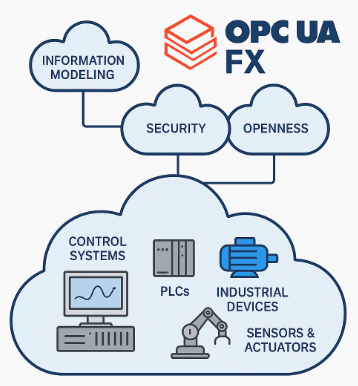
OPC UA FX (Field eXchange) is the OPC Foundation’s answer to that fragmentation. It extends OPC UA, already the dominant standard for vertical, machine-to-cloud data exchange, down to the field level, where controllers, drives, and I/O devices talk to each other in real time.
The goal is a single, vendor-neutral communication standard that runs from the sensor to the cloud, without a translation layer at every step.
This article breaks down what OPC UA FX actually is, how it differs from classic OPC UA, and what it means for the future of PLCs, safety systems, and industrial network design.
What Is OPC UA FX?
OPC UA FX is an extension of the OPC UA standard designed for controller-to-controller and controller-to-device communication, the deterministic, real-time layer that classic OPC UA was never built to handle.
Classic OPC UA excels at moving structured data up the stack (machine to SCADA, SCADA to MES, MES to the cloud), but it was never intended to replace real-time fieldbus or industrial Ethernet protocols for motion control or high-speed I/O.
OPC UA FX closes that gap by adding
Publish/Subscribe (PubSub) over TSN
Deterministic, low-latency messaging built on Time-Sensitive Networking, an IEEE 802.1 standard for prioritizing and time-synchronizing traffic on standard Ethernet.
Controller-to-controller communication
PLCs and controllers from different vendors can exchange data directly, without a proprietary bridge.
Safety over OPC UA FX
A path toward functional safety communication (comparable to PROFINET/PROFIsaFE or CIP Safety) riding on the same unified network.
Companion specifications and information models
Standardized “vocabularies” so a variable frequency drive from one vendor and a motion controller from another describe themselves the same way.
OPC UA FX aims to be the one network that does everything. Real-time control, safety, and enterprise data exchange, instead of three or four separate ones stitched together with gateways.
Why the Industry Needs This Now
The Multi-Protocol Problem Is Getting Worse, Not Better
Every additional protocol on a plant floor adds engineering hours, spare-parts complexity, and points of failure.
Gateways between PROFINET and EtherNet/IP, for example, work, but they add latency, require separate configuration tools, and are yet another device that can fail at 2 a.m.
As factories add more sensors, edge computing, and AI-driven analytics, the cost of protocol fragmentation compounds.
IT/OT Convergence Demands a Common Language
Industry 4.0 initiatives depend on getting field-level data into MES, ERP, and cloud analytics platforms without manual re-mapping at every layer.
Classic OPC UA already solved this for the upper layers of the automation pyramid. OPC UA FX extends the same information model and security model all the way down, so a temperature reading from a field device carries the same semantic meaning whether it’s read by a local HMI or a cloud dashboard.
TSN Makes Real-Time Ethernet Finally Practical
Historically, standard Ethernet couldn’t guarantee the microsecond-level determinism that motion control and safety applications require, which is exactly why the industry ended up with PROFINET IRT, EtherCAT, and similar real-time variants in the first place.
TSN changes that by adding time synchronization and traffic scheduling directly into the IEEE 802.1 Ethernet standard.
OPC UA FX builds on TSN rather than reinventing determinism from scratch, which is a big part of why major automation vendors are backing it.
How OPC UA FX Differs From Classic OPC UA
| Feature | Classic OPC UA | OPC UA FX |
|---|---|---|
| Primary use case | Machine-to-SCADA, SCADA-to-cloud data exchange | Field-level, controller-to-controller, and controller-to-device |
| Communication model | Client/Server (request-response) | Publish/Subscribe over TSN, plus Client/Server |
| Determinism | Not designed for hard real-time control | Deterministic, microsecond-level timing via TSN |
| Typical layer | Vertical integration (top of the automation pyramid) | Horizontal integration (field level, controller-to-controller) |
| Safety communication | Not addressed | Safety over OPC UA FX (in development/rollout) |
| Network hardware | Standard Ethernet | TSN-capable Ethernet switches and NICs |
Classic OPC UA moves information up and down the automation pyramid, while OPC UA FX is built to move information sideways, between the real-time devices that actually run the process.
What This Means for PLCs and Controller Architecture
OPC UA FX has direct implications for how control systems get designed and specified going forward:
Vendor interoperability at the controller level
In theory, a PLC from one manufacturer could exchange real-time I/O data directly with a drive or robot controller from another, without a proprietary gateway, something that’s historically required custom middleware or accepting a single-vendor ecosystem.
Simplified network architecture
A single TSN-based network could, over time, replace the current mix of fieldbus, real-time Ethernet, and standard Ethernet segments, reducing the number of network types a plant has to design, document, and maintain.
Native cloud connectivity from the field
Because OPC UA FX shares its information model with classic OPC UA, field data can, in principle, flow to MES and cloud platforms without a separate OT-to-IT translation layer.
A longer transition than the marketing suggests
Existing investments in PROFINET, EtherNet/IP, and EtherCAT aren’t disappearing overnight.
Expect years of hybrid networks, with OPC UA FX gateways bridging to legacy protocol islands during the transition, similar to how PROFINET coexisted with fieldbus for well over a decade.
Where OPC UA FX Stands Today
OPC UA FX is an active, evolving specification backed by the OPC Foundation and a broad coalition of automation vendors, but adoption is still in its early-to-middle stages as of 2026.
Expect the rollout to look uneven: some vendors will ship OPC UA FX-capable controllers and I/O well ahead of others.
Companion specifications for specific device classes (drives, robots, safety I/O) will mature at different rates, and greenfield installations will likely adopt it faster than brownfield retrofits.
Anyone specifying new equipment should verify current OPC UA FX certification status directly with the OPC Foundation and individual vendors rather than assuming blanket support.
Practical Takeaways for Automation and Controls Engineers
Track it, don’t panic about it
Existing PROFINET, EtherNet/IP, and Modbus networks remain fully viable for new projects today. OPC UA FX is a multi-year transition, not a rip-and-replace mandate.
Ask about TSN readiness in new network hardware
Switches and NICs purchased today may need to support TSN to stay compatible with future OPC UA FX deployments, worth a line item in capital equipment specs.
Watch the safety companion specification closely
Safety over OPC UA FX is one of the more consequential pieces for plants running safety-rated I/O, and it deserves scrutiny before committing to any single-network safety architecture.
Build vendor-agnostic skills now
Engineers fluent in OPC UA’s information modeling concepts (address spaces, companion specifications, node sets) will have a head start as FX-based systems roll into the field.
Frequently Asked Questions
Is OPC UA FX going to replace PROFINET and EtherNet/IP?
Not immediately. It’s designed to eventually unify what those protocols do, but the transition will take years, and hybrid networks with gateways will be common in the meantime.
Does OPC UA FX require new hardware?
Full participation requires TSN-capable Ethernet infrastructure, switches, NICs, and controllers that support IEEE 802.1 time-sensitive networking standards. Older equipment will typically connect through gateways rather than natively.
Is OPC UA FX safe for safety-rated applications?
A safety communication layer for OPC UA FX is in development, following the model of existing safety protocols like PROFIsafe and CIP Safety.
Engineers specifying safety systems today should confirm current certification status before relying on it for SIL-rated applications.
How is OPC UA FX different from regular OPC UA?
Classic OPC UA is a client/server protocol built for moving data up the automation pyramid (machine to SCADA to cloud). OPC UA FX adds Publish/Subscribe messaging over TSN for deterministic, real-time communication directly between field devices and controllers.
Who is backing OPC UA FX?
The OPC Foundation leads the specification, with support from a broad coalition of major automation vendors.
As with any emerging standard, actual vendor implementation timelines vary. Check the current status before specifying it in a project.
Have questions about integrating OPC UA FX into your control architecture, or how it compares to the protocol you’re already running? Drop a comment below.
