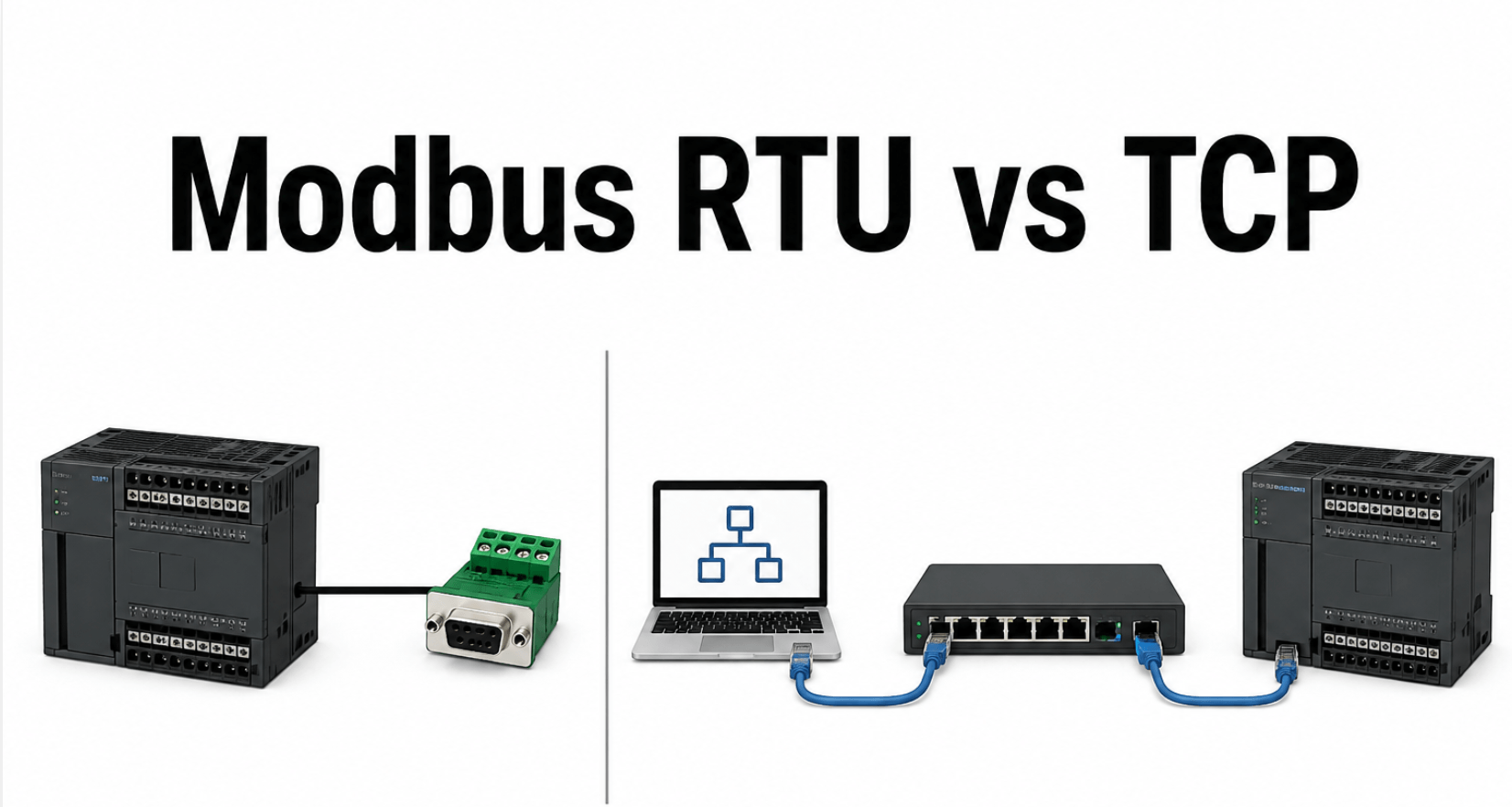
If you’ve spent any time around a control panel, you’ve run into Modbus. It’s the protocol that refuses to die, invented in 1979 for PLCs, and still running half the industrial world today.
But when you sit down to actually wire up a device, you hit the fork in the road immediately: RTU or TCP?
They share a name and a data model, but under the hood they’re built for different problems.
Pick the wrong one, and you’ll either fight noise and cable runs for years or pay for network infrastructure you didn’t need.
This guide breaks down exactly where each one wins, so you can make the call once and move on.
What Modbus RTU and Modbus TCP Have in Common
Before splitting them apart, it’s worth being clear about what doesn’t change. Both variants use the same.
- Function codes (Read Holding Registers, Write Single Coil, etc.).
- Data model, coils, discrete inputs, input registers, holding registers.
- Master/slave (client/server) request-response logic.
This is why Modbus has survived so long. The application layer is identical. What changes is everything underneath it: the physical medium, the framing, and how devices are addressed.
Modbus RTU: The Serial Original
Modbus RTU runs over serial connections, almost always RS-485, sometimes RS-232 for point-to-point links.
It’s a multidrop protocol, meaning one master can talk to multiple slaves over a shared pair of wires (a daisy chain), with each device distinguished by a slave ID (1–247).
RTU packs its data into a compact binary frame and uses a CRC-16 checksum for error checking.
There’s no header overhead, no IP stack, just raw bytes on a wire, which is part of why it’s so lightweight and so widely embedded in cheap field devices.
Where RTU shines
Long cable runs
RS-485 can reliably run up to 1200 meters (about 4000 feet) without repeaters, far beyond what Ethernet’s 100-meter segment limit allows.
Noisy environments
Differential signaling on twisted-pair RS-485 rejects electrical noise well, which matters next to VFDs, motors, and switchgear.
Low-cost field devices
Sensors, meters, and small controllers with RTU support are cheaper because they don’t need an Ethernet PHY or IP stack.
Simplicity
No network configuration, no IP addressing, no switches. Just wire the devices and set slave IDs and baud rate.
Where RTU struggles
Speed
Typical baud rates run 9600–19200 bps, occasionally up to 115200 bps. That’s fine for a handful of registers polled every second, but it doesn’t scale.
Device limits
RS-485 supports up to 32 devices per segment without repeaters (extendable with hubs, but it adds complexity).
One conversation at a time
RTU is strictly polled by only one master, and only one exchange is in flight at a time. No concurrent requests.
Troubleshooting
Wiring faults, termination resistor mistakes, and grounding issues are common headaches that TCP networks simply don’t have.
Modbus TCP: The Ethernet Native
Modbus TCP wraps the same Modbus data model inside a TCP/IP packet and runs it over standard Ethernet (or Wi-Fi). Instead of a slave ID on a shared wire, devices are addressed by IP address and port 6502.
The CRC checksum is dropped. TCP/IP’s own error checking handles that job, and a simpler MBAP (Modbus Application Protocol) header replaces it.
Because it rides on Ethernet, Modbus TCP inherits everything that comes with a modern network: switches, routers, VLANs, and critically the ability to run alongside other traffic on the same infrastructure.
Where TCP shines
Speed
Standard Ethernet runs at 100 Mbps or 1 Gbps, orders of magnitude faster than serial baud rates.
Multiple simultaneous connections
A single Modbus TCP device can typically handle several master connections at once, which serial simply can’t do.
Integration with existing IT infrastructure
If the plant already has a managed Ethernet network, adding Modbus TCP devices is often just a cable and an IP address.
Scalability and diagnostics
Standard networking tools, Wireshark, ping, and switch port statistics make troubleshooting far more transparent than a serial bus.
Distance, with infrastructure
Ethernet segments are limited to 100 meters, but switches, fiber, and media converters extend that indefinitely.
Where TCP struggles
Cost
Devices need an Ethernet PHY, and the installation needs switches, patch panels, and structured cabling, more expensive than a twisted pair.
Network dependency
Performance and reliability now depend on the health of the broader network. Congestion, misconfigured VLANs, or a flaky switch can introduce latency that a dedicated RS-485 bus never would.
Cybersecurity exposure
Putting Modbus TCP on a network means it inherits an IT-style attack surface. Modbus TCP has no built-in authentication or encryption, so segmentation (VLANs, firewalls) is essential.
Modbus RTU vs TCP: Side-by-Side Comparison
| Feature | Modbus RTU | Modbus TCP |
|---|---|---|
| Physical medium | RS-485 / RS-232 serial | Ethernet (Wi-Fi possible) |
| Addressing | Slave ID (1–247) | IP address + port 502 |
| Max devices per segment | 32 (unamplified) | Limited mainly by network design |
| Typical speed | 9600–115200 bps | 100 Mbps–1 Gbps |
| Max cable distance | ~1200 m (no repeater) | 100 m per segment (extendable via switches/fiber) |
| Error checking | CRC-16 | TCP/IP checksum |
| Concurrent connections | No (single master, polled) | Yes (multiple clients) |
| Wiring cost | Low | Higher (Ethernet infrastructure) |
| Noise immunity | High (differential signaling) | Moderate (standard Ethernet shielding) |
| Setup complexity | Simple (ID + baud rate) | Requires IP/network configuration |
| Native security | None | None (needs VLAN/firewall segmentation) |
| Diagnostics tooling | Limited, protocol analyzers | Mature (Wireshark, SNMP, switch logs) |
| Typical use case | Field devices, remote sensors, legacy retrofits | SCADA integration, plant-wide networks, high-speed data |
When to Use Modbus RTU
RTU is still the right call when it is.
- Devices are spread out over long distances, and running fiber or Ethernet isn’t practical.
- You’re retrofitting legacy equipment that only speaks serial.
- The environment is electrically noisy (near VFDs, large motors, switchgear).
- The budget is tight, and the point count is small.
- You don’t need more than a handful of devices polled at a modest rate.
This is why RTU remains dominant in field-level devices: gas detectors, flow meters, small PLCs, and remote I/O modules even as plant-wide networks move to TCP.
When to Use Modbus TCP
TCP is the better fit when.
- The site already has, or plans to build, structured Ethernet infrastructure.
- You need high-speed polling of a large point count (SCADA historians, BMS front-ends).
- Multiple systems need to read the same device simultaneously.
- You want to leverage standard IT tools for monitoring and troubleshooting.
- The application will eventually integrate with other Ethernet-based protocols (BACnet/IP, OPC UA, MQTT).
Can You Mix Modbus RTU and TCP?
Yes, this is extremely common in real installations. A Modbus gateway (RTU-to-TCP converter) sits between a serial segment of field devices and the plant Ethernet network, translating requests in both directions.
This lets you keep cheap, noise-resistant RTU devices at the edge while giving the SCADA or BMS system a single TCP connection point to poll from.
It’s often the most cost-effective architecture: RTU where distance and cost matter and TCP where speed and integration matter.
Modbus RTU vs TCP: Which Should You Choose?
There isn’t a universal winner; the right answer depends on the application, not the protocol’s popularity.
As a rule of thumb: if you’re wiring individual field devices over a distance or in a harsh electrical environment, an RTU is usually still the pragmatic choice.
If you’re building or expanding a networked control system that needs speed, multiple clients, and easy integration with IT infrastructure, TCP is the natural fit.
Most modern industrial sites end up running both, joined by a gateway, rather than standardizing on one exclusively.
FAQ
Is Modbus TCP faster than Modbus RTU?
Yes. Modbus TCP runs over Ethernet at 100 Mbps to 1 Gbps, while RTU is limited to serial baud rates, typically 9600–115200 bps. TCP also allows concurrent connections, further increasing effective throughput.
Can Modbus RTU and TCP communicate directly?
Not without a gateway. RTU and TCP use different physical layers and framing, so a protocol converter (Modbus RTU-to-TCP gateway) is required to bridge them.
Which is cheaper to install, Modbus RTU or TCP?
RTU is generally cheaper for small point counts, since it needs only twisted-pair wiring and no network switches. TCP becomes cost-competitive at scale, especially where Ethernet infrastructure already exists.
Does Modbus TCP use the same registers as Modbus RTU?
Yes. Both use identical function codes and register types (coils, discrete inputs, input registers, holding registers). The data model is unchanged. Only the transport layer differs.
Is Modbus TCP secure?
Not by default. Modbus TCP has no built-in authentication or encryption, so it should be isolated on a segmented VLAN or protected behind a firewall, particularly if any part of the network has external connectivity.
What port does Modbus TCP use?
Modbus TCP communicates over TCP port 502.
