A single lightning-induced transient or a nearby motor’s inductive kickback can take out a PLC’s power supply, fry an analog input card, or silently degrade a communication port until it fails weeks later.
If you’ve ever replaced a “randomly dead” I/O module after a storm rolled through the plant, you’ve already paid the tuition that surge protection is supposed to save you.
This guide breaks down the surge protection devices (SPDs) worth specifying for PLCs and control panels, where they belong in the panel, and how to size them so you’re not buying protection that looks good on paper but does nothing in the field.
Why PLCs Are So Vulnerable to Surges
PLCs sit at the intersection of three surge-prone pathways at once:
AC power input
Main-borne transients from utility switching, lightning strikes on nearby lines, or large motors starting on the same feeder.
I/O wiring
Field cables that run alongside VFDs, contactors, and motor starters pick up induced surges even without a direct lightning hit.
Communication lines
Ethernet, RS-485, and 4-20 mA loops that run long distances between panels are exposed to ground potential differences and induced voltage, especially outdoors or between buildings.
Unlike a motor or a simple relay, a PLC’s input/output circuitry uses semiconductor components with microsecond-scale damage thresholds.
A transient that a contactor coil would never notice can put a permanent hole in an optocoupler or ADC.
Types of Surge Protection Devices for Control Panels
Type 1 and Type 2 SPDs (Power Feed Protection)
Type 1 devices are rated for direct or partial lightning strike energy and are typically installed at the service entrance.
Type 2 devices handle the residual and induced surges that get through and are the ones you’ll usually mount inside or immediately upstream of the control panel, on the main incoming feed.
For most industrial control panels, a DIN-rail-mounted Type 2 SPD on the panel’s main AC feed is the baseline, non-negotiable layer of protection.
Type 3 SPDs (Point-of-Use Protection)
Type 3 devices are lower-energy, fast-response units meant to sit close to sensitive equipment, directly ahead of the PLC power supply, an HMI, or a VFD control input.
They complement a Type 2 device rather than replacing it; think of Type 2 as the first line of defense and Type 3 as the fine cleanup stage closest to the sensitive load.
Signal and Data Line Protectors
Separate from power protection, these guard.
Analog I/O (4-20mA, 0-10V)
Inline surge protectors on transmitter loops, especially for field devices with long cable runs
RS-485/Modbus
Protects communication ports on remote I/O and VFDs from induced surges on long serial runs
Ethernet
Surge-protected patch panels or inline Ethernet SPDs for links between buildings or panels with separate grounding points
Skipping data line protection is one of the most common gaps: panels get a nice SPD on the power feed, and the RS-485 run to a remote panel 200 meters away gets nothing.
Comparison: Surge Protection Options for PLC Panels
| Protection Type | Where It Goes | Protects Against | Typical Use Case |
|---|---|---|---|
| Type 1 SPD | Service entrance / main panel | Direct/partial lightning strike energy | Facility main distribution board |
| Type 2 SPD | Control panel main AC feed | Induced surges, switching transients | Every PLC control panel is DIN-rail mounted |
| Type 3 SPD | Directly ahead of PLC power supply | Residual surges after Type 2 clamps | High-value or highly sensitive PLC/HMI loads |
| Analog signal SPD | Inline on 4-20mA/0-10V loops | Induced surges on field wiring | Long transmitter runs, outdoor sensors |
| RS-485/Modbus SPD | Inline on serial comm lines | Ground potential differences, EMI-coupled transients | Remote I/O, inter-panel comms |
| Ethernet SPD | Inline on network drops | Induced surges on network cabling | Building-to-building or panel-to-panel Ethernet |
Where to Install Surge Protection in the Panel
Placement matters as much as device selection. A few field-tested rules:
- Mount the Type 2 SPD as close as possible to where power enters the panel, with the shortest, most direct lead length to ground. Long or coiled leads add inductance that reduces the device’s effectiveness exactly when you need it most.
- Bond the SPD’s ground connection to the panel’s main ground bus, not a daisy-chained ground from another device.
- Keep signal and communication SPDs close to the port they’re protecting, not bundled somewhere else in the panel; the unprotected length of cable between the SPD and the PLC is still exposed.
- Separate protected and unprotected wiring inside the panel where practical, so a surge on an unprotected circuit doesn’t couple into a protected one running alongside it.
Sizing and Selection Checklist
When specifying an SPD for a control panel, check.
Nominal discharge current (In) and maximum discharge current (Imax)
Sized to the exposure level of the installation (indoor panel vs. panel fed from an exposed overhead line)
Voltage protection level (Up)
should be well below the PLC power supply’s rated withstand voltage
Response time
Sub-nanosecond response matters more for Type 3 devices protecting semiconductor-based I/O
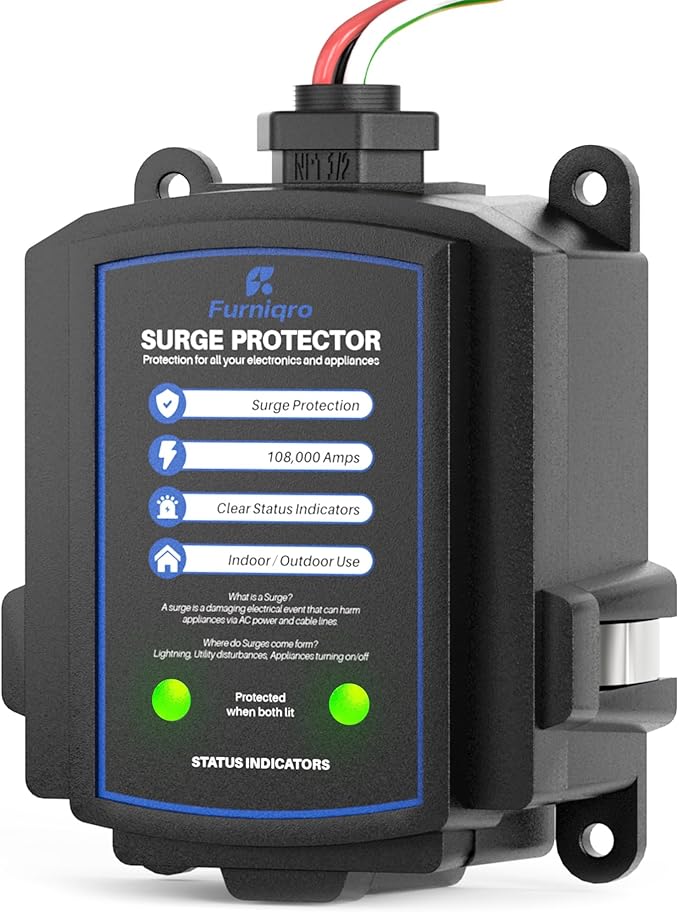
Status indication
A visual or dry-contact “SPD failed” indicator so a sacrificed protector doesn’t go unnoticed for months
UL 1449 listing (or the applicable regional standard)
Confirms independently tested performance, not just a manufacturer’s claim
Common Mistakes That Defeat Surge Protection
Long ground leads
Every extra centimeter of lead length adds inductance and raises the let-through voltage during a fast transient
No signal-line protection
A well-protected power feed doesn’t help if the surge comes in through a 4-20mA loop instead.
Ignoring SPD failure indicators
SPDs sacrifice themselves to protect downstream equipment; an unmonitored, already-failed unit gives false confidence.
Under-sizing for the exposure level
A panel fed from overhead lines in a lightning-prone region needs a higher discharge current rating than an indoor panel fed from underground service.
Mixing grounding systems
Bonding an SPD to an isolated or separate ground instead of the panel’s single-point ground reference undermines the whole strategy.
FAQ
Do I need surge protection if my PLC panel is indoors?
Yes. Indoor panels are still exposed through the AC feed, field wiring that runs near VFDs and motor starters, and communication lines to remote panels, none of which require a direct lightning strike to pick up a damaging transient.
Is a surge protector the same as a UPS?
No. A UPS protects against power loss and sags; it doesn’t clamp fast transients the way an SPD does.
Many critical panels use both a UPS for continuity and an SPD for transient protection.
How often do SPDs need to be replaced?
SPDs degrade with each surge event they absorb. Devices with a status indicator should be checked during routine panel inspections, and any unit showing a “replace” or fault indication should be swapped immediately, since a degraded SPD may no longer clamp effectively.
Can one SPD protect the whole panel?
A single Type 2 SPD on the main AC feed protects against power-line surges but does nothing for signal and communication lines. Comprehensive protection means separate devices for power, analog I/O, and data lines.
