When designing or upgrading a PLC panel, one component quietly determines whether your system runs flawlessly or becomes a troubleshooting nightmare: the DIN rail power supply.
Most engineers focus on PLC selection, communication protocols, and I/O configuration. But in real-world industrial environments, many “mysterious” issues, random PLC resets, communication drops, and sensor instability are often traced back to poor or undersized power supplies.
This in-depth guide will walk you through everything you need to know about choosing the best DIN rail power supply for PLC panels, including top models, sizing calculations, real-world engineering insights, and best practices used in industrial automation.
What Is a DIN Rail Power Supply?
A DIN rail power supply is an industrial-grade AC-to-DC converter designed to mount directly onto a DIN rail inside control panels.
Its main role is to convert incoming AC voltage (typically 120V or 230V AC) into a stable 24V DC output, which powers the following.
- PLC CPUs
- Digital and analog I/O modules
- Sensors and transmitters
- Relays and contactors (via control circuits)
- Industrial communication devices (switches, gateways, radios)
- HMIs and industrial PCs
The reason 24V DC is the industry standard is simple: it offers the ideal balance between safety, efficiency, and compatibility across industrial devices.
Why the Power Supply Is Critical in PLC Panels
In theory, any 24V DC power supply should work. In practice, the quality of your PSU directly impacts:
System Stability
PLCs require stable voltage. Even small dips can cause the following.
- CPU resets
- I/O faults
- Communication errors
Communication Reliability
Protocols like Ethernet/IP, Modbus TCP, and PROFINET are sensitive to the following.
- Electrical noise
- Voltage ripple
- Grounding issues
A low-quality PSU increases noise and instability.
Equipment Lifespan
Poor power quality leads to the following.
- Premature failure of sensors and modules
- Overheating components
- Increased maintenance costs
Downtime Risk
In critical industries (oil & gas, manufacturing, utilities), power supply failure = production loss.
Best DIN Rail Power Supplies for PLC Panels (Top Picks)
Below are industry-proven power supplies used by automation engineers worldwide.
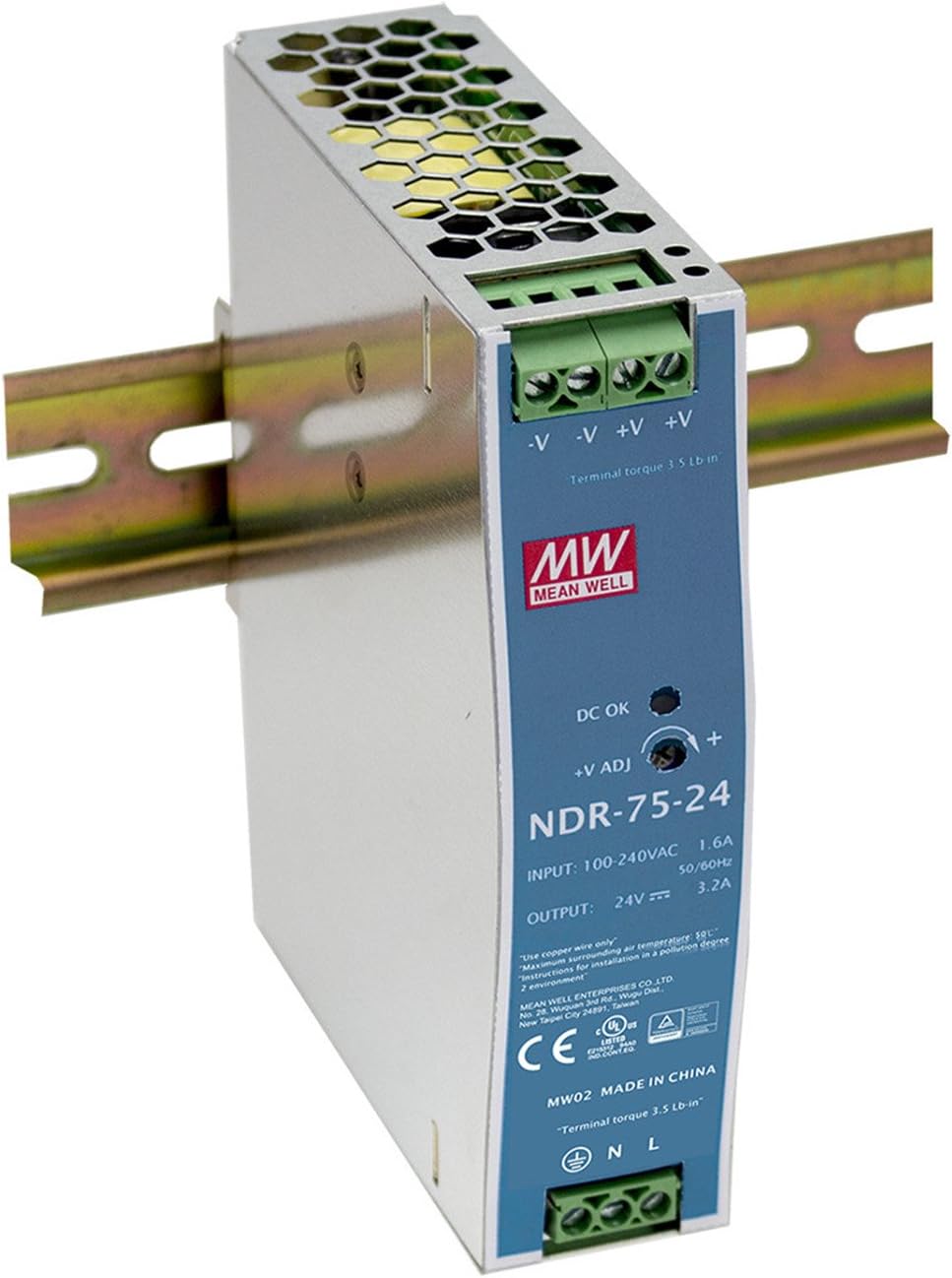
Mean Well HDR / NDR Series (Best Budget Option)
Overview
Mean Well is one of the most widely used brands globally, especially in cost-sensitive applications.
Why engineers choose it
- Affordable without being unreliable
- Widely available
- Simple installation
Key Features
- Output: 24V DC
- Power range: 60W to 480W
- Efficiency: ~88–90%
- Overload and short-circuit protection
Pros
- Excellent value for money
- Compact size (great for small panels)
- Reliable for non-critical systems
Cons
- Limited diagnostics
- Lower surge handling compared to premium brands
Best Use Case
- Small machines
- OEM panels
- Non-critical industrial systems
Phoenix Contact QUINT Power (Best for Critical Systems)
Overview:
Phoenix Contact’s QUINT series is designed for high-reliability industrial environments.
Why it stands out:
- Advanced protection features
- Exceptional reliability
- Built-in system monitoring
Key Features:
- Output: 24V DC (up to 40A+)
- Selective Fuse Breaking (SFB) technology
- Dynamic Boost (extra current during startup)
- Preventive function monitoring
Pros:
- Extremely reliable
- Handles inrush current well
- Ideal for continuous operation
Cons:
- Higher cost
- Overkill for small systems
Best Use Case:
- Oil & gas
- Continuous manufacturing
- Critical automation systems
Siemens SITOP PSU8600 (Best Smart Power Supply)
Overview
The SITOP PSU8600 is not just a power supply. It’s a smart power management system.
Why engineers love it
- Communication-enabled
- Modular design
- Full diagnostics
Key Features
- Ethernet/PROFINET integration
- Channel-level monitoring
- Modular expansion
- Remote diagnostics
Pros
- Ideal for Industry 4.0
- Advanced load management
- Predictive maintenance capability
Cons
- Expensive
- Requires configuration
Best Use Case
- Smart factories
- Large PLC systems
- High-tech automation environments
Allen-Bradley 1606-XLS Series (Best for Rockwell Systems)
Overview
Designed for seamless integration with Rockwell Automation environments.
Key Features
- Output: 24V DC
- High efficiency (~94%)
- Wide temperature range
Pros
- Trusted in North American industries
- Strong compatibility with Rockwell PLCs
- Durable design
Cons
- Premium pricing
- Limited smart features compared to SITOP
Best Use Case
- Rockwell-based PLC panels
- Harsh industrial environments
Schneider Electric Phaseo (Best Mid-Range Option)
Overview
A solid balance between cost and performance.
Key Features
- Output: 24V DC
- Good overload capacity
- Compact design
Pros
- Reliable and affordable
- Easy integration
- Widely supported
Cons
- Fewer advanced features
Best Use Case
- General industrial applications
- Medium-sized PLC panels
How to Size a DIN Rail Power Supply (Step-by-Step)
Sizing is where most mistakes happen.
Step 1: List All Loads
Include
- PLC CPU
- Each I/O module
- Sensors
- HMI
- Communication devices
Step 2: Calculate Total Current
Example:
- PLC CPU: 1.2A
- I/O modules: 2.5A
- Sensors: 1.0A
- HMI: 1.5A
Total = 6.2 A
Step 3: Add Safety Margin
Add 20–30%:
6.2A × 1.3 = 8.06A
👉 Choose a 10A power supply.
Step 4: Consider Startup Current
Some devices draw higher current at startup:
- Relays
- Contactors
- Motors (control side)
Choose a PSU with boost capability if needed.
Redundancy: When You Absolutely Need It
For critical systems, use:
Dual Power Supplies + Redundancy Module
Benefits:
- Zero downtime if one PSU fails
- Load sharing
- Improved reliability
Typical setup:
- 2 × 24V power supplies
- 1 redundancy module
Key Features to Look For
Efficiency (>90%)
- Less heat
- Lower energy consumption
- Longer lifespan
Protection Features
Must include:
- Overvoltage protection
- Overcurrent protection
- Short-circuit protection
- Thermal shutdown
Power Boost Capability
Helps during:
- Startup surges
- Temporary overloads
Low Ripple and Noise
Critical for:
- Communication networks
- Analog signals
Wide Input Voltage Range
Useful for:
- Global deployments
- Unstable power grids
Environmental Considerations
Industrial environments are harsh. Consider.
Temperature
- Standard: -10°C to +60°C
- High-end: up to +70°C
Vibration
Important for:
- Mobile equipment
- Heavy machinery
Dust and Humidity
Choose rugged designs for
- Mining
- Outdoor installations
Common Mistakes to Avoid
Undersizing the Power Supply
This leads to:
- Voltage drops
- System instability
Ignoring Heat Dissipation
Poor ventilation causes
- Overheating
- Reduced lifespan
No Redundancy in Critical Systems
Single PSU = single point of failure
Using Cheap Consumer Power Supplies
Industrial panels require industrial-grade PSUs
Poor Wiring Practices
Even the best PSU fails with
- Loose connections
- Incorrect grounding
My Insight
Many intermittent PLC issues are NOT programming problems—they are power quality problems.
Engineers often spend hours troubleshooting:
- Network timeouts
- Random alarms
- Sensor failures
Only to discover the root cause was:
- Voltage ripple
- Undersized PSU
- Poor grounding
Upgrading to a high-quality DIN rail power supply often resolves these issues instantly.
Best DIN Rail Power Supply by Use Case
| Use Case | Recommended Option |
|---|---|
| Budget systems | Mean Well HDR/NDR |
| Critical processes | Phoenix Contact QUINT |
| Smart factories | Siemens SITOP PSU8600 |
| Rockwell panels | Allen-Bradley 1606-XLS |
| General industrial | Schneider Phaseo |
Final Verdict
If you want reliability
- Go premium (Phoenix Contact) for critical systems
- Go smart (Siemens SITOP) for advanced automation
- Go budget (Mean Well) for simple applications
But remember:
👉 The power supply is NOT where you save money in industrial automation.
Conclusion
Choosing the best DIN rail power supply for your PLC panel is about more than just voltage and current. It’s about system reliability, uptime, and long-term performance.
A well-selected PSU will:
- Protect your PLC
- Stabilize your network
- Reduce downtime
- Extend equipment life
If you’re designing industrial control panels, treat the power supply as a core component, not an afterthought.
