If you’re building a career in industrial automation, you’ve probably noticed that job postings for PLC programmers, controls engineers, and automation technicians rarely agree on what qualifications they actually want.
Some list a degree. Some list years of experience. A growing number list a specific certification from Rockwell, Siemens, or a vendor-neutral credential like the CSIA or ISA badges.
So which PLC certifications are actually worth your time and money in 2026? This guide breaks down the certifications that carry real weight with employers, what each one costs, how long they take, and how to pick the right one based on where you want your career to go.
Why PLC Certifications Matter (and When They Don’t)
Before diving into specific programs, it’s worth being honest about what a certification can and can’t do for you.
A PLC certification won’t replace hands-on experience. Nobody hires a controls engineer based on a certificate alone.
Panel-building, troubleshooting a machine at 2 a.m., and reading a schematic under pressure are skills you only build on the floor or in a lab.
But certifications solve a specific problem: they prove to an employer, recruiter, or client that you know a particular platform before they’ve had a chance to watch you work.
That’s especially valuable in three situations:
You’re switching platforms
You’ve spent five years on Allen-Bradley and need to prove Siemens competency for a new role.
You’re early in your career
A certification signals initiative and baseline competency when your resume doesn’t have much field experience to lean on yet.
You’re going independent
System integrators and contract automation engineers use certifications to win client trust and qualify for vendor partner programs.
If you’re already a working PLC programmer with a strong portfolio and references, a certification is a nice-to-have that can support a raise or promotion conversation, not something that will transform your career on its own.
Vendor-Specific vs. Vendor-Neutral Certifications
PLC certifications fall into two broad categories, and understanding the difference shapes which ones you should pursue.
Vendor-specific certifications are issued by the PLC manufacturers themselves: Rockwell Automation, Siemens, Schneider Electric, Mitsubishi, and others.
These prove you can program and troubleshoot that company’s specific hardware and software.
Because roughly 30–40% of the North American industrial base runs on Allen-Bradley/Rockwell platforms, Rockwell certifications tend to open the most doors in the U.S. and Canada.
Siemens dominates in Europe and much of the rest of the world, making Siemens certifications the stronger regional choice depending on where you work.
Vendor-neutral certifications, like those from the International Society of Automation (ISA) or the Control System Integrators Association (CSIA), validate broader engineering knowledge: control theory, instrumentation, safety systems, and project execution that applies regardless of which brand of PLC sits in the panel.
These carry more weight for engineering-track roles, government and regulated industries, and system integrator businesses.
Most serious automation careers eventually combine both: a vendor-neutral credential for the fundamentals, plus platform-specific certifications matching whatever hardware dominates your region or industry.
The Best PLC Certifications Worth Getting
Rockwell Automation Certifications (Allen-Bradley)
Rockwell’s certification track is built around its RSLogix/Studio 5000 software and ControlLogix/CompactLogix hardware families. The path typically runs through tiers.
Certified Associate
Foundational ladder logic, I/O configuration, and basic troubleshooting
Certified Professional
Advanced programming, structured text, networking (EtherNet/IP), and system integration
Rockwell certifications are administered through Rockwell’s TechConnect and PartnerNetwork training programs, and cost varies by course bundle, expect several hundred to a few thousand USD depending on whether you self-study or take instructor-led courses.
Best for
Anyone working in North American manufacturing, food and beverage, automotive, or general industry, where Allen-Bradley hardware is the de facto standard.
Siemens Certified Professional for TIA Portal
Siemens’ certification path centers on the TIA Portal engineering environment and the S7-1200/1500 PLC families.
Siemens offers tiered digital badges through its Mindsphere Academy and regional training centers, covering basic programming through advanced diagnostics and safety-integrated systems (F-CPU programming).
Best for
Engineers working in Europe or in industries like pharmaceuticals, packaging, and process manufacturing where Siemens hardware is common worldwide, including a significant footprint in Mexican and Latin American plants tied to European parent companies.
ISA Certified Automation Professional (CAP)
The CAP credential, issued by the International Society of Automation, is one of the most respected vendor-neutral certifications in the industry.
It tests broad competency across five domains: feasibility studies, system design, development, deployment, and support/maintenance of automation and control systems.
Unlike vendor certifications, CAP requires a mix of education and documented work experience to sit for the exam. It’s positioned as a mid-career credential rather than an entry-level one.
Best for
Automation engineers with several years of field experience who want a credential recognized industry-wide, independent of any single hardware platform, are particularly useful if you consult, contract, or move between industries.
ISA Certified Control Systems Technician (CCST)
The CCST is the technician-level counterpart to the CAP, aimed at people who install, maintain, calibrate, and troubleshoot control systems rather than design them from scratch.
It’s offered at three tiers (I, II, and III) based on experience level, making it one of the few certifications with a clear on-ramp for early-career technicians.
Best for
Instrumentation and controls technicians who want a structured, recognized career ladder without needing an engineering degree.
Schneider Electric EcoStruxure / Modicon Certifications
Schneider Electric’s certification programs cover its Modicon PLC line and EcoStruxure ecosystem, with a growing footprint in energy management, water/wastewater, and building automation, sectors adjacent to BACnet and BMS work.
Best for
Engineers working in utilities, water treatment, or building automation, especially outside North America, where Schneider has a strong regional presence.
Mitsubishi Electric FA Certifications
Mitsubishi’s GX Works-based certification track is less common in North America but carries significant weight in automotive manufacturing (particularly Japanese-owned plants) and in Asia-Pacific markets.
Best for
Engineers working in or near automotive OEM supply chains, or anyone targeting roles with Japanese manufacturers.
Comparison Table

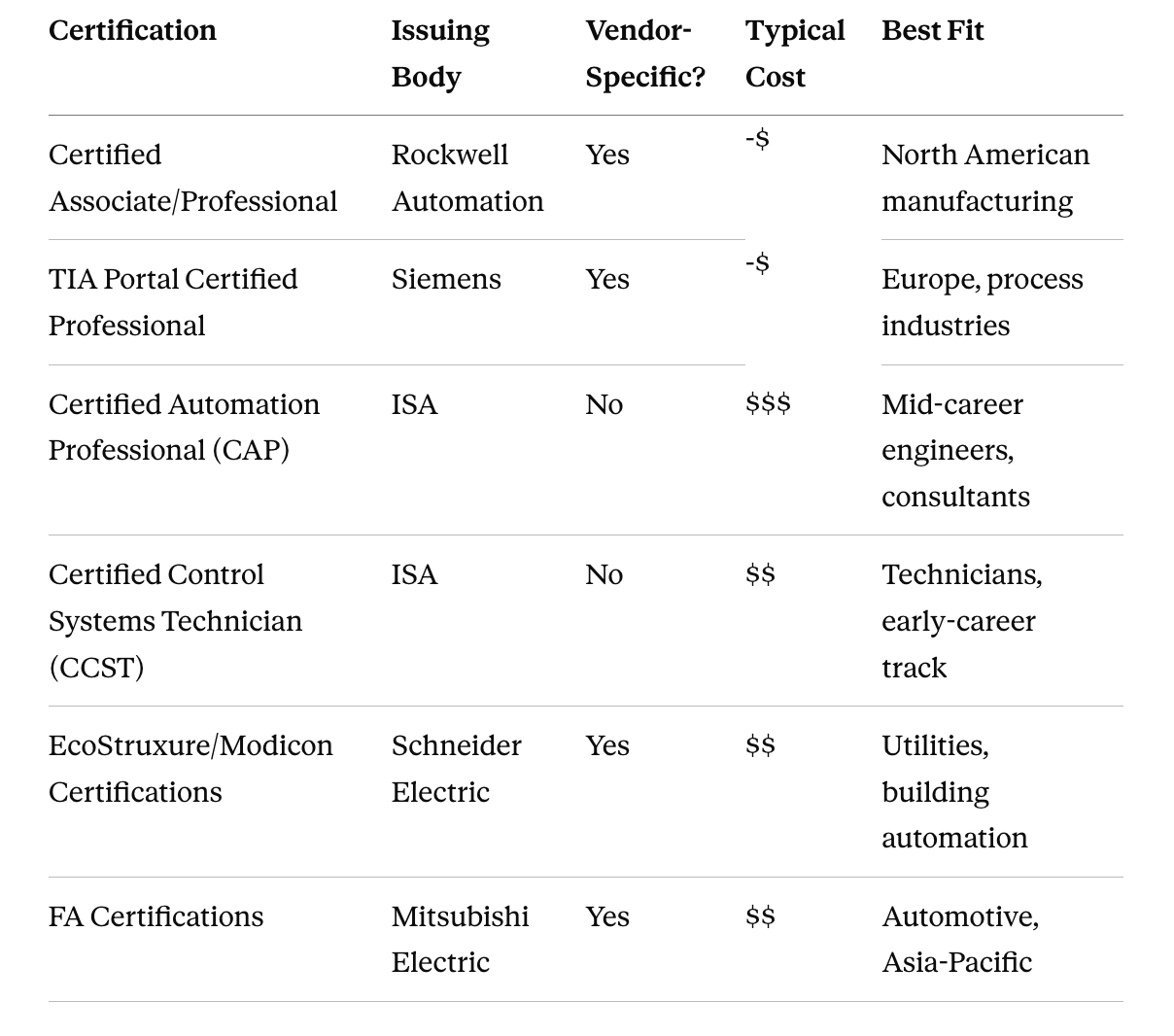
How to Choose the Right Certification for You
Rather than chasing every credential on this list, work backward from your target role:
- If you want to work in North American manufacturing plants: start with Rockwell. It’s the platform you’ll encounter most often.
- If you’re targeting European employers, pharma, or process industries, Siemens TIA Portal certification will serve you better.
- If you’re aiming for a consulting, systems integration, or senior engineering track: invest in ISA’s CAP once you have the field experience to qualify. It signals engineering judgment, not just software fluency.
- If you’re early-career and want a technician-level credential: ISA’s CCST Level “I” is a strong, achievable starting point.
- If you’re not sure which hardware you’ll end up specializing in, get comfortable with ladder logic and structured text fundamentals first through free or low-cost vendor training, then commit to a paid certification once you see which platform your target employers actually use.
Frequently Asked Questions
Do I need a certification to become a PLC programmer?
No. Many PLC programmers build careers through hands-on experience, technical school, or an engineering degree without ever sitting a vendor certification exam.
Certifications help most when you need to prove competency quickly switching platforms, entering a new industry, or building a resume with limited field experience.
Which PLC certification pays the most?
Certifications themselves don’t set pay directly, but Rockwell and Siemens certifications tend to correlate with the highest-paying roles simply because those platforms dominate the industries (automotive, pharma, and oil and gas) that pay the most for automation talent. ISA’s CAP is also associated with higher-paying, more senior positions since it targets experienced engineers rather than entry-level technicians.
How long does it take to get PLC certified?
Vendor-specific associate-level certifications can often be completed in a few weeks of focused study and a single exam.
Professional-level vendor certifications and ISA’s CAP typically require months of preparation and, in CAP’s case, documented work experience before you’re even eligible to test.
Are online PLC certifications legitimate?
Yes, most major vendors and ISA now offer online and hybrid certification paths, and these carry the same weight as in-person programs as long as they culminate in a proctored exam. What matters to employers is the credential itself, not the delivery format.
Is Rockwell or Siemens certification better?
Neither is universally “better”. It depends on where you work. Rockwell/Allen-Bradley dominates North America; Siemens dominates Europe and has a strong global presence in process industries. Many experienced automation engineers eventually hold certifications in both.

Pingback: PLC vs Microcontroller: Key Differences