A multimeter tells you whether a circuit is live. A megohmmeter tells you whether it’s safe, whether the insulation around a motor winding, a feeder cable, or a switchgear busbar will still hold back leakage current a year from now.
In my work commissioning and maintaining industrial control and safety systems, the insulation resistance tester is the one instrument that catches failures before they trip a plant.
This guide is built for people who actually use these tools: maintenance electricians, commissioning engineers, panel builders, and reliability technicians.
I’ll walk through the specs that decide whether a tester fits your job, then give tiered recommendations from a sub-$1,000 field workhorse up to a 5 kV diagnostic instrument.
If you only want the short version, the comparison table below covers it, but the buying criteria are where most people either save money or avoid a mismatch.
Best Insulation Resistance Tester
| Model | Max test voltage | Max resistance range | Diagnostic tests | Best for |
|---|---|---|---|---|
| Fluke 1507 | 1000 V | 10 GΩ | PI, DAR | LV troubleshooting & general field work |
| Fluke 1587 FC | 1000 V | 2 GΩ | PI, DAR (plus full TRMS DMM) | Techs who want a megger + multimeter in one |
| Klein ET600 | 1000 V | 4000 MΩ | Basic | Budget-conscious residential/light commercial |
| Megger MIT525 | 5000 V | 10 TΩ | PI, DAR, DD, SV, Ramp + memory | Motors, MV cables, switchgear, documented PM |
Prices move around, so I’ve avoided pinning exact figures. Check current listings before you buy.
As a rough guide, in 2026, the entry 1 kV units sit under or around the $900 mark, the Fluke combo lands near four figures, and the 5 kV diagnostic class runs into several thousand dollars.
How a Megohmmeter Actually Works (and Why It Matters for Buying)
An insulation resistance tester applies a known DC test voltage across insulation and measures the tiny leakage current that flows through it.
From that current, it calculates resistance typically reported in megohms, gigaohms, or teraohms.
Healthy insulation gives a high, stable reading; damp, contaminated, or aged insulation reads low or drifts downward as you watch.
DC is used deliberately. Unlike AC, a stable DC voltage stresses the insulation without the capacitive complications, giving you a repeatable number you can trend over the life of the asset.
That word, “trend,” is where insulation testing earns its keep. A single reading tells you far less than the same reading taken every six months and plotted against its own history.
Two consequences for buying follow directly from the physics.
Test voltage has to match the equipment
Test too low, and you can mask a weakness that only shows up under real operating stress; test too high, and you risk over-stressing otherwise good insulation.
Low-voltage work lives at 250 V, 500 V, and 1000 V. Motors, medium-voltage cables, and switchgear need 2.5 kV or 5 kV to be tested meaningfully.
The resistance range has to be high enough
Modern insulation is genuinely good, so a tester that tops out at a few hundred megohms can’t distinguish “excellent” from “merely adequate.”
Reaching into the gigohm or teraohm region is what lets you separate a healthy machine from one that’s quietly degrading.
What to Look For in an Insulation Resistance Tester
Test voltage range
Buy for the highest-voltage asset you’ll realistically test, not the average. A 1000 V tester is perfect for building wiring, control panels, and small motors.
The moment you’re responsible for medium-voltage cable, large motors, or switchgear, you need a 5 kV instrument. No amount of feature checking substitutes for it.
Resistance measurement range
For general LV maintenance, 10 GΩ (as on the Fluke 1507) is plenty. For predictive trending on high-value apparatus, you want the teraohm reach of a 5 kV unit like the Megger MIT525, which measures up to 10 TΩ.
Higher ceilings let you replace the old, ambiguous “infinity” reading with an actual number you can log and compare.
Diagnostic test modes (PI, DAR, DD, and beyond)
A bare resistance number is pass/fail thinking. The diagnostic modes turn one reading into a condition assessment:
- DAR (Dielectric Absorption Ratio), a short ratio (typically 60 s / 30 s) that flags moisture and contamination quickly.
- PI (Polarization Index), a 10-minute / 1-minute ratio, the classic health check for motor and generator windings.
- DD (Dielectric Discharge) probes multi-layer insulation for a specific weak layer.
- SV (Step Voltage) and Ramp apply increasing voltage to reveal weaknesses that only appear under higher stress.
Entry testers give you PI and DAR, which covers most field needs. The full suite (DD, SV, and Ramp) is the domain of diagnostic instruments and matters most for motors, generators, and capital equipment you’re trying to keep in service for decades.
Safety rating (CAT rating)
Insulation testing puts you in contact with energized and high-energy circuits. Look for a CAT III or CAT IV rating appropriate to where you’ll work.
The Megger MIT525, for example, is rated CAT IV 600 V on all terminals, the right class of protection for substation and industrial environments.
Automatic discharge
After a test, the capacitance in a cable or winding stays charged at the test voltage a genuine hazard.
Automatic discharge, where the instrument bleeds that charge off through an internal resistor when the test ends, isn’t a convenience feature. Treat it as mandatory. Every unit I recommend here has it.
Memory, logging, and reporting
If your insulation tests feed a maintenance record or a compliance report, on-board memory with time-stamped storage and PC download changes the job.
Instead of copying numbers onto a clipboard, you store, date-stamp, and transfer readings.
The tester becomes part of the documentation workflow rather than a step before it. This is a defining strength of the 5 kV diagnostic class.
Battery life and power flexibility
For a handheld you carry all day, battery endurance matters. The Fluke 1587 FC will run roughly 1000 insulation tests on a fresh set of alkalines.
On the diagnostic side, rapid-charge batteries plus the ability to run from line power on a dead battery, as the MIT525 offers, keep a commissioning day moving.
The Best Insulation Resistance Testers of 2026
Best Overall for Field Work: Fluke 1507

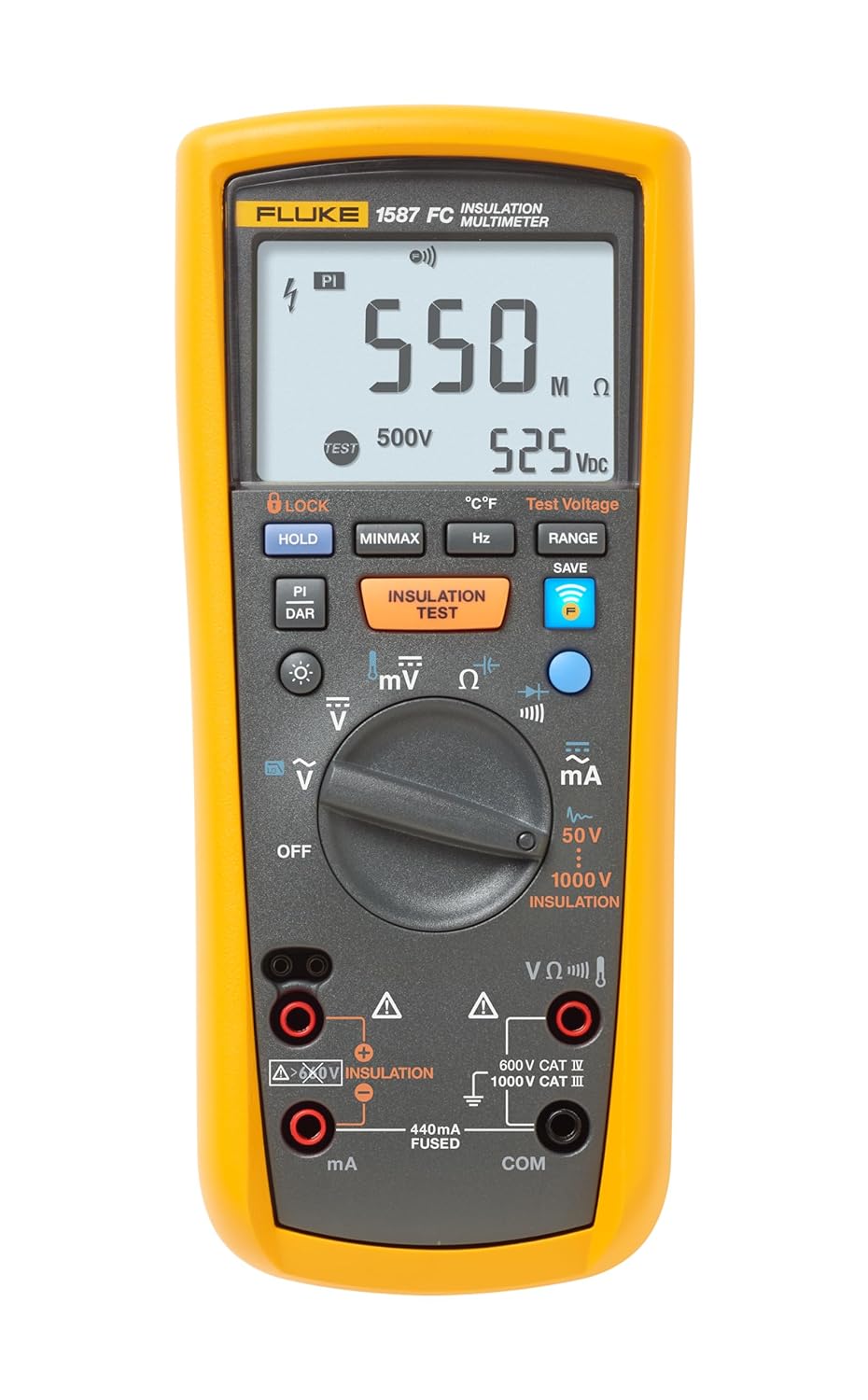
The Fluke 1507 is the tester I’d hand most electricians and maintenance techs. It offers five test voltages, 50 V, 100 V, 250 V, 500 V, and 1000 V, and measures from 0.01 MΩ up to 10 GΩ, which covers the overwhelming majority of low-voltage troubleshooting, commissioning, and preventive-maintenance work.
It calculates PI and DAR automatically. Has a compare (pass/fail) function for repetitive testing, a remote test probe for hard-to-reach points, live-circuit detection that blocks a test if it sees more than 30 V, and automatic capacitive discharge.
It’s compact, rugged, and does one job extremely well. If your world is buildings, panels, and small-to-medium motors, this is the sweet spot.
Best for: LV maintenance, commissioning, general field troubleshooting.
Skip it if you need to test medium-voltage cable or large machines. It stops at 1000 V.
Best All-in-One: Fluke 1587 FC
The 1587 FC combines a 1000 V insulation tester with a full-featured true RMS digital multimeter in one handheld.
If you’re tired of carrying a megger and a DMM, this is the answer. On the insulation side, it offers 50 V, 100 V, 250 V, 500 V, and 1000 V test voltages and reads up to 2 GΩ; on the multimeter side, you get AC/DC voltage and current, resistance, continuity, capacitance, diode test, temperature, and frequency, plus a VFD low-pass filter for accurate readings on motor drives. Fluke Connect wireless lets you log and share results from your phone.
The trade-off versus the 1507 is a lower insulation ceiling (2 GΩ vs. 10 GΩ) in exchange for the multimeter.
For a lot of techs, one tool that does both is worth more than a slightly higher resistance range.
Best for: technicians who want a single tool for troubleshooting and insulation checks. Skip it if you rarely need a DMM and want maximum insulation range instead.
Best Budget Pick: Klein Tools ET600

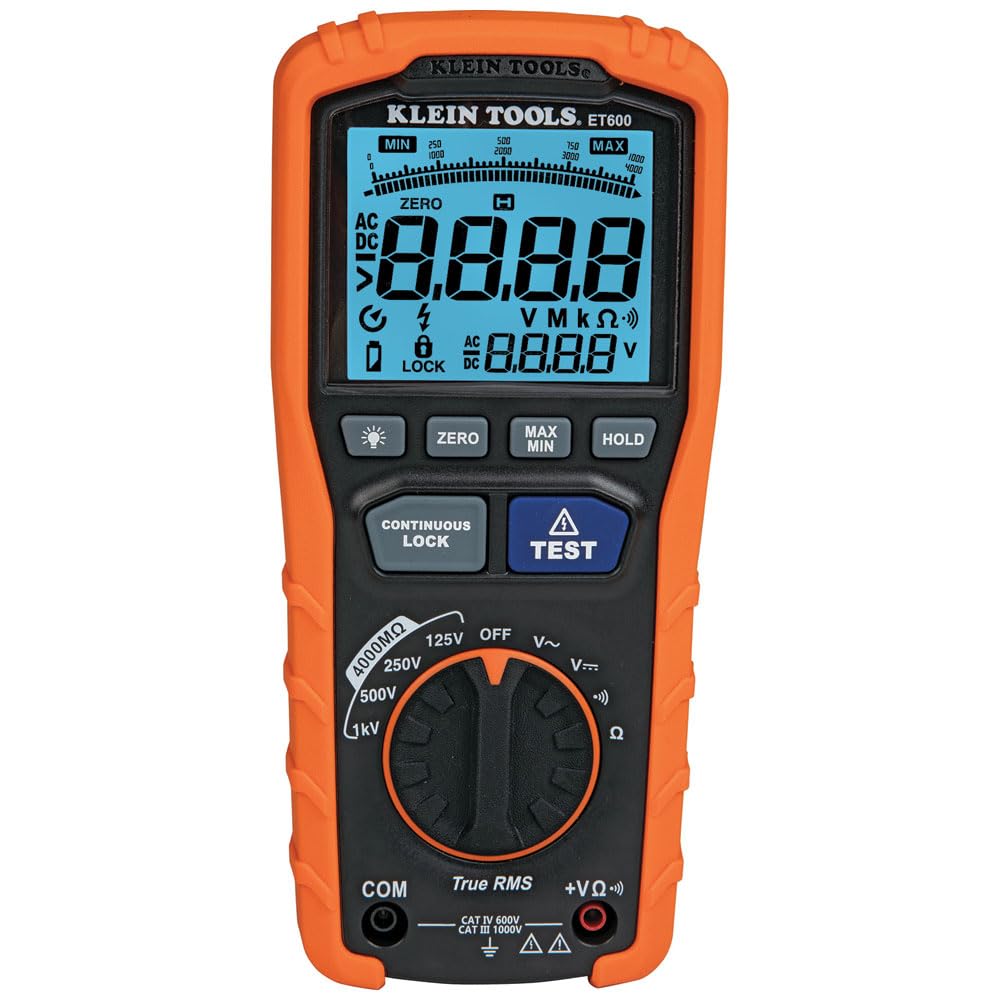
If you need real insulation-testing capability without professional-instrument pricing, the Klein ET600 is a sensible entry. It’s an auto-ranging TRMS multimeter with megohmmeter functionality, offering 125 V, 250 V, 500 V, and 1000 V test voltages, and it ships with CAT III/CAT IV-rated leads, a case, and batteries.
Its resistance ceiling (4000 MΩ) and diagnostic depth are modest next to the Fluke units, so treat it as a capable tool for residential and light-commercial work rather than a substitute for a dedicated industrial megger.
Best for budget-conscious electricians and residential and light commercial service.
Skip it if you need PI/DAR-driven predictive maintenance or a high resistance range.
Best for Motors, MV Cable & Switchgear: Megger MIT525

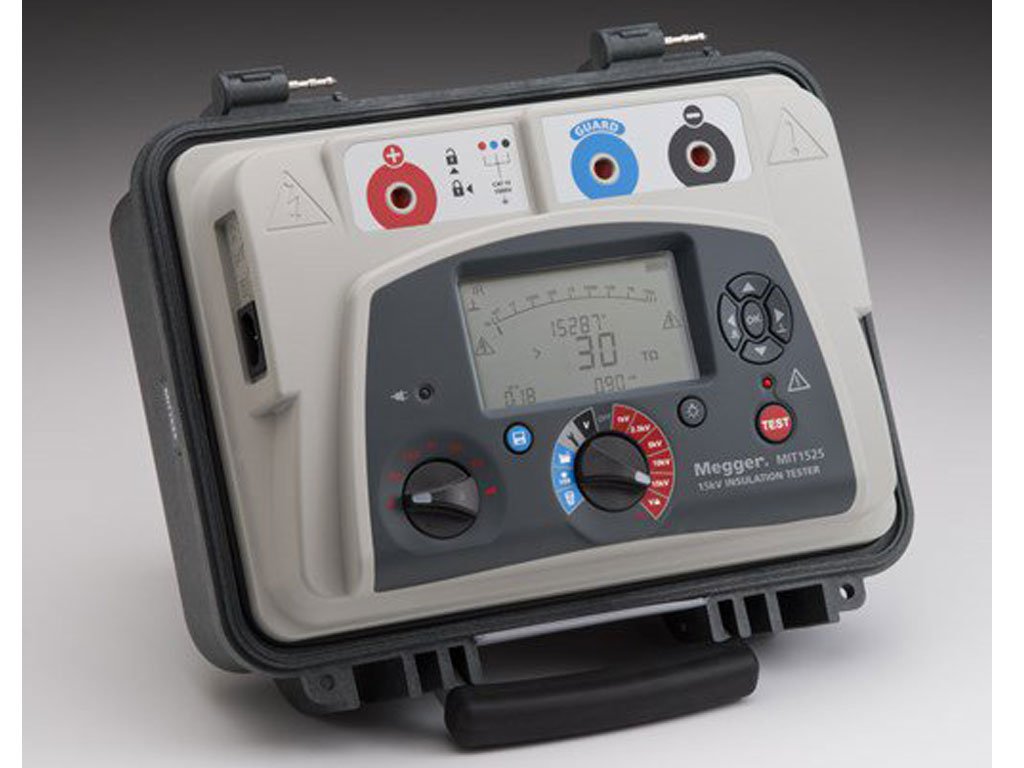
When the job moves up to 5 kV, the Megger MIT525 is my pick. It delivers a continuously adjustable output up to 5 kV and measures insulation up to 10 TΩ, the reach you need to trend high-quality insulation on capital equipment rather than staring at an “infinity” symbol.
Crucially, it carries the full diagnostic suite: timed IR, PI, DAR, DD, step voltage, and ramp, so you can characterize how insulation behaves under stress rather than settle for a single number.
It’s built for the environments where that matters. All terminals are rated CAT IV 600 V (to 3000 m altitude).
It uses a dual-case design with a fire-retardant inner case, and it stores time-stamped results in on-board memory for USB download into your maintenance records.
Rapid-charge batteries plus line-power operation on a dead battery keep it working through a commissioning day. A PI-predictor function shortens the classic 10-minute PI test.
This is the instrument for anyone whose reports have to stand up to scrutiny — where evidence, repeatability, and documentation matter as much as the reading itself.
Best for: motors, generators, medium-voltage cable, switchgear, documented predictive maintenance.
Skip it if you only ever work at low voltage; you’d be paying for capability you won’t use.
A Note on the Very High End
Above the handheld 5 kV class sit the substation-grade instruments combined test sets from the likes of Doble, Omicron, and larger Megger units that bundle insulation resistance with power-factor, tan-delta, and other high-voltage diagnostics.
These are five-figure, dedicated-team instruments, not personal tools. If you’re a field engineer doing commissioning, a 5 kV handheld like the MIT525 (or the larger MIT1025) is the right primary instrument; the big test sets are shared resources you book, not gear you carry.
Also worth knowing: PV-specific insulation testers (such as the Fluke 1587 FC SOLAR and Megger MIT525 variants tuned for solar arrays) account for array voltage and add daytime-testing interlocks relevant if solar is part of your scope.
How to Choose: A Simple Decision Path
Match the tester to the highest-voltage, highest-value asset you’re responsible for:
- Residential/light commercial, tight budget? Klein ET600.
- General LV maintenance and commissioning? Fluke 1507.
- Want one tool for insulation and everyday electrical measurement? Fluke 1587 FC.
- Motors, MV cable, switchgear, or you need documented PI/DD/SV testing? Use the Megger MIT525.
Buy for the top of your range, not the middle. The most common regret I see is someone buying a 1000 V unit, then landing a medium-voltage job six months later and having to buy again.
Frequently Asked Questions
What is the difference between a megohmmeter and a multimeter?
A multimeter measures voltage, current, and low resistance on live or de-energized circuits.
A megohmmeter applies a high DC test voltage (250 V to 5 kV or more) to measure the very high resistance of insulation, a value a standard multimeter can’t reach.
Combo units like the Fluke 1587 FC do both, but a true megger is defined by its high-voltage insulation function.
What test voltage should I use?
Match it to the equipment rating. A common rule of thumb is to test at roughly the equipment’s rated voltage or a step above: 500 V or 1000 V for typical LV systems, and 2.5 kV or 5 kV for medium-voltage cables, large motors, and switchgear. Testing too low can hide a fault; testing too high can stress good insulation.
What is a good insulation resistance reading?
Higher is better, but the number depends on the equipment, its rated voltage, and temperature.
More important than any single value is the trend: a reading that’s steady or rising over time is healthy, while a steady decline signals degradation even if the absolute number still looks acceptable. This is why logging and diagnostic ratios (PI, DAR) matter.
What are PI and DAR tests?
Both are ratios of readings taken at different times during a single test. DAR (Dielectric Absorption Ratio) compares readings at 60 and 30 seconds to flag moisture and contamination quickly.
PI (Polarization Index) compares the 10-minute reading to the 1-minute reading and is the standard health check for motor and generator windings. A rising ratio indicates good insulation; a flat one suggests trouble.
Do I need a 5 kV tester?
Only if you work on medium-voltage cable, large motors and generators, or switchgear. For building wiring, control panels, and small motors, a 1000 V tester like the Fluke 1507 is the correct choice. A 5 kV unit would be paying for a range you’ll never use.
Is automatic discharge really necessary?
Yes. Cables and windings behave like capacitors and stay charged at the test voltage after a test ends, which is a shock hazard.
Automatic discharge safely bleeds that energy off through the instrument. Don’t buy a tester without it.
This guide reflects hands-on experience with industrial control, motor, and safety system maintenance.
Always follow your site’s electrical safety procedures, wear appropriate PPE, and confirm circuits are de-energized and isolated before insulation testing.
