Industrial automation projects demand structured engineering documentation from early stages.
Among essential documents, the I/O list holds particular significance. It defines how field devices connect to programmable controllers.
Every sensor and actuator requires accurate identification and classification. Without structured records, wiring errors easily occur during installation. Commissioning delays frequently originate from incomplete signal documentation.
An I/O list organizes digital and analog signals systematically. It aligns instrumentation details with controller hardware configuration. Engineers rely on this document throughout design and testing.
Maintenance teams also reference it during troubleshooting activities. Clear documentation reduces miscommunication between disciplines and contractors.
This article reviews the structure of an I/O list, its elements, lifecycle role, and why it critically matters in PLC projects.
What is an I/O list, and why does it matter in PLC projects?
An I/O list represents a structured inventory of field signals. The abbreviation I/O means input and output channels.
Inputs transmit information from field devices to controllers. Outputs deliver commands from controllers toward field actuators.
Each entry corresponds to a physical or virtual signal. Tag numbers uniquely identify instruments within the plant.
Descriptions clarify the functional purpose of each signal. Signal type classification distinguishes digital from analog channels. Voltage or current ranges are clearly specified for accuracy.
Additional columns frequently include cable numbers and termination points. Panel references indicate the cabinet containing associated modules.
PLC rack and slot information ensures proper hardware allocation. Engineering units define scaling parameters for analog measurements.
This document evolves progressively during project development phases. Initial versions may contain estimated signal quantities only.
Detailed design stages introduce precise device references. Final revisions reflect the built installation conditions accurately.
Structure and Key Elements
A well-prepared I/O list follows consistent formatting rules. Standardized templates improve clarity and cross-team collaboration. Spreadsheet software commonly supports tabular signal organization effectively.
Typical columns begin with tag identification and service description. Next, signal direction is defined as input or output.
Signal category specifies digital, analog, pulse, or communication. Electrical characteristics describe voltage, current, or contact type.
For analog inputs, the measurement range is explicitly documented. Scaling parameters convert raw counts into engineering units. Alarm limits may also appear within dedicated columns.
Digital signals identify normally open or closed contacts. Safety-related channels often include redundancy classification details. Spare channels are listed to anticipate future expansion.
Revision history tracks document updates and approval dates. Version control prevents confusion during parallel engineering activities. Consistency across documentation sets strengthens overall project coordination.
Role During System Design
During conceptual design, signal estimation guides controller selection. Engineers calculate total digital and analog channel requirements.
Hardware sizing depends heavily on this early estimation. Underestimating signals may require costly redesign later.
The I/O list directly influences PLC rack configuration. Module selection must match voltage and current specifications.
Manufacturers such as Siemens provide diverse input and output modules. Another major supplier is Rockwell Automation, offering modular controller platforms.
Panel layout drawings reference channel allocation from the list. Terminal block numbering follows documented signal assignments precisely. Cable schedules derive directly from I/O documentation.
Interdisciplinary coordination relies strongly on shared signal databases. Instrument engineers validate sensor ranges and classifications.
Control engineers confirm addressing and scaling logic. Electrical teams verify power distribution compatibility accordingly.
Importance During PLC Programming
PLC programmers depend heavily on accurate signal definitions. Each I/O point requires correct addressing within the controller memory. Misaligned addresses cause unpredictable system behavior during testing.
Symbol tables often import data directly from I/O lists. Consistent tag naming simplifies ladder diagram development. Clear descriptions help programmers understand process intent.
Analog scaling functions use documented measurement ranges precisely. Incorrect range data produces distorted control responses. Alarm handling routines reference threshold values from documentation.
Simulation and factory acceptance testing require verified signal mapping. Virtual commissioning platforms emulate field devices realistically. Without validated I/O mapping, simulation results become unreliable.
Structured documentation, therefore, accelerates programming efficiency significantly. Reduced ambiguity minimizes debugging time during commissioning.
Impact on Installation and Commissioning
Field installation teams wire devices according to schedules. The I/O list confirms termination points and channel numbers. Accurate cross-references reduce wiring mistakes considerably.
Commissioning engineers perform loop checks systematically. Each signal is verified from the sensor to the controller input. Discrepancies are corrected based on documented expectations.
Analog loop testing confirms proper scaling and polarity. Digital inputs are tested for correct logical state response.
Faults discovered early prevent costly production downtime later. Change management procedures update the list after modifications.
As-built documentation reflects actual field conditions accurately. Reliable records support smooth plant startup and handover.
Well-maintained I/O lists shorten commissioning duration significantly. They also reduce frustration among multidisciplinary project teams.
Lifecycle Value for Maintenance and Expansion
Operational facilities undergo continuous improvement initiatives regularly. New instruments may be added for optimization purposes. An updated I/O list simplifies expansion planning efforts.
Maintenance technicians consult documentation during troubleshooting activities. Signal history references support fault isolation procedures. Clear identification avoids accidental disconnection of critical loops.
Spare capacity evaluation becomes straightforward using documented channels. Future projects can reuse available inputs efficiently. Lifecycle cost decreases when documentation remains accurate.
Regulatory audits often require traceable signal documentation records. Safety systems demand verified input classification and redundancy details. Comprehensive records strengthen compliance with industrial standards.
Over time, documentation quality influences operational reliability strongly. Poorly maintained records create hidden technical debt. Structured signal inventories protect long-term system integrity.
Integration with PLC Hardware Architecture
Modern PLC systems use modular input/output assemblies. Racks contain digital and analog interface modules.
Distributed architectures reduce centralized cabinet wiring complexity. Remote I/O stations communicate through industrial networks.
Protocols such as PROFINET enable deterministic data exchange. Another widely implemented protocol is Ethernet/IP supporting real-time control messaging. Each remote module channel corresponds to documented I/O entries.
Address mapping tables align physical terminals with logical tags. Safety PLC platforms require specialized certified modules.
Separation between standard and safety channels is mandatory. Detailed documentation prevents hazardous cross-wiring conditions.
Scalable architecture planning depends on signal growth forecasts. The I/O list, therefore, guides long-term infrastructure decisions. Proper integration ensures reliable and maintainable automation systems.

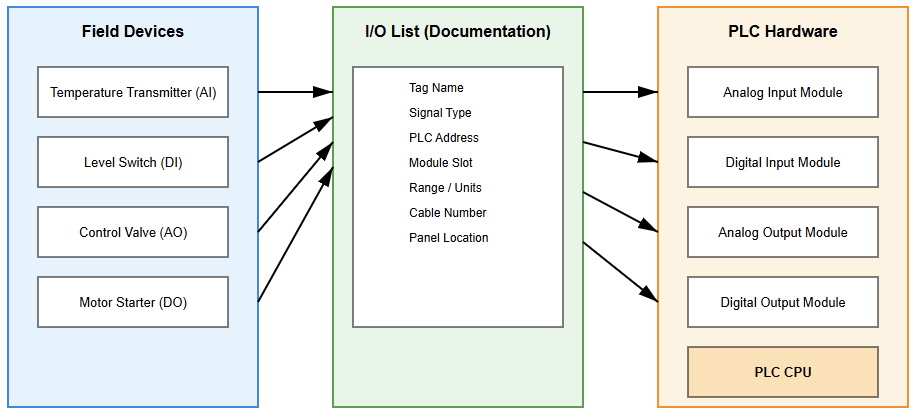
Relationship Between Field Devices, I/O List Documentation, and PLC Hardware Modules
Digital and Analog Classification Within I/O Lists
Digital inputs represent discrete device conditions clearly. Examples include limit switches and motor feedback contacts. These signals require voltage level and contact type documentation.
Digital outputs command solenoids, relays, and indicators. The output current rating must match the actuator consumption precisely. Interposing relays may be specified within documentation notes.
Analog inputs measure continuous variables proportionally over ranges. Typical standards include four to twenty milliampere loops.
Voltage-based signals may span zero to ten volts. Analog outputs drive control valves or variable frequency drives.
Scaling data ensures accurate proportional control performance. Clear classification prevents incorrect module selection during procurement.
It also avoids programming mismatches within controller logic. Balanced allocation of signal types optimizes cost efficiency.
Best Practices for Developing an Effective I/O List
Early collaboration improves documentation completeness significantly. All engineering disciplines should contribute during initial drafting. Standard naming conventions enhance clarity across project teams.
Tag formats should reflect plant area and equipment function. Consistent abbreviations avoid ambiguity during interpretation.
Automated validation tools can detect duplicate addresses quickly. Cross-checking with P and ID diagrams increases accuracy.
Regular revision reviews maintain alignment with design evolution. Structured approval processes ensure responsibility assignment and auditability. Digital database solutions are replacing static spreadsheets increasingly.
A centralized system enables coordinated information updates among involved parties. Ultimately, discipline in documentation determines project success.
An accurate I/O list serves as the engineering backbone. Investing time in preparation yields substantial long-term benefits.
Conclusion
This article studied the structure, purpose, and lifecycle importance of an I/O list within PLC-based automation projects.
It explained how signal inventories support hardware selection, programming accuracy, installation efficiency, and long-term maintenance reliability.
An I/O list systematically documents digital and analog channels. It aligns field instrumentation with controller architecture clearly.
Programming, testing, and troubleshooting depend heavily on accurate signal mapping.
Installation quality improves when documentation eliminates ambiguity. Lifecycle expansion becomes manageable through structured records. Compliance and safety validation also benefit from traceable signal data.
Engineers who prioritize documentation reduce project risk substantially. A well-maintained I/O list ultimately safeguards performance, scalability, and operational continuity across complex industrial automation systems.
FAQs: What is an I/O list, and why does it matter in PLC projects?
What is an I/O list in PLC projects?
It is a structured document listing all controller inputs and outputs.
Why is an I/O list important during design?
It guides hardware selection and prevents underestimating signal quantities.
Does the I/O list support PLC programming?
Yes, it ensures correct addressing and consistent tag naming.
How does it help during commissioning?
It supports systematic loop checks and signal verification.
Should the I/O list be updated after startup?
Yes, as-built updates maintain long-term documentation accuracy.
