Industrial automation systems demand reliability, determinism, and operational safety at every operational level.
Programmable Logic Controllers operate under strict real-time execution constraints in industrial environments.
Unexpected software faults can jeopardize entire production processes. It also endangers the critical assets.
Electrical disturbances and electromagnetic interference may also disrupt normal program execution unexpectedly.
Engineers therefore implement mechanisms that detect abnormal execution states before consequences escalate. One essential mechanism integrated into modern controllers is the watchdog timer.
This internal component continuously supervises the program scan cycle duration and CPU responsiveness.
If execution exceeds configured limits, protective actions activate immediately and predictably.
Such supervision prevents uncontrolled machine behavior and unsafe operating conditions.
It also improves maintainability and diagnostic transparency across industrial facilities. This article reviews fundamental principles, implementation details, configuration strategies, and practical engineering considerations.
Understanding the PLC Scan Cycle
To understand watchdog timers properly, the PLC scan cycle must first be examined carefully. A PLC executes instructions in repetitive, deterministic loops throughout operation.
Each loop typically follows three structured operational phases in sequence. First, input modules update internal memory registers with field device states. Second, the CPU processes the user control program instructions logically.
Third, output modules update field devices according to calculated results. This repetitive execution sequence is known as the scan cycle.
Scan time depends on program size, instruction type, and communication load. Under stable conditions, scan duration remains predictable and consistent.
However, abnormal logic structures can extend processing time unexpectedly. Infinite loops or excessive computation may delay scan completion dangerously.
These abnormal timing conditions require automatic detection and corrective action. The watchdog timer performs this continuous supervisory monitoring function reliably.
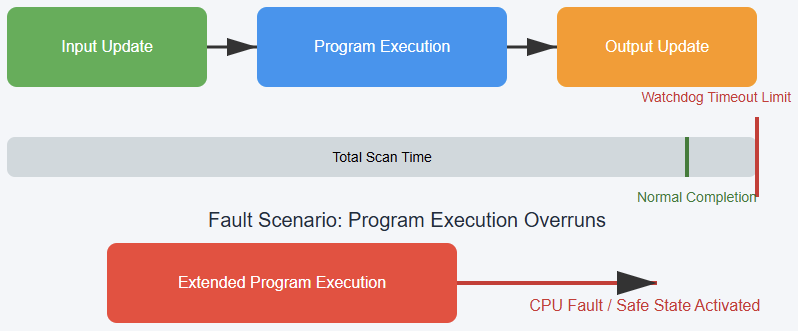
The following figure illustrates the PLC scan cycle sequence and watchdog supervision clearly.
It shows input update, program execution, and output update blocks sequentially. A timing bar represents the total scan duration measurements.
The watchdog timeout limit defines the maximum allowed execution time. When execution overruns this boundary, a CPU fault condition activates.
What Is a Watchdog Timer in PLCs?
A watchdog timer is a supervisory timing mechanism embedded within the PLC architecture. It monitors whether the CPU completes each scan cycle within a predefined time limit.
The timer measures elapsed execution time during program processing continuously. If execution finishes within configured limits, the timer resets automatically. If limits are exceeded, a fault condition is triggered intentionally.
This protective response may halt program execution to prevent unsafe continuation. In many PLC platforms, outputs transition into predefined safe states immediately. A diagnostic fault code is usually generated for troubleshooting purposes.
Maintenance personnel can then analyze logs to determine the root cause systematically. The watchdog therefore acts as a safety sentinel within the control system. Without such supervision, runaway code could cause severe equipment damage.
Hardware and Firmware Implementation
Watchdog timers may be implemented in dedicated hardware circuitry or embedded firmware routines. Hardware watchdogs operate independently of the main processor logic circuitry.
This independence ensures detection even during severe processor malfunction conditions.
Firmware watchdogs, by contrast, integrate closely with the controller operating system.
Both approaches aim to detect unresponsive CPU behavior consistently and deterministically.
In advanced controllers, layered watchdog architectures provide enhanced reliability. One layer supervises the application program scan time specifically.
Another layer monitors the operating system kernel’s responsiveness separately. Such redundancy supports compliance with functional safety standards.
Controllers developed under IEC 61508 incorporate deterministic fault detection principles.
These design requirements strengthen system integrity under abnormal operating scenarios.
Configuring Watchdog Time Parameters
Proper watchdog configuration requires careful engineering judgment and measurement. Setting the timeout value too low can cause nuisance trips frequently. Conversely, setting it excessively high reduces protective effectiveness significantly.
Engineers typically measure worst-case scan time under maximum load conditions. Communication overhead and interrupt routines must be considered during evaluation. Complex arithmetic operations or data logging tasks may increase execution duration.
Many PLC platforms provide diagnostic tools displaying maximum observed scan times. Systems from Siemens include diagnostic buffers and timing statistics for analysis.
Controllers from Rockwell Automation similarly report CPU load and scan metrics. Using these measurements, engineers define safe margins above the expected execution time. Clear documentation of selected thresholds supports future maintenance activities.
Causes of Watchdog Faults
Watchdog faults frequently indicate underlying programming or hardware issues. Infinite loops within ladder logic commonly trigger timeout conditions. Uncontrolled recursion or excessive iteration can exhaust processor resources rapidly.
Heavy communication retries may delay scan completion beyond acceptable limits. Faulty input modules sometimes block data exchange operations unexpectedly. Electrical noise may corrupt memory transactions under harsh industrial conditions.
Firmware anomalies can also result in processor lockups, but rarely. Large data handling routines may overload CPU capacity during peak operations.
Each of these conditions extends execution time beyond configured thresholds. The watchdog timer detects these abnormal durations and initiates a protective response.
Watchdog Response and Safety Considerations
When the watchdog limit is exceeded, predefined safety actions execute immediately. Most PLCs transition into a fault state requiring operator intervention. Outputs typically deenergize to ensure machines enter safe conditions.
Alarm systems may activate to notify operators and supervisors promptly. Human machine interfaces display diagnostic messages for troubleshooting guidance. After corrective actions, controllers usually require a manual reset before restarting.
Automatic restart strategies must undergo careful safety evaluation before implementation. Watchdog timers support functional safety objectives within industrial control systems.
Systems aligned with ISO 13849 require validated timing behavior documentation. Nevertheless, watchdogs do not replace emergency stop circuits or hardware interlocks. They supervise software execution timing rather than mechanical hazard mitigation directly.
Practical Engineering Perspective
From a practical engineering standpoint, watchdog tuning often requires iterative refinement.
During commissioning, engineers monitor scan time fluctuations under realistic operating conditions.
Segregating heavy calculations into periodic tasks can reduce primary scan duration. Structured and modular programming improves determinism and maintainability considerably.
Eliminating unnecessary nested logic enhances performance predictability significantly. In applications involving motor drives or power electronics converters, CPU freezes may cause costly damage.
A properly tuned watchdog provides an essential protective software layer. This layer complements hardware protections such as circuit breakers and interlocks. Thoughtful configuration reflects professional engineering responsibility and foresight.
Conclusion
This article introduced the watchdog timer as a critical supervisory mechanism within PLC systems. It explained how scan cycles determine execution timing and operational predictability.
The discussion described hardware and firmware implementation approaches clearly. Configuration strategies were examined alongside common fault causes systematically.
Functional safety standards provided contextual relevance for industrial environments. Practical engineering considerations highlighted commissioning and maintenance realities effectively.
The limitations and misconceptions regarding watchdog functionality were clarified carefully.
Ultimately, watchdog timers improve system reliability by quickly identifying abnormal execution delays.
Proper configuration balances responsiveness with operational stability requirements. Engineers who understand watchdog principles design safer and more resilient automation systems
FAQs
In a PLC, what is a watchdog timer?
It is a timing system that checks PLC scan or task run and spots execution delays or faults.
PLCs employ watchdog timers for what reasons?
PLCs employ them to guard the system and identifyproblems,s including frozen logic or infinite loops.
How does a watchdog timer work in a PLC?
The PLC routinely refreshes the timer while running normally. If it doesn’t reset it in time, a fault occurs.
When the watchdog timer runs out, what transpires?
Usually, the PLC halts execution, enters a fault condition, and could compel outputs to a secure state.
What typical problems result in watchdog failures?
Hardware interrupts, ineffective code, and infinite loops can increase scan time past the watchdog constraint.
Is the watchdog timer adjustable?
On several PLC systems, watchdog timeouts are customizable to correspond with anticipated scan times.
Does the watchdog timer replace safety devices?
No, a watchdog helps with software security but does not take the place of mandated hardware safety devices like E-STOP circuits.
How is the watchdog timer set?
Usually, it is set based on worst-case scan time plus a margin to prevent pointless false alarms.
Can a watchdog reset the PLC automatically?
Some systems may initiate a reset or safe shutdown upon timeout.
Using a watchdog timer mostly serves what purpose?
By finding errors early and stopping uninvited behavior, it improves system dependability.
