Industrial automation systems demand greater degrees of operating dependability and safety more and more. Complex equipment with considerable mechanical, electrical, and thermal hazards is found in modern manufacturing plants.
Simultaneously, engineers have to safeguard employees, equipment, and general manufacturing continuity.
In dangerous surroundings, normal control methods alone cannot promise enough risk reduction.
Dedicated safety systems are integrated within modern automation architectures to address these risks.
Among these protective technologies, Safety PLCs perform a particularly critical function.
They constantly watch emergency stops, light curtains, interlocks, and other safety devices.
Unlike traditional programmable controllers, they are constructed under rigorous functional safety requirements.
Their architecture ensures predictable responses even during internal faults or component failures.
Understanding their structure and purpose is essential for automation professionals.
This article reviews the concept of Safety PLCs, their architecture, standards compliance, and the fundamental differences that distinguish them from standard PLCs.
Fundamentals of Programmable Logic Controllers
A programmable logic controller, also known as a PLC, manages industrial processes through deterministic logic execution.
It reads input signals from sensors, switches, and transmitters installed in the field. The controller processes these signals using user-defined logic programs.
It then drives outputs such as relays, motor starters, and control valves accordingly. Standard PLCs give operational flexibility, modularity, and dependable real-time performance top priority.
Globally, in energy plants, water treatment, and industry, they are extensively used. Among the major automation vendors are Siemens and Rockwell Automation.
These controllers speak ladder logic, organized text, and function block programming languages. They also integrate communication protocols for distributed control architectures.
However, their primary purpose remains efficient process control rather than certified life protection. When hazardous situations arise, additional safety mechanisms are typically required.
What is a Safety PLC?
A safety PLC is a specialized programmable controller engineered for safety-related functions.
Its main objective is to reduce risk to an acceptable and demonstrable level. The controllers meet established international requirements for functional safety compliance.
IEC 61508 is the primary standard in this domain. Also, another standard is ISO 13849, which is a leading one.
Compliance with these standards ensures systematic design integrity and hardware fault tolerance. Safety PLCs are assigned specific Safety Integrity Level or Performance Level ratings.
These ratings quantify the probability of dangerous failure during operation. Internally, Safety PLCs incorporate redundant processing paths and comprehensive diagnostics. If an abnormal condition is detected, the controller transitions to a defined safe state.
This safe state typically de-energizes outputs controlling hazardous motion. Safety PLCs, therefore, act as central elements within modern safety instrumented systems.
Architectural Differences Between Safety and Standard PLCs
The internal architecture represents one of the most important distinctions between controller types. Standard PLCs commonly use single-processor designs without mandatory redundancy.
A single hardware failure may therefore compromise control performance. Safety PLCs typically employ dual-channel or diverse processor configurations. These processors continuously compare execution results during every scan cycle.
Any discrepancy between channels immediately triggers a protective shutdown response. Memory systems within Safety PLCs include error detection and correction mechanisms.
Cyclic redundancy checks validate both firmware and user programs regularly. Standard PLCs rarely implement such extensive self-verification procedures. Safety controllers also monitor input and output circuitry integrity.
They detect short circuits, cross faults, and unexpected signal discrepancies. This architectural rigor significantly reduces the probability of dangerous, undetected failures.

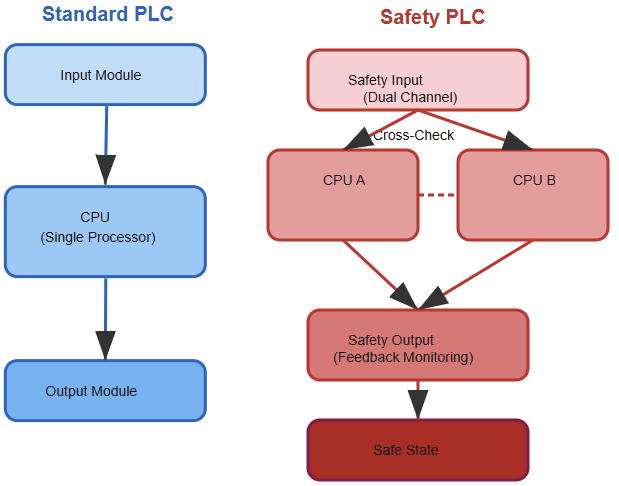
Architectural Comparison Between Standard PLC and Safety PLC
Programming Environment and Certification Constraints
Programming practices also differ substantially between safety and conventional controllers.
Safety PLCs require certified engineering environments provided by manufacturers. Companies such as Schneider Electric supply dedicated safety configuration platforms.
These environments restrict developers to pre-validated safety function blocks. Each function block undergoes rigorous verification and validation testing before release. User-defined code flexibility is intentionally limited to minimize systematic design errors.
In contrast, standard PLC platforms allow extensive customization and algorithm development. While flexible, this freedom introduces potential risk if applied to safety functions.
Safety applications also demand strict documentation and change management procedures.
Every modification must be traceable for audit and compliance purposes. Certification bodies require documented evidence of design integrity throughout the lifecycle.
Safety Integrity Levels and Performance Metrics
Risk reduction in functional safety is demonstrated through defined and verifiable performance parameters.
The well-known SIL one to four are the safety integrity levels within the IEC 61508 standard. Higher SIL classifications correspond to lower probabilities of dangerous failure.
Machinery safety applications often reference performance levels defined by ISO 13849. These performance levels range from PL a through PL e. The selection of a Safety PLC depends on the required integrity rating.
Performance-based metrics are fundamental to achieving validated risk reduction in functional safety systems.
The resulting analysis defines the necessary risk reduction factor. Standard PLCs lack certified SIL or PL ratings for safety functions.
Consequently, they cannot independently satisfy high-integrity safety requirements. Safety PLCs integrate these certified capabilities within a unified control platform.
Diagnostics, Fault Handling, and Fail-Safe Behavior
Diagnostic coverage strongly differentiates Safety PLCs from conventional controllers. Safety PLCs continuously perform internal self-tests during operation. Watchdog mechanisms supervise execution timing and processor consistency.
Memory areas are checked for corruption or unexpected modification. Input modules verify redundant channel agreement from safety devices. Output modules often monitor feedback from external contactors.
When any inconsistency is detected, outputs transition to a safe state. Standard PLCs typically log faults while maintaining process continuity.
Their design philosophy emphasizes productivity rather than maximum hazard mitigation.
Safety PLCs prioritize human protection above operational availability. Fail-safe principles ensure that loss of power results in de-energized outputs. This predictable behavior forms the foundation of functional safety strategies.
Communication and Network Considerations
Modern automation systems rely heavily on networked communication infrastructures. Standard PLCs exchange data through conventional industrial Ethernet protocols. Safety PLCs implement additional certified safety communication layers.
These layers incorporate redundancy, time stamping, and integrity verification mechanisms.
Data packets include checksums and sequence validation procedures. Transmission errors or unexpected delays trigger immediate protective responses.
Deterministic fault detection timing is required for certification compliance. Network topology changes may invalidate validated safety configurations. Therefore, configuration management is strictly controlled within safety systems.
Safety communication protocols ensure that distributed safety devices operate cohesively. This integration supports complex machinery with multiple protective zones.
Hardware Design and Physical Characteristics
Safety PLC hardware modules differ physically from standard automation components. Safety input modules support dual-channel wiring from protective devices. They detect cross faults and short circuits between channels reliably.
Output modules frequently incorporate force-guided relay contacts. Some systems use redundant solid-state switching elements for reliability. Redundant power supply options further enhance operational robustness.
Manufacturers clearly label and color-code safety components. This visual distinction reduces installation and maintenance errors significantly. Standard PLC modules prioritize cost efficiency and scalability.
They generally lack mandatory redundancy and advanced diagnostic circuitry. Safety hardware instead emphasizes reliability and predictable fail-safe behavior. These physical differences reflect their fundamentally distinct design objectives.
Application Examples Across Industries
Safety PLCs are extensively used within automotive manufacturing facilities. Robotic cells require immediate shutdown when protective barriers are breached. Safety PLCs coordinate emergency stops and safe torque-off functions.
Process industries also deploy safety instrumented systems for hazard mitigation. Companies such as Honeywell provide integrated safety platforms for refineries. Oil and gas installations often require high SIL-rated controllers.
Boiler management systems rely on certified safety logic for burner protection. Packaging machinery integrates light curtains with safety PLC inputs. Conveyor systems may incorporate safe speed-monitoring features.
These diverse applications demonstrate the practical importance of safety controllers. In each case, protecting human life remains the primary objective.
Cost, Integration, and System Strategy
Safety PLCs typically involve higher acquisition and engineering costs. Certification, redundancy, and diagnostics increase hardware complexity significantly. Engineering documentation and validation activities demand specialized expertise.
Nevertheless, financial investment should be assessed in relation to foreseeable accident risks.
Regulatory frameworks frequently require certified safety solutions for hazardous machinery. Insurance and liability considerations further justify proper safety investments.
Standard PLCs remain appropriate for non-critical control functions. Many installations adopt a combined architectural strategy.
A standard PLC manages general process automation tasks. A separate Safety PLC independently supervises hazardous operations. This separation enhances clarity, compliance, and overall system integrity.
Conclusion
This article introduced the concept of Safety PLCs and explained how they differ from standard programmable logic controllers in architecture, certification, diagnostics, and application.
Safety PLCs are specialized controllers dedicated to functional safety applications. It explained how they differ fundamentally from standard programmable logic controllers. Architectural redundancy and extensive diagnostics distinguish their internal design.
Certified programming environments restrict development to validated safety functions. Quantified integrity levels provide measurable and auditable risk reduction. Communication layers include deterministic fault detection mechanisms for compliance.
Hardware components emphasize fail-safe behavior under fault conditions. Although more expensive, Safety PLCs significantly reduce operational hazards.
Appropriate system selection depends on documented risk evaluation and governing standards. Understanding these differences enables engineers to design safer industrial systems.
FAQs
What is a safety PLC?
A programmable logic controller intended to carry out safety-related control tasks is known as a safety PLC.
What distinguishes a safety PLC from a conventional PLC?
Safety. Unlike regular PLCs, PLCs include fail-safe systems, redundancy, and ongoing self-diagnostics.
What causes safety PLCs to be employed in industrial automation?
To safeguard people and equipment, they guarantee predictable and safe machine shutdowns brought on by hazardous conditions.
Can a typical PLC handle safety tasks?
Conventional PLCs are not approved for safety functions and make no promise of secure conduct upon failure.
What style of construction do safety PLCs employ?
To find defects and force secure states, they often employ dual-channel or redundant processing.
