When it comes to protecting life and property, fire alarm systems play a critical role. They are designed to detect fire conditions early.
They also provide clear warnings to occupants. A well-designed system reduces panic and confusion. It also supports fast evacuation.
Fire alarm systems are used in public buildings, factories, offices, and homes. Each environment has different risks.
Because of this, several types of fire alarm systems exist. Each type has its own purpose and, without forgetting, its own structure.
Understanding these systems helps engineers, technicians, and building owners. It also supports correct selection and maintenance.
This article reviews the main categories of fire alarm systems, their working principles, and typical applications.
What Is a Fire Alarm System?
A fire alarm system is an integrated safety system. It detects fire-related events. These events include smoke, heat, or flame.
The system then triggers audible and visual alarms. Some systems also notify emergency services.
A basic system includes detectors, a control panel, and notification devices. Power supplies and wiring are also required.
Modern systems may include communication modules. They may also connect to building management systems.
The next figure illustrates a basic block diagram of a fire alarm system showing detectors, a control panel, and alarms.

Classification of Fire Alarm Systems
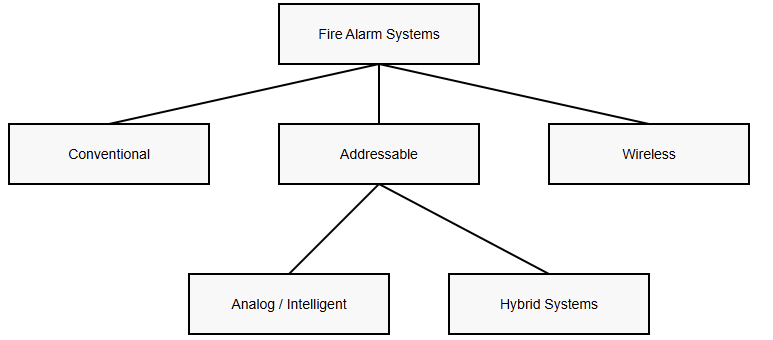
Fire alarm systems are classified by design and operation. The most common classification is by control method.
This includes conventional, addressable, and analog systems. Another classification is by application.
Examples include manual, automatic, and hybrid systems. Wireless and smart systems are also gaining popularity. Each type is explained in the following sections.
Conventional Fire Alarm Systems
Conventional fire alarm systems are the simplest type. They divide a building into zones. Each zone has multiple detectors connected. When a detector activates, the control panel shows the zone in alarm.
The exact detector is not identified. This limits fault-finding. These systems are easy to install. They are also low in cost. They are suitable for small buildings. Examples include small offices and shops.
Components of Conventional Systems
A conventional system uses basic components. These include smoke detectors and heat detectors. Manual call points are also used. Sounds and alarm bells serve as warnings.
The control panel monitors zone circuits. End-of-line resistors are required. Wiring is usually radial. Faults affect the whole zone. Maintenance is simple but less precise.
Advantages of Conventional Systems
Conventional systems are affordable. They use simple technology. Installation does not require complex programming. Spare parts are widely available.
Training requirements are minimal. These systems are reliable in small applications. They are also easy to understand for maintenance staff.
Limitations of Conventional Systems
Conventional systems have several limitations. They cannot identify individual devices. Large buildings require many zones.
This increases wiring complexity. Fault isolation is difficult. System expansion is limited. These systems are not ideal for high-risk sites.
Addressable Fire Alarm Systems
Addressable fire alarm systems are more advanced. Each device has a unique address. The control panel identifies the exact device in alarm.
This improves response time. These systems are suitable for medium and large buildings. Examples include hospitals and hotels. Wiring is usually loop-based. This improves reliability.
Components of Addressable Systems
Addressable systems use intelligent devices. These include addressable smoke detectors. Addressable heat detectors are also common.
Manual call points have unique IDs. Sounders may also be addressable. The control panel uses software logic. Loop isolators improve fault tolerance.
Advantages of Addressable Systems
Addressable systems provide precise information. They reduce response time. Maintenance is easier due to device identification.
Wiring is reduced compared to conventional systems. System expansion is flexible. Advanced features can be added. These include cause-and-effect programming.
Limitations of Addressable Systems
Addressable systems are more expensive. They require trained installers. Programming is more complex. Spare parts may be brand-specific. Initial design requires careful planning.
Analog Fire Alarm Systems
Analog fire alarm systems are often confused with addressable systems. They are sometimes called intelligent systems.
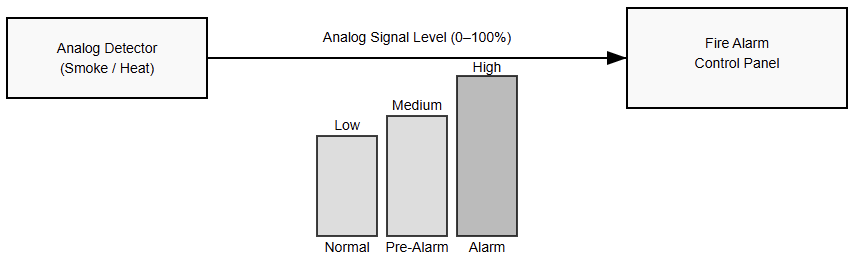
Each detector sends analog values to the panel. These values represent smoke or heat levels. The control panel makes the alarm decision. Sensitivity can be adjusted by software.
Features of Analog Systems
Analog systems provide early warning. They support pre-alarm conditions. False alarms can be reduced.
Detectors adapt to environmental changes. Maintenance alerts are provided. System performance is improved over time.
Manual Fire Alarm Systems
Manual fire alarm systems rely on human action. They use manual call points only. Occupants activate the alarm when fire is seen.
These systems are simple. They are used in small or low-risk areas. They are often combined with automatic systems.
Automatic Fire Alarm Systems
Automatic fire alarm systems use detectors. These detectors sense fire conditions. Smoke detectors are the most common.
Heat and flame detectors are also used. Automatic systems provide faster detection. They are essential in most buildings. Human intervention is not required.
Smoke Detection Systems
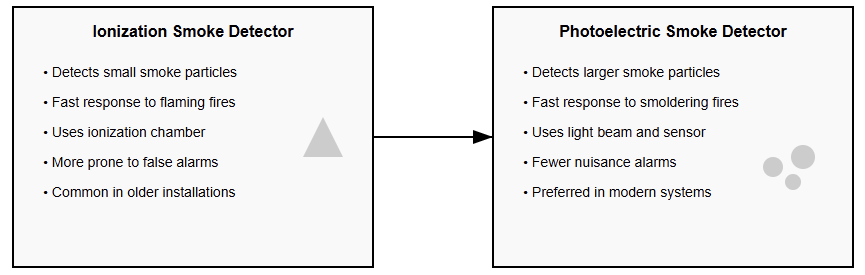
Smoke detection systems detect smoke particles. Ionization detectors respond quickly to flames.
Photoelectric detectors respond to smoldering fires. Each type has specific applications. Proper selection reduces false alarms.
Heat Detection Systems
Heat detectors respond to temperature changes. Fixed temperature detectors trigger at set limits. Rate-of-rise detectors respond to rapid increases.
Heat detectors are robust, and they are useful in dusty environments. Examples include kitchens and workshops.
Flame Detection Systems
Flame detectors work by sensing ultraviolet radiation or infrared. They respond very quickly.
They are used in high-risk areas. Examples include fuel storage and refineries. These systems are specialized and costly.
Wireless Fire Alarm Systems
Wireless fire alarm systems use radio communication. They reduce the need for cabling. Installation time is shorter.
These systems are ideal for existing buildings. Battery management is critical. Signal integrity must be monitored.
Smart and Networked Fire Alarm Systems
Smart fire alarm systems integrate with other systems. They may connect to HVAC and access control. Data is shared over networks.
Remote monitoring is possible. Cloud platforms may be used. These systems support predictive maintenance.
Hybrid Fire Alarm Systems
Hybrid systems combine different technologies. Wired and wireless devices may coexist. Manual and automatic detection may be used together. Hybrid designs improve flexibility. They are common in retrofit projects.
Application-Based System Selection
System selection depends on risk and building size. Residential buildings need simple systems. Commercial buildings require addressable systems.
Industrial sites may need flame detection. Local codes must be followed. Risk assessment is essential.
Standards and Regulations
Fire alarm systems must meet standards. Common standards include NFPA and EN codes. Local regulations also apply.
Compliance ensures safety and legality. Documentation is required, and without forgetting, regular inspections are mandatory.
Maintenance and Testing
Reliability is always ensured through the performance of regular maintenance. Detectors must be cleaned and tested. Batteries must be checked.
Control panels should be inspected. Fault logs should be reviewed. Maintenance reduces false alarms and failures.
Key takeaways: What is a fire alarm system?
This article details the major types of fire alarm systems, their features, advantages, and limitations.
Fire alarm systems are essential safety systems. Different types serve different needs. Conventional systems suit small buildings.
Addressable and analog systems suit larger sites. Manual and automatic systems support detection and warning.
Wireless and smart systems offer flexibility. Proper selection improves safety and compliance.
Regular maintenance is critical for performance. Understanding these systems helps engineers and building owners. It also supports safer environments for all occupants.
FAQ: What Is a Fire Alarm System?
What types of fire alarm systems are available?
The most common types are hybrid, conventional, wireless, and addressable systems.
What is a wireless fire alarm system?
Instead of using cables to connect the devices, radio signals are used.
What is a conventional fire alarm system?
It groups detectors into zones and only shows which zone has a fire.
What is an addressable fire alarm system?
Each device has its own ID, so the exact alarm location is shown.
What is an analog fire alarm system?
The detector sends signal levels, and the panel decides when to trigger an alarm.
