Programming machines to do what you want, specifically with PLCs (programmable logic controllers), is essential in the industrial automation world. For a long time, the standard way to do these tasks meant using visual, “drag-and-drop” languages like Ladder Logic or Function Block Diagrams.
But today’s automation needs a lot more horsepower for complex decision-making and handling mountains of data. Structured Text (ST) is suitable for this particular task. If offers a robust alternative that looks much more like standard computer code.
It’s all part of the industry-wide rulebook called the IEC 61131-3 standard. ST looks much like conventional programming languages such as Pascal or C. This form of programming makes it more familiar to computer science professionals.
This article explores the fundamentals, syntax, benefits, and applications of Structured Text programming. It highlights why it is rapidly becoming the preferred language for complex industrial control.
What is Structured Text (ST)?
International standard IEC 61131-3 defines five languages for PLS programming. The most powerful of these five is Structured Text, which is one of them. The standard aims to unify PLC programming across different hardware manufacturers.
ST is a high-level, textual language. It uses typical programming constructs. One example of this statement includes the IF-THEN-ELSE statements.
Furthermore, FOR loops are widely used. In addition, the other two common ones are WHILE loops and CASE statements. This syntax allows for complex control algorithms and mathematical calculations.
ST is highly readable once you understand the basic syntax. It is often favored by those with backgrounds in software engineering or computer science. It offers more flexibility than purely graphical languages in certain situations.
International standard IEC 61131-3 defines five languages for PLC programming; Structured Text is one of them.
Basic Syntax and Structure
ST syntax is straightforward, such as statement must end with a semicolon (;). Variables are declared first, typically in a variable declaration table. The main logic then uses these variables.
Assignment operations use the combination of a colon and an equal symbol:=. In this case, assignment of a value of 120 to a variable Furn_Temp; , the code is written as, Furn_Temp=120 ;
Comments are important for readability. They start with (* and end with *). For example, (*Comment goes here*. Boolean logic uses standard words like AND . Also, OR is commonly used.
To do arithmetic operations, use + In addition, – is also used for arithmetic. The language also supports comparison operators like >, <, =, and <>.
Control Flow and Decision Making
ST excels at handling complex control flow. Decision-making is managed with IF statements. You can chain these with ELSIF and ELSE clauses.
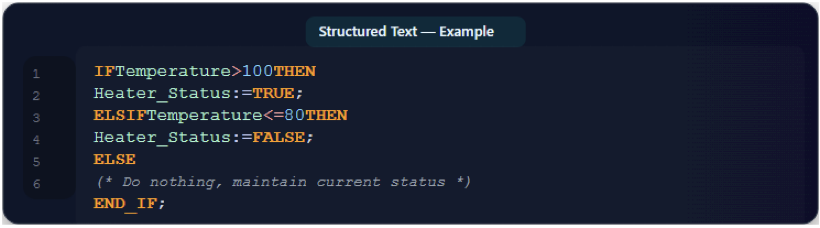
This structure clearly defines logic paths. For multi-way branching, the CASE statement is used. It checks a single expression against several possible values.
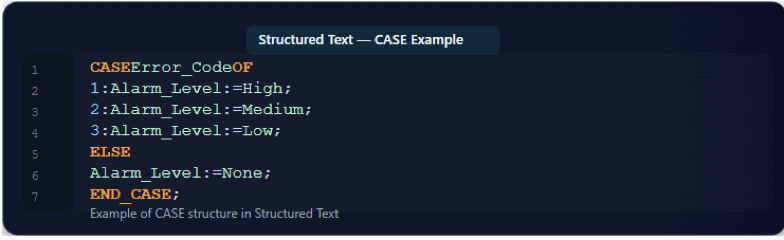
These constructs make ST ideal for programming complex decision matrices common in automation. They are much cleaner than trying to represent the same logic in many rungs of ladder logic.
Loops and Iteration
Loops are one of the best tools you get with Structured Text (ST). They let your program repeat a specific job until a certain condition is finally hit.
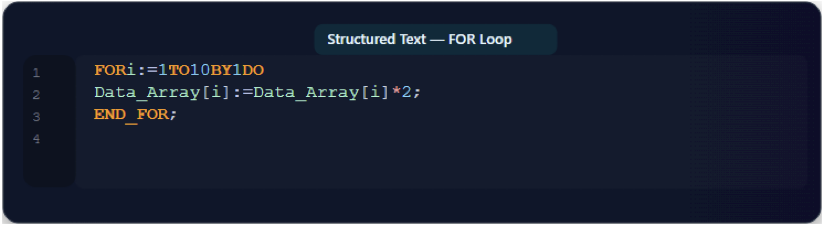
Think of the FOR loop as your reliable counter. You use it when you already know exactly how many times a task needs to happen:
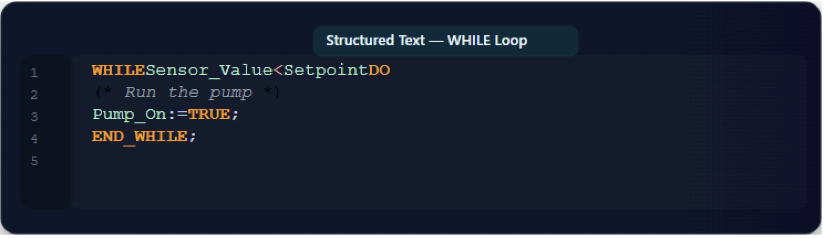
For the equivalency of a continuous monitoring system, the WHILE loop is the best choice. It keeps running a block of code only as long as a specific condition stays true (it checks the condition first):
The REPEAT loop and WHILE loop work similarly, but with one key difference: it check the condition after running the code. This guarantees the action happens at least one time:
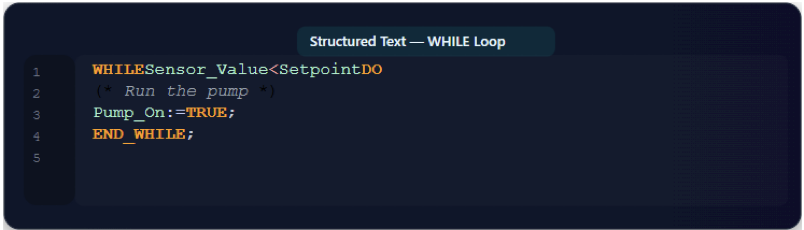
When it comes to handling and processing large amounts of data during a program, loops are the best choice. These data could be like arrays or used to tackle complicated math problems. Trying to do these tasks efficiently using traditional ladder logic is much harder.
Functions and Function Blocks (FBs)
ST works seamlessly with functions and function blocks (FBs). FBs are reusable code components that maintain internal state. You can write the internal logic of an FB using Structured Text.
This allows programmers to create custom, complex control elements. For instance, you could write a PID controller as a function block using ST. Code usability through these blocks is highly promoted by the IEC 61131-3 standard.
Programmers can create complex logic once and apply it to numerous projects or machines. This saves significant development time and improves code reliability.
Advantages of Structured Text Programming
Structured Text offers several key advantages. It is highly efficient for mathematical and data-handling tasks. Complex algorithms are much easier to express in ST than in graphical languages.
The code is also very compact. An ST program can achieve in a few lines what might take dozens of rungs in ladder logic. ST also allows for greater expressiveness and flexibility.
Experienced programmers can implement advanced control strategies quickly. Many university engineering programs teach text-based programming, making ST familiar to new graduates entering the industry. It facilitates better documentation and structured code organization.
Disadvantages and Considerations
The primary disadvantage is readability for non-programmers. Factory maintenance technicians are often very familiar with ladder logic.
Ladder logic visually mimics electrical relay logic, making it intuitive for electricians. ST requires training in traditional programming concepts. Troubleshooting running systems can sometimes be harder in ST.
While debuggers exist, the “flow” of logic is less visually apparent than watching power flow in a ladder diagram. For very simple “start/stop” logic, ladder logic is often faster to write and easier to maintain by a general maintenance team.
Best Practices in ST Programming
Writing excellent Structured Text (ST) code takes a little discipline and effort. First off, consistency is everything. Use clear, descriptive names for your variables; think Motor_Run-Time, instead of something confusing like MRT.
Also, one must be generous with comments. This means, instead of explaining what the code is doing, explain why you decided to do it that way.
The code must be logically structured. The functions and function blocks must be used. For instance, the use of building blocks to break a huge problem into smaller ones. So, this gives bite-sized pieces that are easier to manage.
Try to avoid nesting loops or IF statements too deeply. This will just make the code understanding almost impossible in the future. Smart decision is to stick with the main industry standard IEC 61131-3.
It helps ensure your code can easily move between different PLC brands. The common and most famous ones are Siemens, Rockwell, and Beckhoff without getting any code readability problems.
Conclusion
This article walks through the basics of Structured Text, how it works, why it’s useful, and where it’s used. It showed that Structured Text is a strong, modern language for industrial automation.
It gives you the flexibility you need for complex control tasks, data handling, and advanced logic. Ladder Logic is still great for simple jobs and easy for technicians to understand.
But Structured Text offers big advantages for engineers who prefer a more software-style approach, especially in tougher applications. In the end, the “best” language depends on how complex the project is, the skills of your team, and how the system will be maintained.
As automation continues to grow and become more advanced, Structured Text will play an even bigger role in the future of PLC programming.
FAQ: Structured Text Programming
What is Structured Text?
A high-level text programming language for PLCs defined in IEC 61131-3.
What languages are in IEC 61131-3?
ST, Ladder (LD), Function Block Diagram (FBD), Sequential Function Chart (SFC), and Instruction List (IL).
What is ST used for?
Complex logic, math, data handling, loops, and algorithms.
What does ST look like?
Similar to Pascal/C-style logic with IF, CASE, FOR, WHILE, functions, and arrays.
Why choose ST over Ladder?
More compact, cleaner for complex code, and better for algorithms and data processing.
Can you mix ST with Ladder and FBD?
Yes, IEC 61131-3 languages work together in the same project.
Is ST portable across PLC brands?
Mostly yes, since it is standardized.
Is ST beginner-friendly?
Easier for people with programming experience; harder for those used only to Ladder.
When is ST not ideal?
For simple interlocks, relay logic, or when technicians need easy visual troubleshooting.
What industries use ST?
Manufacturing, process control, robotics, motion control, and utilities.
What are ST’s main features?
Functions, function blocks, loops, arrays, timers, and math operations.
Can ST handle advanced calculations?
Yes, it’s ideal for heavy logic and computation.
