When it comes to the world of compact programmable logic controllers (PLCs), one of the most important of this kind is Siemens SIMATIC S7-1200. It was introduced as a modern successor to the highly successful S7-200 range.
The 1200 series is built for those smaller to mid-sized automation jobs. It strikes a fantastic balance, giving you solid performance and flexibility without breaking the bank. A giant bonus is how smoothly it works with Siemens’ TIA Portal software.
That hookup creates one clean workspace where you handle everything, setting things up, programming, and getting it all running.
This review is all about diving into those features and benefits. It explains exactly why the S7-1200 remains a worldwide favorite among engineers and technicians everywhere.
Core Features of the S7-1200
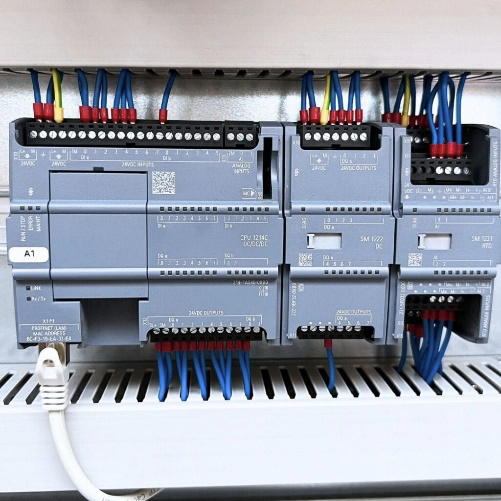
The S7-1200 is a modular PLC system since it offers a range of CPUs with varying performance levels.
The main processing units (CPUs) come in a few different physical sizes. Common example is the model CPU 121C. Likewise, another variant is CPU 1214C, to mention a few.
They all share common base features. These include integrated PROFINET I/O (Input/Output).
They also have onboard digital and analog I/O points. This built-in I/O reduces the need for immediate expansion modules.
Memory size is a key differentiator between models. More advanced models offer larger work memory and load memory.
The extra space allows for more complex programs and more data logging. Most CPUs also include integrated web servers.
These web servers allow for basic monitoring and diagnostics via a standard web browser. This enhances remote accessibility and maintenance capabilities.
Modularity and Expansion
Modularity is a major strength of the S7-1200 platform. The base CPUs provide flexibility for future growth.
Expansion is handled through different module types. Signal Boards (SBs) plug directly onto the front of the CPU.
They offer a quick, low-cost way to add a few extra digital or analog I/O points without increasing the PLC footprint significantly. Signal Modules (SMs) snap onto the right side of the CPU rack.
They provide substantial I/O expansion. Communication Modules (CMs) are also added to the side for extra network interfaces.
You can add up to eight additional signal modules to the larger, higher-end CPUs, like the 1214C model and those above it.
This smart modular setup gives you the opportunity to build personal hardware precisely for what your project needs.

Communication Capabilities
The S7-1200 CPUs come standard with one or two integrated PROFINET ports. PROFINET is Siemens’ industrial Ethernet standard. It uses standard Ethernet physical layers.
It allows for easy communication between the PLC, HMI panels, drives, and other field devices. The built-in switch in the dual-port models (1215C, 1217C) makes it easier to connect.
Apart from PROFINET, the S7-1200 supports many other communication protocols. It can be a Modbus TCP Master or Slave. Moreover, it is also capable of supporting Modbus RTU using a specialized Communication Module.
With the right modules, it can also support additional protocols like GPRS, AS-i, and OPC UA, depending on specific firmware versions.
The S7-1200’s connectivity enables it to function as a versatile hub for integration into a variety of plant infrastructures.
Programming Environment: TIA Portal
You can program the S7-1200 using Siemens’ big software suite called the Totally Integrated Automation Portal (TIA Portal).
This platform is basically the nerve center for all modern Siemens automation gear, bringing absolutely everything into one tidy workspace.
It unifies PLC programming (STEP 7 Basic or Professional) and HMI development (WinCC Basic or Comfort).
This integration is a huge advantage. It has the ability to provide a consistent user interface and shared data management across different hardware components.
Ladder logic (LAD), function block diagrams (FBD), and structured control languages (SCL) are the supported programming languages. The latter is a Pascal-like text language. The software provides robust simulation tools (PLCSIM).
It also includes powerful diagnostic features. These features streamline the development, testing, and troubleshooting process significantly compared to older software platforms like STEP 7 Micro/WIN.
Integrated Technology Functions
Siemens has packed significant technology functions into the S7-1200 firmware. It is capable of much more than basic logic control. It offers built-in motion control capabilities.
This feature includes controlling speed and position for up to 4 axes (depending on the CPU model). It uses the PLCopen standard function blocks. This functionality makes configuration and programming motion tasks straightforward.
The system also includes integrated Proportional Integral Derivative (PID) controllers. These are easy to configure and use for process control loops (e.g., temperature or flow control).
The software provides tuning interfaces and diagnostic screens for these functions. Other features include high-speed counter inputs (HSC) for precise counting tasks and pulse generators (PTO) for basic stepper or servo control.
Cybersecurity Features
(PID) As we are in the IIoT-connected world, cybersecurity is critical. The S7-1200 incorporates robust security features. It offers multi-level password protection for the CPU.
It supports intellectual property protection for function blocks (know-how protection). This stops unauthorized viewing or modification of proprietary code. The system also includes protection against unauthorized access from external networks.
Access Control Lists (ACLs) have the total power to restrict which devices can communicate with the PLC.
These built-in measures help protect automation systems from cyber threats. They help maintain system integrity and operational safety.
Real-World Applications
The S7-1200 is a key choice when it comes to small to medium applications. The goal of these kinds of applications is space, cost, and performance balance.
It is commonly used in packaging machines. It is found in material handling systems, such as conveyors.
It is also suitable for building automation tasks (HVAC control). Other applications include simple process control in water/wastewater management and general machine control in manufacturing.
Its compact size and robust feature set make it a versatile choice. It can also handle basic logic and sophisticated motion control with equal ease within its capacity limits.
Advantages and Disadvantages
The S7-1200 offers strong advantages and a few disadvantages. The tight integration with TIA Portal is a major Pro.
The robust PROFINET communication capability is excellent. The modular, scalable design allows for flexible system designs.
Integrated technology functions like motion control add significant value without extra hardware.
The system is reliable and backed by Siemens’ global support. The primary con is the reliance on the TIA Portal software suite itself.
The software has a learning curve and can be expensive for hobbyists. The S7-1200 also has limits on I/O count and network performance compared to higher-end Siemens models like the S7-1500. It is a compact controller and not suitable for huge, plant-wide automation systems.
Conclusion
This article addressed Siemens S7-1200. It explained the core feature, modularity, communication capability, and pros and cons.
From the afore-seen, we can say that the Siemens S7-1200 is, simply put, a fantastic little PLC. It provides a powerful, up-to-date answer for small to mid-sized automation challenges.
Where it really shines is in its ability to be customized (modularity), how well it talks to other devices (connectivity), and how perfectly it plugs into that TIA Portal software environment.
It really plays a huge part in getting outstanding performance and paying a fair price. For any engineer hunting for a reliable, future-proof platform that can tackle all sorts of industrial jobs, the S7-1200 is easily one of the best options out there.
It’s a true workhorse built for today’s modern control systems.
FAQ: Siemens S7-1200
What is the S7-1200 used for?
This compact PLC is designed for small- and mid-scale automation tasks.
Is it easy to program?
Yes. It uses TIA Portal, which has a simple, unified interface.
What programming languages does it support?
LAD, FBD, and SCL.
Does it support Ethernet communication?
Yes. All CPUs include built-in PROFINET.
Can the S7-1200 be expanded?
Yes. You can add signal modules, signal boards, and communication modules.
Is it suitable for beginners?
Yes. Clear documentation and user-friendly software make it beginner-friendly.
What are the main advantages?
Compact size, modular design, good performance, and easy integration.
Does it support Modbus?
Yes. Modbus TCP or RTU can be configured.
Are safety versions available?
Yes. “F” CPUs provide basic functional safety features.
What are its limitations?
It is not suitable for large, high-speed, or high-memory applications.
How many modules can it handle?
Larger CPUs can accommodate up to eight signal modules.
Is it suitable for motion control?
Yes, basic motion is supported; however, for advanced tasks, the S7-1500 is required.
Does it have excellent diagnostics?
Yes. The built-in diagnostics in the TIA Portal simplify the troubleshooting process.
Is it reliable?
Yes. It is widely used in the industry and is known for its stable operation.
Can it work with Siemens HMIs?
Absolutely. It integrates seamlessly with WinCC HMIs.
