Just like any complex system, working almost 24 hours a day without going OFF. Electrical power systems require dependable protection. This protection must be against faults and abnormal conditions.
There is a vital safety device within power distribution networks that is charged with this. This device, called a circuit breaker, serves as. Its main function is to interrupt the current automatically during an abnormal condition. Such as overloads and short circuits. It also deals with equipment failures.
Hence, for professional personnel such as engineers, understanding circuit breaker parts is a must. Not only for engineers but also for technicians. Each internal component contributes to safe detection and rapid fault interruption.
Modern breakers integrate mechanical assemblies with thermal, magnetic, and electronic elements. Damage to equipment is minimized by their coordinated action. This results in a reduction of operational downtime.
This knowledge supports proper selection, maintenance, and troubleshooting of breakers.
Fundamental components remain similar despite variations in ratings and applications. This article reviews the main components, functions, and operation of circuit breakers.
Fixed and Moving Contacts
Contacts form the primary current-carrying path within a circuit breaker. The fixed contact remains stationary and connects directly to incoming conductors. The moving contact travels during opening and closing operations.
Together, both contacts ensure low resistance conduction during normal operation. Contact materials are selected for conductivity, arc resistance, and mechanical durability.
Silver alloys are commonly used to reduce heating and contact erosion. When a fault occurs, contacts separate rapidly to interrupt current flow.
Precise contact alignment is essential for consistent electrical performance. Contact wear over time influences breaker lifespan and maintenance intervals.
Arc Chute or Arc Extinguisher
When contacts separate, an electrical arc forms between conductive surfaces. The arc chute controls, cools, and extinguishes this high-energy arc. It consists of metallic splitter plates arranged within an insulated enclosure.
These plates divide the arc into smaller segments, reducing the temperature rapidly. Magnetic forces often drive the arc into the chute region. Efficient arc extinction protects contacts from severe thermal damage.
Arc chutes are critical in medium and high-current circuit breakers. In addition, arc movement and splitting are important inside chute plates.
Different breaker types use air, oil, vacuum, or gas arc quenching. Proper arc management ensures safe interruption without external flash hazards.
Operating Mechanism
The operating mechanism provides mechanical energy for contact movement. It includes springs, levers, latches, and mechanical linkages. Energy is usually stored in springs during breaker closing operations.
During tripping, stored energy is released rapidly to separate contacts. This mechanism ensures opening speed remains independent of operator action. Manual handles or motor drives may charge the operating springs.
The reliability of the mechanism directly affects breaker tripping performance. Hence, as mentioned, spring has a charged and discharged mechanism position.
Lubrication and periodic inspection maintain smooth mechanical operation. Mechanical failures often cause delayed tripping or incomplete contact separation.
Trip Unit
The trip unit senses abnormal electrical conditions within the circuit. It determines when the breaker must open to protect equipment. Trip units may be thermal, magnetic, electronic, or microprocessor-based.
Thermal elements respond to prolonged overload conditions through heating effects. Magnetic elements respond instantly to high magnitude short circuits. Electronic trip units provide adjustable protection and precise fault discrimination.
They often measure current using current transformers or sensors. On the other hand, Modern units support communication, monitoring, and event recording features. Accurate trip units significantly enhance overall system protection coordination.
Bimetallic Strip
The bimetallic strip is central to thermal overload protection. It consists of two bonded metals with different expansion coefficients.
Under overload current, heating causes the strip to bend gradually. This bending action eventually triggers the trip mechanism.
Response time depends on current magnitude and ambient temperature. Bimetal strips provide inverse time overload protection characteristics. They closely mimic the thermal behavior of protected conductors and motors.
Finally, the bimetal deformation under rising temperature can be avoided. Calibration ensures accurate tripping within standardized time-current curves. Though simple, bimetal elements remain widely used for reliability.
Magnetic Coil or Solenoid
Magnetic coils provide instantaneous protection against short circuit faults. High fault current generates strong magnetic fields within the solenoid. This magnetic force pulls a plunger, actuating the trip mechanism.
Response occurs within milliseconds, limiting fault energy significantly. Magnetic tripping operates independently from thermal overload elements. It protects conductors from severe electromechanical stress.
Coil design determines pickup current and tripping sensitivity. Hence, we all know the solenoid action during short circuit events.
Magnetic elements ensure rapid disconnection under extreme fault conditions. Their simplicity contributes to dependable high-speed operation.
Insulating Case or Housing
The housing encloses and supports all internal circuit breaker components. It provides electrical insulation and mechanical protection from the environment. Materials include molded thermoset plastics or reinforced insulating composites.
The case withstands high temperatures and internal arc pressures. It also ensures user safety during breaker operation and maintenance.
Internal partitions guide arc gases away from sensitive components. Proper enclosure design prevents flashover between live parts.
The figure in the last section shows a sectional view of the breaker housing. Ingress protection ratings define resistance against dust and moisture. Robust housings contribute significantly to breaker operational safety.
Terminals and Connectors
Terminals provide an electrical connection between the breaker and external conductors. They must carry rated current without excessive heating or losses.
Designs include screw, clamp, or bolted terminal arrangements. Good contact pressure ensures low resistance and stable operation. Poor terminal connections often cause overheating and nuisance tripping.
Terminals are usually integrated with fixed contact assemblies. Copper alloys are commonly used for strength and conductivity.
The figure below illustrates the position of a typical terminal and conductor attachment. Proper tightening torque is critical during installation procedures. Regular inspection prevents loosening caused by thermal cycling.
Auxiliary Contacts
Auxiliary contacts provide status indication and control signaling functions. They operate simultaneously with the main breaker contact movements. These contacts connect to control circuits, alarms, or automation systems.
Normally open and normally closed configurations are available. Auxiliary contacts do not carry the main load current. They support remote monitoring of breaker open or closed states.
They are mounted or integrated within the breaker body. Industrial systems rely heavily on these signaling capabilities.
They enhance operational visibility and coordinated system control. Reliable auxiliary contacts improve safety during maintenance activities.
Shunt Trip and Undervoltage Release
Shunt trip devices allow remote electrical tripping of breakers. Applying control voltage energizes a coil that triggers the opening. Undervoltage releases trip the breaker when the supply voltage drops.
They prevent automatic reclosing during unsafe voltage conditions. Both devices enhance system-level protection and control flexibility.
They are commonly used in emergency shutdown applications. Integration supports fire protection and safety interlocking schemes.
The figure below indicates the position of the shunt trip coil installation. Proper coordination ensures reliable operation during abnormal conditions. These accessories expand the breaker’s functional capabilities significantly.

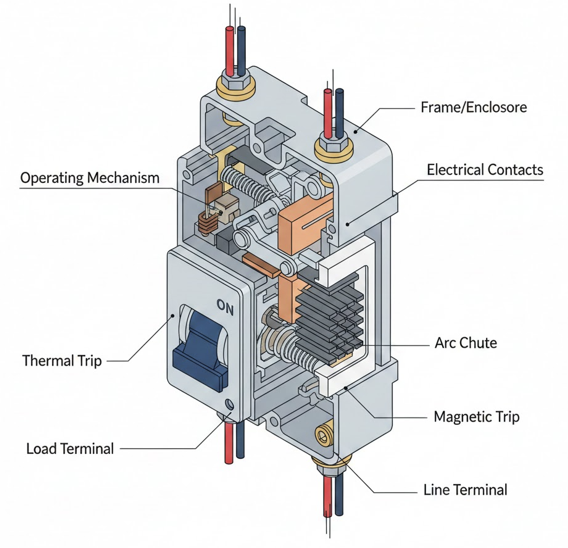
3D Model of a circuit breaker showing different parts
Conclusion
This article detailed the construction, purpose, and interaction of essential circuit breaker components. Circuit breakers rely on multiple coordinated components for effective protection.
Each part contributes uniquely to fault detection and interruption performance. Contacts conduct current, while arc chutes manage dangerous interruption arcs. Operating mechanisms ensure consistent opening speed under all conditions.
Trip units intelligently decide when abnormal currents require disconnection. Trip units make sensible judgments on when aberrant currents call for separation.
Overloads and short circuits are guarded against by thermal and magnetic components. Auxiliaries, housings, and terminals help with safety and system integration.
Understanding these elements helps to enhance design, operation, and maintenance procedures.
Good breakers improve electrical system safety and dependability. Engineers can choose suitable breakers confidently with thorough knowledge.
Frequently Asked Questions
What function does the frame or housing have?
The frame offers insulation from live components, protects inner components against dust or moisture, and provides structural strength.
Circuit breaker contact contacts are?
Contacts are conductors that separate during faults and normally transfer current. They incorporate fixed and movable contact sets.
Why is the operating mechanism important?
The operating mechanism enables manual or automatic opening and closing of the breaker’s contacts during normal and fault conditions.
What is a trip unit?
The travel unit identifies strange electrical conditions and commands the machine to open, therefore protecting the circuit from overloading or short-circuiting.
How does an arc extinguisher operate?
When contacts open while carrying current, an electric arc can form. The arc extinguisher helps guide and cool that arc so it goes out safely.
Are auxiliary accessories considered parts?
Yes. Auxiliary elements like auxiliary contacts or reset levers support control, signaling, or remote trip functions inside the breaker.
May a circuit breaker have more inner components?
Certainly. Many breakers feature bimetallic strips or electromagnetic coils that help to detect overload and faults.
Which materials are breaker contacts built with?
Chosen for their strength and low resistance, contacts typically consist of high-conductivity metals or alloys (often with silver).
