Modern industry depends on industrial boilers, which are essential devices. They create steam or hot water that supports a broad spectrum of industrial applications.
Boilers are used by manufacturing facilities for cleaning and heating. They help power plants to create electricity.
Reliable boiler operation is also crucial for chemical facilities, food processing plants, and refineries.
Though boiling water appears straightforward, an industrial boiler is a complex machine. Controls, fuel, air, and water have to work together.
High pressure and temperature call for tight safety precautions. Knowing the functioning of an industrial boiler enables engineers to increase reliability and efficiency. Moreover, it lowers fuel use and environmental impact.
This article clarifies the operating mechanism of an industrial boiler in a methodical and organized manner.
Understanding Industrial Boilers?
Designed to heat water, an industrial boiler is a closed pressure vessel. The heating process results in hot water or steam.
This thermal energy next finds industrial uses. Higher pressures and temperatures are used by boilers than by household systems.
Built from thick steel, these designs adhere to tight regulations. Energy transfer, or heat transfer, is the primary goal of a boiler. Thermal energy comes from fuel energy. Water receives that energy.
Steam results from water’s boiling point. Although boiler designs differ, the basic process remains the same across businesses.
To maximize efficiency, the procedure runs in a closed loop. Fundamental Elements of an Industrial Boiler
An industrial boiler comprises several main parts. Every part has a particular function. For safe operation, all parts have to work together.
Main Parts of Industrial Boilers
Pressure Vessel
Sometimes known as the boiler shell, has steam and water. It is meant to resist great internal pressure. Typically, cylindrical shells are used to evenly distribute stress.
Thick steel plates guarantee sturdiness and longevity. Strict inspection criteria are used as stored energy is substantial.
Burner
Thermal energy is delivered by the heat source or burner. The burner blends air and gasoline in fuel-fired boilers. Combustion takes place in the boiler furnace. Among typical fuels are coal and diesel.
Also, it may include natural gas and biomass. Electric boilers substitute heating components for combustion. Controlling heat production is the objective in every instance.

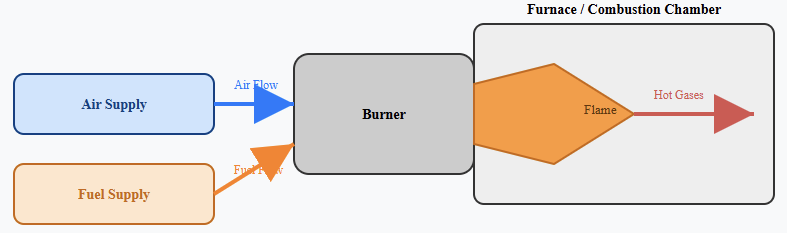
An industrial boiler burner showing air and fuel flow paths
Furnace
Burning of fuel occurs in the furnace, or combustion chamber. It is surfaced with a refractory substance.
This substance guards the steel shell and resists high temperatures. Heat transfers to surfaces that receive hot gases from the furnace. Efficient combustion guarantees minimal emissions and high efficiency.
Heat Exchanger
Energy can be transferred from hot gases to water using heat transfer surfaces. Plates and tubes are among these surfaces.
Outer surface hot gases run across. Water moves through the tubes inside or outside. Increasing the area for heat transmission raises boiler efficiency.

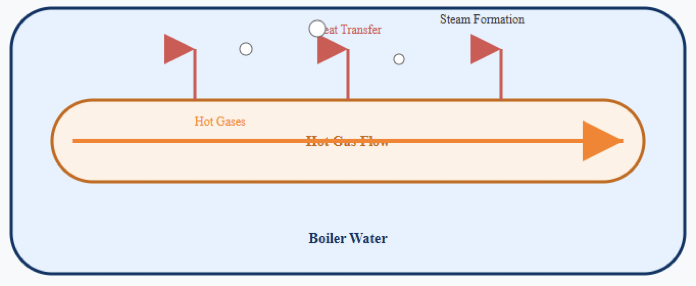
Paths of heat transfer between boiler water and hot gases
Steam and Water Circuit
Operating a boiler depends on the water and steam circuit. Controlled inlets bring treated feedwater into the boiler, and the temperature of the water rises. This occurs gradually as heat is added.
Steam bubbles start to rise as the boiling starts. Lower density causes these bubbles to float up in the water.
Steam accumulates in the boiler’s top. Steam separators help to get rid of moisture. Then, dry steam is supplied to the process.
The remaining water stays inside the ship and keeps absorbing heat. Operating cycles repeat all the time.
Categories of industrial boilers
Structural factors define industrial boilers. Fire and water tube boilers are two of the most often used kinds.
Fire-tube heaters
Hot combustion gases pass through the fire-tube boilers’ tubes. Water wraps these shell tubes. Heat passes through the walls of the tube.
Fire-tube boilers are straightforward yet powerful. Low and medium-pressure applications frequently use them. Small businesses usually choose this pattern since it makes maintenance simple.
Water-Tube Boilers
Water moves inside tubes in water-tube boilers. Externally, hot gases enclose the tubes. This pattern aids in greater pressures and temperatures. Loads on water-tube boilers are swiftly answered.
Power generation and huge industrial facilities use them extensively. Although their construction is more elaborate, their effectiveness is greater.
Fuel and Combustion Process
As the process of burning fuel inside the boiler takes place, this provides energy. Into the burner flows the fuel, carefully metered. Fans push air into the system.
Getting the mix right matters – too much air wastes heat. Efficiency drops when extra air cools the chamber. Without enough air, flames fail to burn completely.
Complete burning needs just the right amount of oxygen. Fires begin when ignition kicks in. As burning happens, energy bursts out fast. Through chambers and pipes, heated air travels along.
While things run, detectors keep watch on fire behavior plus warmth levels. When something goes wrong, safety controls cut off fuel flow.
Feedwater System
Into the boiler flows water, delivered by the feedwater setup. Purity matters – dirt brings scale, invites rust. Heat moves more slowly when gunk builds up inside. Machines wear down if left unchecked.
Hardness gets pulled out by water cleaners, along with trapped air. When things need adjusting, substances go into the mix.
Pushing force comes from feedwater movers that match what’s needed. Flow stays steady because valves step in now and then. Sensors watch how high the water climbs, so nothing runs too far.
The pump runs the water into the boiler, followed by a valve that manages the flow. Control keeps the level steady through adjustments. The system works best when parts sync without delays.
Steam Production and Managing Pressure
Fog begins to rise when warmth soaks into cold liquid. Slowly, things get hotter – until a tipping point clicks in.
That is where water lets go, turning itself into vapor instead. What pushes through the pipes ties back to how hot it runs. More squeezing means the boil waits longer now.
Something keeps the burner in check by adjusting its output. Pressure and steam flow stay steady because of how that system works.
Water gets caught in the steam, but separators pull it out before things move further. When the steam is drier, everything runs smoother, and machines down the line last longer, too.
Steam Flow and Condensate Recovery
From the boiler, steam moves inside covered pipes. To manage movement and force, valves step in.
Reaching its destination, it warms machinery or spins turbines. Once done working, it turns back into liquid form.
Heat lingers in the condensate even after use. Back into the boiler it goes, cutting fuel needs.
Efficiency climbs when plants recycle this leftover liquid. Less fresh water means fewer chemicals and lower bills.
Control and Instrumentation
Starting today, industrial boilers rely on smart control technology. Pressure, temperature, and flow are tracked by sensors.
Fuel plus airflow are tweaked on their own through controllers. The operation stays steady while running well without extra waste.
Most factories rely on programmable logic controllers along with screens for operator control. Live data appears constantly in front of workers.
When something goes wrong, warning signals go off immediately. Safety improves because machines can turn themselves off when needed.
Safety Systems in Industrial Boilers
Boilers need careful handling because they hold pressurized steam. If things go wrong, that built-up force might cause harm.
When pressure climbs too high, safety valves open without warning. A water gauge keeps an eye on levels, so heating stops if it runs low. Burners get checked by sensors – when flames vanish, the system knows right away.
When things get too hot, sensors cut power fast. Shutting down happens quickly if danger shows up. Every few weeks, someone checks the parts by hand.
Rules written in ASME books tell what must be done. Outcomes depend on how carefully the steps were followed.
Environmental Considerations
Fumes rise from factories burning fuel. This releases carbon dioxide, which traps heat in the atmosphere.
Smoke also contains nitrogen compounds that degrade air quality.. Governments set hard limits on how much pollution is allowed.
Starting off, low NOx burners help cut down on pollutants during combustion. Moving forward, scrubbers take out toxins while filters catch fine particles.
Natural gas steps in alongside biomass as a gentler fuel choice for nature. Efficiency gains quietly do their part by shrinking emission levels too.
Maintenance and Operation
Cleaning heat transfer surfaces helps keep things running smoothly. When inspections happen, they catch signs of wear before trouble starts.
Reliable boiler performance often follows consistent upkeep. Adjustments to burners make sure fuel burns right over time.
Frequent checks on water composition keep things running smoothly. Training matters – only qualified staff should handle the systems.
Steps for operation need close attention every single time. When upkeep slips, breakdowns happen more often while expenses climb.
Conclusion
This article detailed how industrial boilers operate, using straightforward steps. In countless factories, these machines show up as key players.
Fuel burns inside, turning into thermal energy that feeds the steam or hot water output.
The fire heats metal surfaces, moving warmth where it is needed next. Controls manage timing and temperature without constant human watch. Parts link together so failures stay rare and performance stays steady.
Boilers in factories do their job well when engineers grasp what happens inside them. Because of that knowledge, choices about setup and upkeep tend to improve.
There will be fewer fumes escaping when less fuel burns. This means that things are running smoothly.
When looked after the right way, these machines keep working year after year without quitting.
FAQ: How Does an Industrial Boiler Work?
An industrial boiler is?
A closed pressure vessel is an industrial boiler. It heats water to create hot water or steam. Industrial procedures use the energy.
What purpose does an industrial boiler serve mostly?
Converting fuel power into thermal energy is its primary purpose. Water receives this vitality.
Steam generation in an industrial boiler comes about through what mechanism?
Fuel is used by a burner to transfer heat into water. Then the water heats to the boiling point, which indeed turns into steam.
How do basic boiler operations work?
First occurs the burning of fuel. Heat transfer comes along now. Steam is made. Steam is given the operation.
Which basic elements make up an industrial boiler?
Crucial parts include controls, safety systems, heat transfer surfaces, a pressure vessel, a burner, and a furnace.
