Industrial automation systems rely heavily on accurate measurement data to maintain stability. It also counts on efficiency and safety across complex processes.
Programmable logic controllers continuously process signals received from numerous field instruments distributed throughout industrial facilities.
Many of these signals are transmitted as low-level analog values representing physical quantities.
Temperature, pressure, flow, and level sensors commonly provide such continuous measurement signals.
These measurements directly influence control decisions, alarm thresholds, and protective shutdown actions.
However, industrial environments are electrically noisy by nature and rarely electrically quiet.
High-power equipment generates disturbances that can couple into adjacent signal wiring unexpectedly.
Electromagnetic interference may distort sensitive analog measurements significantly and unpredictably.
Even minor distortion can propagate through control algorithms and affect final outputs. Engineers must therefore understand how analog noise influences PLC systems comprehensively.
This article investigates fundamental principles, industrial causes, system impacts, and practical mitigation strategies.
Understanding Analog Signals in PLC Systems
Analog signals represent continuously varying physical process quantities measured over time within industrial installations. They differ fundamentally from discrete digital signals that only indicate binary states.
PLC analog input modules typically accept standardized voltage or current ranges from sensors.
Common voltage standards include zero to ten volts for instrumentation signals. Current loop standards frequently use four to twenty milliamps for industrial transmitters.
Current loops generally provide better immunity to electrical interference compared to voltage signals.
Inside the PLC, analog modules convert incoming electrical signals into digital values using analog-to-digital converters.
Resolution determines the smallest measurable increment change that the system can detect reliably.
Sampling time influences how accurately dynamic variations are captured and represented internally.
Stable signal representation depends strongly on electrical integrity throughout the transmission path.
When noise contaminates the signal, the digital representation no longer reflects the true process variable accurately.

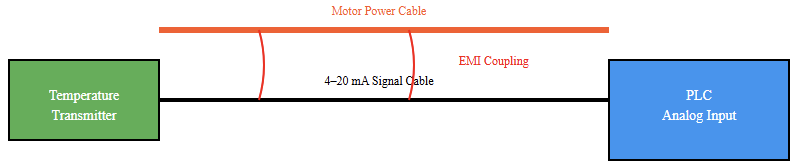
Analog signal transmission path with electromagnetic noise coupling from adjacent power conductors
Nature and Sources of Analog Signal Noise
Analog signal noise consists of unwanted electrical disturbances superimposed onto the intended measurement waveform.
These disturbances may appear as random fluctuations or periodic oscillations within the signal.
Electromagnetic interference represents a primary noise source in industrial facilities containing heavy equipment.
Large induction motors generate strong magnetic fields, especially during startup and load transitions.
Variable frequency drives emit high-frequency switching harmonics due to rapid semiconductor switching events.
Contactors and relays create transient voltage spikes whenever mechanical contacts open or close abruptly.
Improper grounding schemes introduce ground loop currents that circulate between different potential references.
Long cable runs may behave like unintended receiving antennas for external electromagnetic fields. Power conductors routed near signal cables induce capacitive or inductive coupling effects.
Radio frequency transmitters and wireless devices can inject additional interference components.
Thermal noise also originates within electronic circuitry components inherently. Each noise source contributes uniquely to the overall level of signal degradation.
Impact on Measurement Accuracy and Resolution
Noise introduces unwanted fluctuations into measured analog values processed by PLC systems.
These fluctuations distort the true magnitude of the physical process variable. High-resolution input modules become particularly sensitive to small disturbances present in the signal.
Small amplitude noise may, therefore, appear as meaningful variation in displayed values. Operators might interpret these oscillations as genuine process instability conditions.
Control strategies depend on accurate and stable feedback signals for proper performance.
Erroneous measurements lead to inappropriate corrective control actions within closed-loop systems.
Derivative control terms amplify high-frequency noise components significantly during operation. As a consequence, actuator commands may oscillate excessively without actual process change.
Mechanical wear increases due to unnecessary movement and repetitive actuation cycles. Measurement uncertainty also complicates calibration procedures and optimization efforts across industrial plants.
Influence on Closed-Loop Control Performance
Closed-loop control systems rely on precise and trustworthy feedback signals continuously.
Noise effectively behaves as an external disturbance input entering the feedback path. The controller attempts to compensate for perceived deviations from the setpoint value.
When deviations originate from measurement noise, corrective actions become unnecessary and counterproductive. Repeated compensation may produce oscillatory control behavior known as limit cycling.
Limit cycling reduces overall process efficiency and negatively affects energy consumption performance. Integral control action may accumulate error introduced purely by noise components.
Integrator windup increases overshoot during transient responses following disturbances. Settling time exceeds the originally designed or tuned specifications.
Engineers may incorrectly adjust controller gains while attempting to correct noise symptoms.
Such improper tuning decisions can further degrade overall system stability unintentionally.

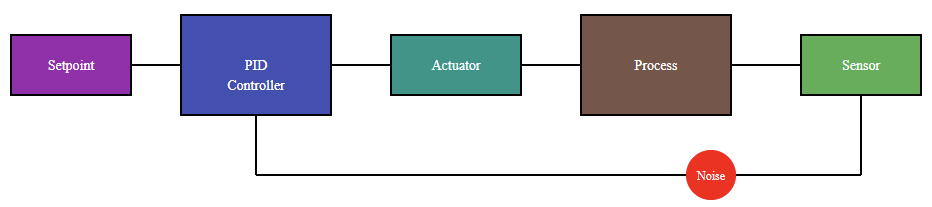
Closed-loop control system showing measurement noise injected in the feedback path
Effects on PLC Hardware and Diagnostics
Persistent electrical noise can stress sensitive analog input circuitry components over extended periods.
High-amplitude transient spikes risk damaging internal protection networks and isolation stages.
Repeated electrical stress reduces the long-term reliability of analog modules significantly.
Intermittent faults may appear within diagnostic logs without obvious physical causes. Technicians might suspect sensor malfunction or wiring faults incorrectly during troubleshooting activities.
Troubleshooting time increases because symptoms do not reflect the actual root causes clearly.
Spurious alarms triggered by noisy measurements reduce operator confidence in instrumentation systems. Operators may gradually ignore alarm messages, including legitimate warnings.
Data historians store corrupted measurement values for long-term analysis purposes. Historical trends become unreliable for performance evaluation and root cause investigations. System credibility declines among production and maintenance teams gradually.
Noise Propagation Across Automation Architectures
Analog noise effects do not remain confined to a single PLC input channel. Once converted into digital values, distorted data propagates through communication networks.
Supervisory control systems and human-machine interfaces rely on transmitted measurements.
Distorted data influences higher-level optimization and scheduling algorithms negatively.
Distributed control architectures amplify localized disturbances across interconnected controllers.
Shared variables may destabilize coordinated sequences between multiple control units. Batch processes become inconsistent under fluctuating feedback conditions.
Energy monitoring systems may miscalculate consumption patterns due to inaccurate sensor inputs.
Predictive analytics platforms receive misleading trend information that compromises reliability.
Thus, localized analog noise can create broader system-wide consequences beyond initial measurement distortion.
Engineering Techniques for Noise Mitigation
Proper grounding establishes the primary reference necessary for controlling electrical noise.
Single-point grounding minimizes unwanted circulating currents between equipment frames.
Shielded cables reduce susceptibility to external electromagnetic interference significantly.
Cable shields must terminate properly at defined grounding points to function effectively. Twisted pair conductors reduce differential mode interference through magnetic field cancellation principles.
Physical separation between power and signal wiring remains a fundamental installation requirement.
Proper cable routing avoids proximity to high current conductors and switching devices.
Signal isolation modules break conductive noise paths between field devices and controllers.
Optical isolation enhances protection against voltage transients and ground potential differences.
Analog filtering attenuates high-frequency disturbances before digital conversion occurs. Software-based filtering complements hardware mitigation measures within PLC programs.


Recommended analog signal wiring and isolation architecture for noise mitigation in PLC systems
Digital Filtering and Signal Conditioning
Digital filtering processes sampled signals using mathematical algorithms executed by the PLC processor.
Moving average filters reduce random noise variations through successive value averaging techniques.
Exponential smoothing filters balance responsiveness with effective signal stabilization performance.
However, excessive filtering introduces undesirable time delay effects within control loops.
Time delay reduces responsiveness and may degrade dynamic control performance noticeably.
Engineers must evaluate appropriate filter time constants carefully during commissioning phases. Signal amplification increases the signal-to-noise ratio for weak sensor outputs.
Proper scaling ensures accurate numerical representation within PLC memory registers. Calibration establishes reliable baseline references for measurement integrity.
Periodic verification maintains long-term stability of signal conditioning performance. Combined conditioning strategies enhance overall system robustness and measurement fidelity.
Practical Industrial Design Considerations
Industrial facilities present challenging electromagnetic environments requiring disciplined engineering practices. Design must anticipate worst-case interference scenarios realistically and conservatively.
Control panel layout significantly influences internal coupling between power and signal circuits.
Analog modules should be physically separated from high-power switching components. Dedicated instrumentation power supplies improve the stability of sensitive measurement systems.
Routine inspection prevents the gradual degradation of grounding and shielding connections.
Commissioning tests should explicitly evaluate susceptibility to electrical interference conditions. Monitoring scan times and signal trends may reveal abnormal fluctuations early.
Proper training increases understanding of interference sources and appropriate mitigation techniques.
Comprehensive documentation of wiring practices aids future troubleshooting and maintenance activities.
Proactive noise management ultimately supports reliable automation performance and long-term operational stability.
Conclusion
This article introduced the mechanisms through which analog signal noise affects PLC systems and industrial control reliability.
It explained how electrical disturbances distort measurement accuracy and digital representation integrity.
The discussion examined consequences for control stability, hardware reliability, and diagnostics systematically.
Broader system-wide impacts across communication and supervisory layers were clarified.
Practical grounding, shielding, isolation, and filtering techniques were described in detail. Digital conditioning strategies were analyzed alongside realistic industrial design considerations. Industrial environments will always contain potential interference sources that challenge signal integrity.
Engineers must therefore prioritize disciplined installation practices and thoughtful configuration decisions.
Proper noise mitigation leads to control actions that are accurate, feedback loops that are stable, and the operation of the plant is safe.
Knowing such principles, one can design automation systems that are not only resilient and dependable but also of high performance.
FAQs
In a PLC system, what constitutes analog signal noise?
Unwanted electrical interference, known as analog signal noise, distorts the actual analog measuring signal before it gets to the PLC input.
How is noise vulnerable to analog signals?
Analog circuits have continuously changing values; thus, low-level voltages or currents can readily pick up electrical noise from nearby appliances or wiring.
What common equipment generates noise in industrial environments?
Heavy motors, variable frequency drives, contactors, and high voltage cables are typical noise sources that inject interference into analog lines.
How does noise enter the analog signal cable?
Acting like an antenna, a signal cable can pick up coupled noise when it passes by magnetic sources or power cables.
What visible effect does noise have on PLC analog readings?
Even when the process is steady, noise can cause measured value jitter, spikes, or random variations.
.
