Today, we all believe that smart digital technologies are becoming more and more crucial for industrial automation. This is happening in the current time.
The digital twin stands prominently among these technologies. The concept transforms how industries design systems. It also changes maintenance and operational strategies.
A digital twin represents a physical asset virtually. It continuously mirrors real-time operating conditions.
Sensors collect data from physical equipment constantly. This data feeds accurate and dynamic simulation models.
Engineers analyze behavior without disrupting actual operations. The approach reduces uncertainty during technical decision-making.
It enhances efficiency across modern production environments. Industries adopt digital twins for strategic advantage. This article studies digital twin principles, components, applications, and benefits.
Understanding the Digital Twin Concept
A digital twin is a dynamic virtual representation. It reflects the current state of equipment.
The model evolves with incoming operational data. Unlike static simulations, it updates continuously.
This synchronization creates highly accurate operational insights. Physical and digital systems remain tightly connected.
Communication occurs through industrial networks and sensors. Advanced analytics interpret the collected system information.
The twin predicts responses under varying conditions. Engineers test improvements within the virtual environment.
The physical system remains unaffected during experimentation. This significantly reduces operational risks and downtime.
Digital twins rely heavily on precise modeling techniques. Mathematical algorithms describe system behaviors accurately.
Continuous validation ensures long-term model reliability. Calibration procedures maintain alignment with reality.
Model accuracy determines decision quality outcomes. Reliable twins require structured engineering methodologies.
Core Components of a Digital Twin
Several integrated components form an effective digital twin. First, physical assets generate operational process data.
These assets include machines and automated production lines. Sensors measure temperature and pressure. Also, the quantification of vibration and flow is performed by these sensors.
Smart sensors provide enhanced diagnostic capabilities. Data acquisition systems transmit measurements securely.
Industrial controllers manage communication at the field level. Edge devices preprocess information before cloud transmission.
Reliable protocols ensure accurate industrial data exchange. Redundant communication improves overall system reliability.
Next, the virtual model processes incoming signals. Simulation software represents mechanical and electrical dynamics.
Control logic mirrors actual automation sequences. A database stores structured historical operational information.
Structured data models ensure consistent representation standards. Analytics engines evaluate trends and detect anomalies.
Machine learning algorithms enhance predictive modeling accuracy. Visualization dashboards display real-time performance indicators.
Users interact through intuitive graphical interfaces. Integration platforms connect enterprise resource planning systems.
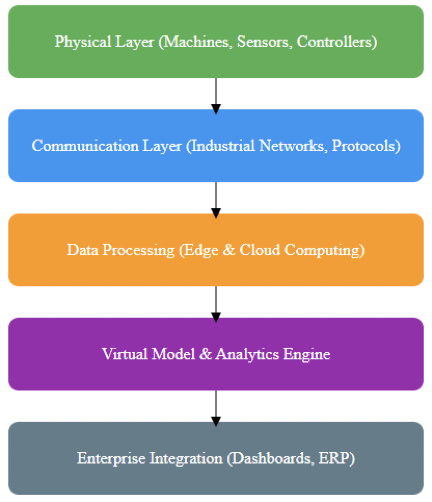
Architecture of a digital twin system
Role of Data and Connectivity
Data forms the essential foundation of digital twins. Without reliable data, virtual models lose credibility.
High-resolution sensor inputs improve simulation precision. Data sampling rates influence modeling responsiveness.
Time synchronization ensures consistency across system measurements. Data quality management becomes critically important.
Noise filtering improves the interpretation of raw signals. Validation routines detect abnormal data patterns.
Cybersecurity protects transmitted industrial information continuously. Encrypted communication prevents unauthorized system access.
Authentication protocols secure network endpoints effectively. Data historians maintain long-term archival records.
Historical patterns support predictive maintenance analytics. Real-time streaming enables immediate condition monitoring.
Cloud infrastructure supports scalable processing capacity. Distributed databases enhance redundancy and reliability.
Edge computing reduces latency during decision processes. Balanced architectures optimize both cost and performance.
Connectivity ensures seamless interaction between systems. Reliable infrastructure strengthens digital twin effectiveness.
Applications in Industrial Automation
Digital twins serve diverse industrial automation applications. Manufacturing plants use twins for production optimization.
Virtual commissioning accelerates automation system deployment. Engineers validate control logic before installation.
This approach reduces startup errors significantly. Process parameters undergo simulation before production launch.
Predictive maintenance lessens surprises in equipment failure. Teams in charge of maintenance plan service visits ahead of time.
Energy management improves through accurate consumption modeling. Utilities analyze load patterns using simulations.
Process industries enhance control through simulations. Chemical plants test control adjustments virtually.
Safety analysis becomes more comprehensive virtually. Operators test emergency procedures safely.
Robotics systems undergo trajectory optimization digitally. Packaging lines benefit from performance simulations.
Supply chains integrate predictive planning capabilities. Logistics systems simulate warehouse automation flows.
Quality control improves through continuous feedback analysis. Industrial productivity increases through informed decisions. Asset lifecycle management becomes more efficient.
Benefits of Digital Twin Implementation
Organizations gain substantial operational advantages. Regular performance optimization raises operational efficiency.
Predictive maintenance insights reduce downtime. Maintenance costs reduce across equipment lifecycles.
Spare part inventory planning becomes more accurate. Decision-making becomes strongly data-driven.
Innovation accelerates through virtual experimentation capabilities. Product development cycles shorten considerably.
Design errors become detectable earlier. Energy efficiency improves with accurate operational modeling.
Carbon emissions may be reduced through optimization. Safety risks decrease through proactive monitoring systems.
Compliance documentation becomes easier with recorded data. Collaboration improves between engineering and operations teams. Cross-functional communication strengthens through shared dashboards.
Remote monitoring enhances global asset management. Optimizing methods fit the goals of sustainability. Digital transformation projects improve competitive edge. Long-term technological investments are justified by financial returns.
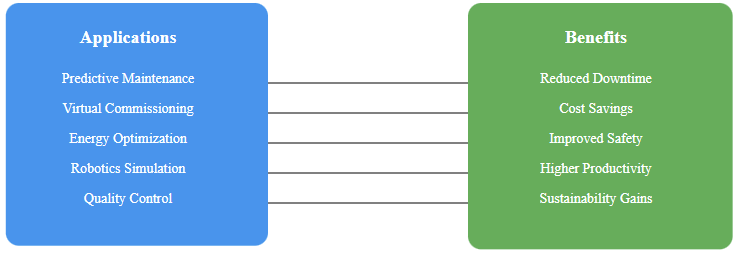
Applications and benefits of digital twin implementation
Implementation Challenges and Considerations
Implementation results in significant obstacles, even with benefits. Initial investment costs may appear significant.
Accurate modeling requires specialized technical expertise. Integration with legacy systems proves complex.
Existing equipment may lack digital interfaces. Data silos hinder seamless system communication.
Cybersecurity threats mean we need strong, well-planned protection strategies. Scalability planning becomes essential during the early stages.
Interoperability standards must be carefully evaluated. Organizational resistance can slow adoption efforts.
Workforce training supports effective system utilization. Clear project objectives guide deployment success.
Pilot implementations reduce large-scale risks. Vendor collaboration ensures technical compatibility. Data governance policies ensure responsible usage.
Continuous improvement maintains long-term relevance. Performance metrics must be clearly defined. Change management strategies support organizational transition.
Integration with Emerging Technologies
Digital twins integrate with emerging industrial technologies. Artificial intelligence helps us with predictive analysis capabilities.
Machine learning refines anomaly detection algorithms. Internet of Things devices supply extensive sensor data.
Smart devices expand monitoring capabilities significantly. Cloud computing enables distributed processing resources.
Advanced networks improve real-time connectivity. Augmented reality supports immersive maintenance visualization.
Virtual reality enables operator training simulations. Advanced analytics uncover hidden performance patterns.
Edge intelligence supports localized autonomous decisions. Blockchain technology may secure transactional records.
Integration creates interconnected smart factory environments. Industry leaders pursue comprehensive digital ecosystems. These ecosystems improve coordination across enterprise levels.
Future Trends in Digital Twin Development
The digital twin concept continues evolving rapidly. Future twins will become increasingly autonomous.
Self-learning models will update automatically. Greater standardization will improve cross-platform interoperability.
Digital twins may represent entire production facilities. City-scale infrastructure may adopt similar models.
Sustainability metrics will integrate seamlessly into models. Simulation fidelity will increase dramatically over time.
Real-time optimization will become standard practice. Human-machine collaboration will intensify significantly.
Regulatory frameworks may guide deployment practices. Investment trends indicate sustained growth potential.
Research institutions continue advancing simulation methodologies. Industrial automation will rely more on twins. Innovation will expand their industrial capabilities.
Conclusion
This article highlighted digital twin principles, components, applications, and benefits. Digital twins represent physical assets within virtual environments. They connect real equipment with dynamic data models.
Core components include sensors and simulation platforms. Data integrity determines overall system reliability. Manufacturing and energy use the applications.
Also, this may include the process sectors. Benefits include predictive maintenance and efficiency improvements.
Implementation requires planning and technical integration expertise. Emerging technologies further enhance digital twin capabilities. Future developments promise greater automation intelligence.
Organizations that digitally create a twin of their assets get a strategic edge over competitors.
The field of industrial automation is not only witnessing but living the rapid changes leveraging digital technologies.
Frequently Asked Questions
What exactly is a digital twin in the industry?
A digital twin refers to a living, updated model in the form of computer graphics of a physical asset that is capable of demonstrating the real-world characteristics, working, and conditions of the original asset at any time.
How does a digital twin connect to real equipment?
Digital twins are equipped with various types of detection and worldwide collaboration technologies that allow them to be in constant communication with their physical counterparts.
How is a digital twin different than a traditional simulation?
Usually, a conventional simulation is a static one and doesn’t allow for real-world data to be fed into it. Moreover, it doesn’t provide the condition of an asset instantaneously.
Why are digital twins valuable in industrial automation?
It is through digital twins that industries can double their efforts, uncover hidden clues in equipment for predictive maintenance, support decision-making processes, and improve overall performance.
Can digital twins assist in detecting an impending machine failure beforehand?
Definitely, digital twins can detect the failure point well in advance if they are given the sensor data for analysis.
The sensor data provide the necessary clues for the digital twin to detect a possible fault and thus prevent it through timely interventions.
Do digital twins enable remote monitoring of industrial systems?
Yes, they support remote system visibility, control, and real-time condition tracking.
