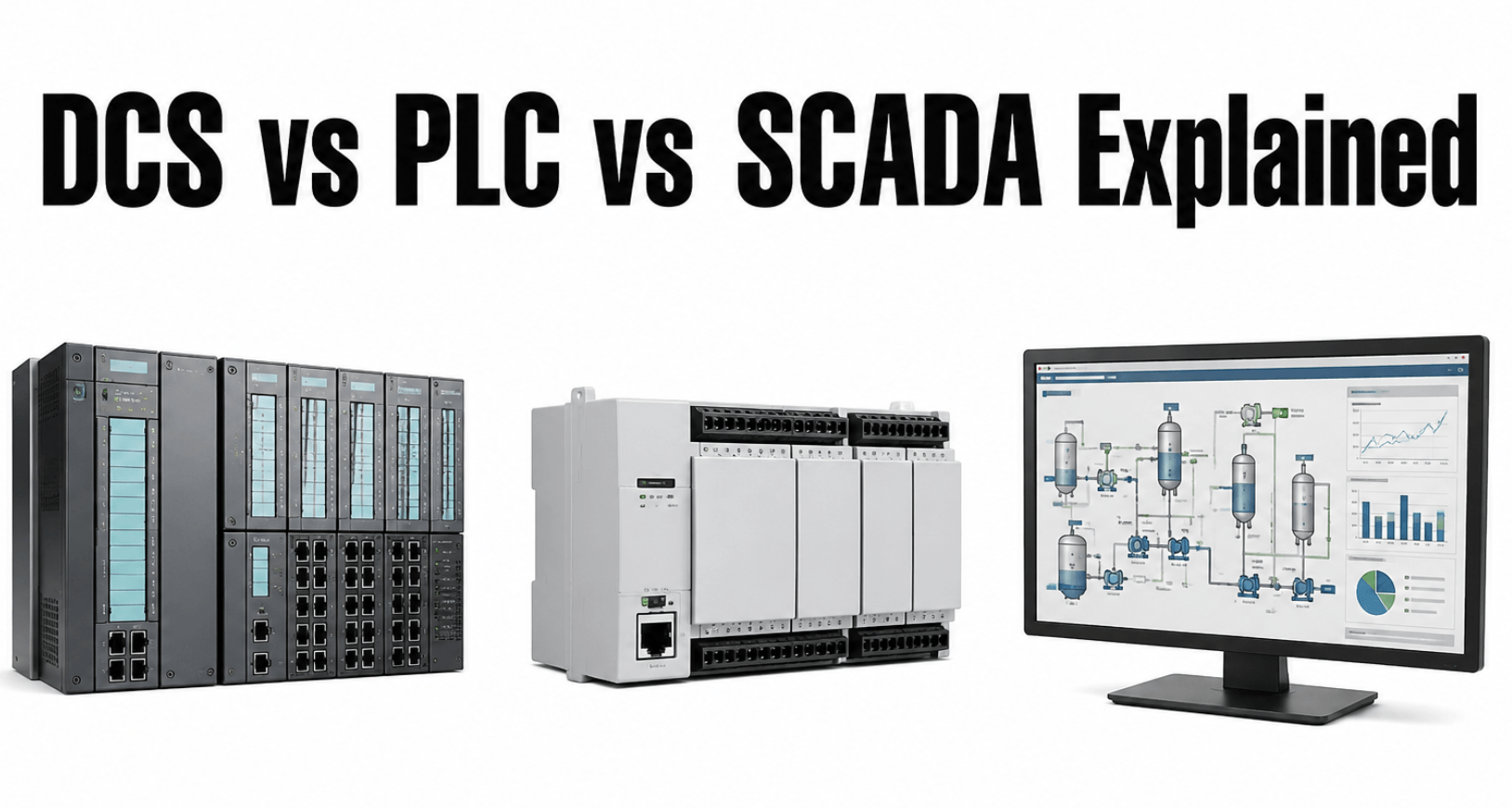
If you’ve spent any time around industrial automation, you’ve heard these three acronyms thrown around like they’re interchangeable. They’re not.
DCS, PLC, and SCADA solve different problems, and confusing them leads to expensive design mistakes, whether you’re specifying a new control system or trying to make sense of a job posting that lists all three as “required experience.”
This guide breaks down what each system actually does, how they differ architecturally, and more importantly, how they typically work together rather than as competing choices.
DCS vs PLC vs SCADA Explained: The Core Difference
PLC (Programmable Logic Controller)
A rugged, single-purpose controller that executes fast, deterministic logic for a specific machine or process cell.
DCS (Distributed Control System)
A network of controllers designed to manage an entire continuous process (a refinery or a power plant) from a unified, redundant architecture.
SCADA (Supervisory Control and Data Acquisition)
A software layer that monitors and supervises equipment spread across a wide area, often pulling data from many PLCs or RTUs.
In short: a PLC controls a machine, a DCS controls a plant, and SCADA watches over a network. Many real-world systems use all three at once.
What Is a PLC?
A programmable logic controller is an industrial computer built to execute logic reliably in harsh environments, heat, vibration, and electrical noise without the crashes or reboot cycles you’d expect from a general-purpose PC.
PLCs scan inputs, run a logic program (commonly ladder logic or structured text), and drive outputs on a tight, repeatable cycle, often in milliseconds.
Typical PLC characteristics
- Localized control of a single machine, skid, or process cell
- Fast scan times suited to discrete, high-speed operations
- Programmed in IEC 61131-3 languages: ladder logic, structured text, function block diagram, and others
- Standalone or networked with a handful of peer controllers
- Relatively low cost and straightforward to replace or expand
Where PLCs show up
Conveyor systems, packaging lines, bottling equipment, robotic work cells, HVAC equipment controls, and any application where you need fast, localized, hard-wired logic.
If you want a deeper dive into how PLC logic is actually written, our ladder logic examples guide and structured text examples article walk through real program patterns.
What Is a DCS?
A distributed control system takes the PLC concept and scales it up architecturally. Instead of one controller running one machine, a DCS distributes control across many processor modules all tied together on a proprietary or semi-proprietary high-speed network and unifies them under a single engineering and operator environment.
The “distributed” part matters: control isn’t centralized in one box that becomes a single point of failure.
Each controller handles its own loops, but they share data, alarms, and historian tags across the system, and operators interact with the whole process through one integrated set of screens.
Typical DCS characteristics
- Built for continuous, process-heavy industries with hundreds or thousands of control loops
- Strong native support for advanced regulatory control (PID tuning, cascade loops, ratio control)
- High redundancy by design. Controllers, networks, and power supplies are commonly duplicated
- Unified engineering environment across the entire plant
- Higher upfront cost and longer engineering lead time than a PLC-based system
Where DCS shows up
Oil refineries, chemical plants, power generation, pulp and paper, and other continuous processes where thousands of analog loops need coordinated, high-availability control.
What Is SCADA?
SCADA is fundamentally different from the other two. It’s not a controller at all. SCADA is a supervisory software layer that gathers data from field devices (often PLCs or remote terminal units, or RTUs), displays it to operators through HMI screens, logs historical trends, and allows limited high-level commands to be sent back down to the field.
SCADA earns its keep in applications spread across large geographic areas, where running a single centralized controller isn’t practical.
Think pipelines, water distribution networks, or electrical grids where field sites might be miles apart and connected by radio, cellular, or leased-line communications rather than a local plant network.
Typical SCADA characteristics
- Monitors and supervises, rather than executing fast local logic itself
- Aggregates data from many geographically dispersed PLCs/RTUs
- Built around HMI visualization, alarming, historian/trending, and reporting
- Tolerant of slower, less reliable communication links (radio, cellular, satellite)
- Often layered on top of a PLC-based control layer, not a replacement for it
Where SCADA shows up
Water and wastewater utilities, oil and gas pipelines, electrical transmission and distribution, and any widely distributed asset network.
DCS vs PLC vs SCADA: Comparison Table
| Feature | PLC | DCS | SCADA |
|---|---|---|---|
| Primary role | Local machine/process control | Plant-wide process control | Wide-area monitoring & supervision |
| Typical scale | Single machine or cell | Entire facility | Multiple sites, wide geography |
| Control speed | Very fast (ms scan times) | Fast, loop-optimized | Slower, supervisory (seconds) |
| Redundancy | Optional, add-on | Built-in by design | Varies by implementation |
| Best fit for | Discrete manufacturing | Continuous process industries | Utilities, pipelines, dispersed assets |
| Programming | Ladder logic, structured text (IEC 61131-3) | Function blocks, proprietary tools | Configuration + scripting, less “control logic” |
| Communication | Local I/O, Ethernet/IP, Modbus | Proprietary high-speed backbone | Radio, cellular, WAN, leased lines |
| Cost & complexity | Low to moderate | High | Moderate to high (site-dependent) |
How They Work Together in Real Systems
In practice, these systems aren’t rivals. They’re layers. A common architecture looks like this:
- Field level: PLCs execute fast, local logic on machines and process skids.
- Process level: A DCS coordinates multiple control loops and units across a facility, sometimes reading data from subordinate PLCs.
- Supervisory level: SCADA sits above one or many sites, pulling aggregated data from PLCs or DCS historians to give operators and engineers a plant-wide or company-wide view.
A water utility, for example, might run PLCs at each pump station for local control, with a SCADA system tying all those stations together over radio links so a central control room can monitor the whole network.
A refinery, by contrast, might run almost entirely on a DCS because its process is centralized and continuous, with PLCs handling only specific packaged equipment (like a fire and gas skid) that the vendor supplies pre-programmed.
How to Choose the Right System
Ask these questions before specifying a control architecture:
- Is the process continuous or discrete? Continuous, loop-heavy processes lean DCS; discrete, machine-level operations lean PLC.
- Is the equipment centralized or spread across a wide area? Widely dispersed assets need a SCADA supervisory layer regardless of what’s controlling them locally.
- What’s the redundancy requirement? If unplanned downtime is extremely costly (a refinery shutdown, a power outage), DCS-level built-in redundancy is usually worth the cost.
- What’s the budget and timeline? PLC-based systems are cheaper and faster to deploy; DCS projects involve longer engineering and commissioning cycles.
- Do you need centralized visibility across multiple sites? That’s a SCADA requirement layered on top of whatever local control you choose.
Many projects don’t pick just one. They pick the right combination for each layer of the architecture.
Frequently Asked Questions
Is a DCS just a big PLC?
Not exactly. A DCS can use PLC-like controllers internally, but its defining feature is the unified, redundant, plantwide architecture and engineering environment, something a collection of standalone PLCs doesn’t provide out of the box.
Can SCADA replace a PLC?
No. SCADA doesn’t execute local control logic the way a PLC does. SCADA supervises and visualizes; PLCs (or RTUs) still perform the actual field-level control.
Which pays more, DCS or PLC programming?
DCS engineering roles in continuous-process industries (oil and gas, power generation, chemicals) often command higher salaries than general PLC programming roles, largely because of the scale, safety-criticality, and specialized platform knowledge (like DeltaV, Foxboro, or Honeywell Experion) involved.
Do I need to learn all three?
Automation engineers who work across industries often do learn all three, but most careers specialize.
Discrete manufacturing leans PLC/HMI skills, process industries lean DCS, and utilities/pipeline roles lean SCADA and RTU communications.
Is SCADA the same as an HMI?
No. An HMI (Human-Machine Interface) is the screen and visualization component. SCADA is the broader system that includes HMI, but also adds data acquisition, historian, alarming, and communication across multiple remote sites.
Final Thoughts
DCS, PLC, and SCADA aren’t competing technologies. They’re different tools built for different scales of control.
A PLC handles the fast, local logic on a machine. A DCS coordinates an entire continuous process with built-in redundancy.
SCADA ties together dispersed assets under one supervisory view. Understanding where each one fits is the first step to specifying or troubleshooting any real-world industrial control architecture.
