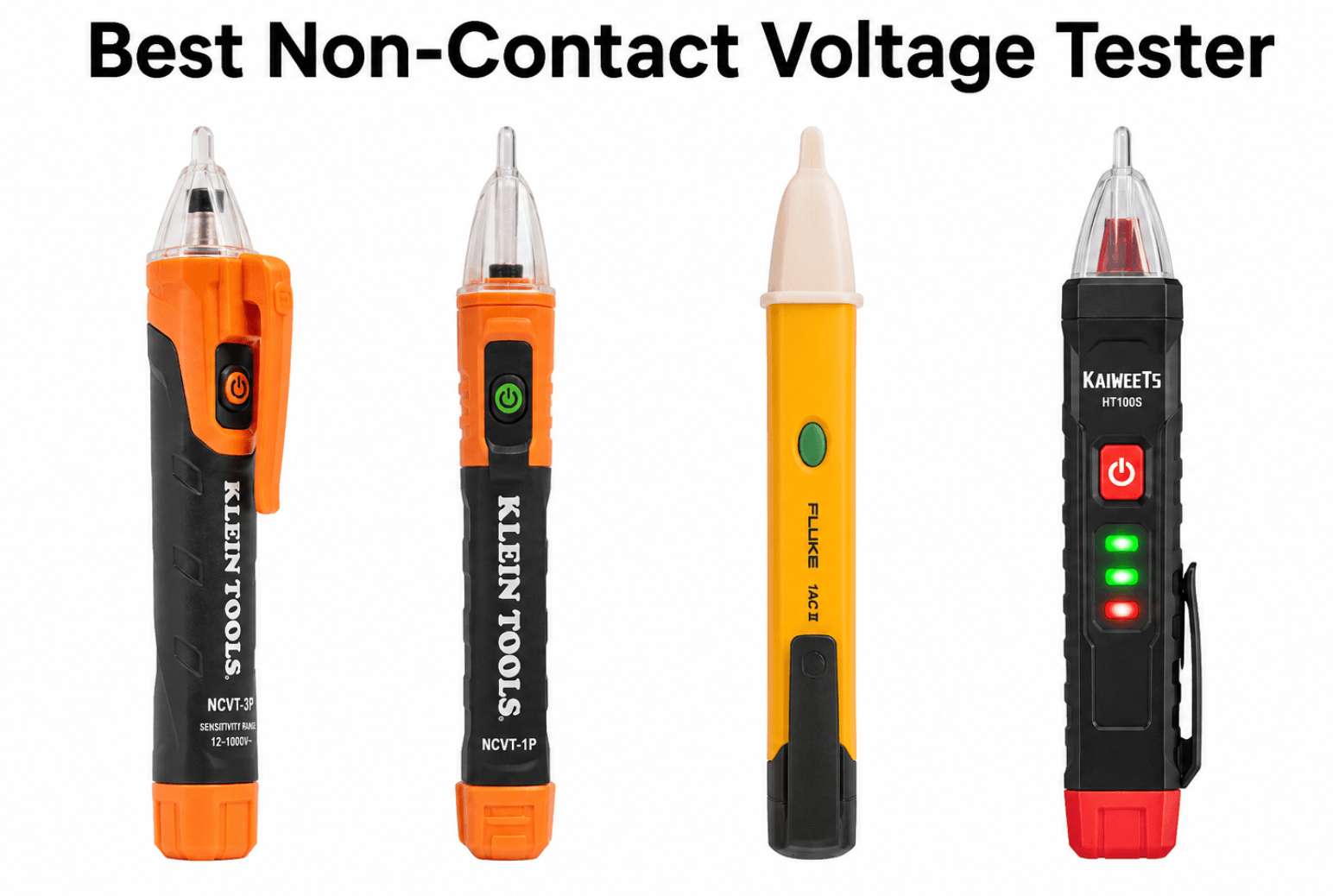
A non-contact voltage tester (NCVT) is the cheapest insurance policy in any electrical toolbox.
Hold the tip near a wire, outlet, or breaker, and it tells you whether the circuit is live, no bare-metal contact, no removing wire nuts, and no guesswork.
For anyone doing electrical work, from weekend DIYers to licensed electricians, it’s the tool that answers the only question that matters before you touch anything: is this energized?
This guide covers the best non-contact voltage testers you can buy right now, how to choose one, and the limitations you need to understand before you trust your safety to any of them.
Quick Picks
- Best overall: Klein Tools NCVT3P, dual-range (12–1000V AC), built-in flashlight, LED bar graph, water/dust-resistant
- Best value: Klein Tools NCVT1P, reliable single-range detection at the lowest branded price
- Best for pros: Fluke 1AC II VoltAlert, continuous self-test, bulletproof reputation
- Best budget with extras: KAIWEETS HT100s, LCD, and signal percentage at a low price
How a Non-Contact Voltage Tester Works
An NCVT detects the electromagnetic field that surrounds any conductor carrying alternating current.
When the sensor tip enters that field, the tester alerts you with a light, a beep, or both without ever making electrical contact.
This mechanism has one important consequence: non-contact testers only detect AC voltage, not DC.
Direct current produces a static field rather than the oscillating field the sensor needs, so an NCVT won’t help you on solar arrays, battery systems, or automotive circuits. For those, you need a contactless multimeter.
It’s also why testers can occasionally give a false reading near a static charge or induced voltage on a nearby wire.
An NCVT tells you a field is present; confirming a circuit is truly dead is a job for a two-point contact tester when the stakes are high.
What to Look For
Voltage range
Single-range testers (typically 90–1000V AC) cover standard household and commercial power but ignore low-voltage control circuits.
If you touch doorbells, 24V thermostats, landscape lighting, or irrigation controllers, choose a dual-range model that detects down to 12V.
Safety rating (CAT rating)
The CAT rating tells you the transient surge environment a tool is built to survive. CAT IV is the highest and is what you want for anything near a service entrance, meter, or panel. Cheap unrated testers are a false economy on a tool whose whole purpose is safety.
Alerts
Look for both audible and visual indications. A beep you can hear over a running HVAC unit plus an LED you can see in a dark crawl space means you won’t miss the warning.
Self-test
The single most dangerous failure mode is a false negative—a tester that stays silent on a live wire.
Models with a self-test feature (or a habit of testing on a known-live circuit first) protect you from a dead battery or failed sensor.
Build and ingress protection
An IP67 rating means dustproof and waterproof, which matters if you work outdoors or in wet locations. Drop resistance is worth having too.
The Best Non-Contact Voltage Testers
Klein Tools NCVT3P: Best Overall
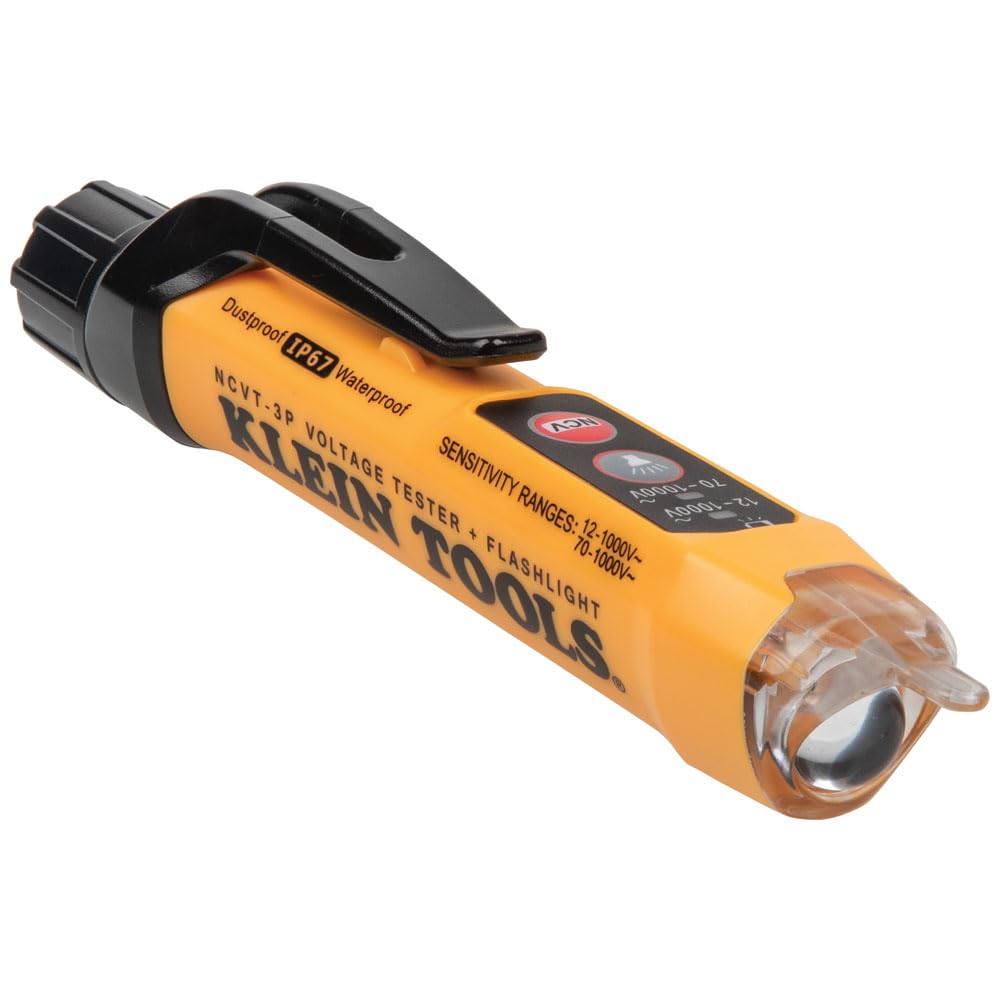
The NCVT3P is the tester most people should buy. It offers dual-range detection, 12 to 1000V AC in low-voltage mode and 70 to 1000V AC in standard mode, so it handles everything from thermostat wiring to a full 240V circuit.
An LED bar graph lights up more segments the stronger the field, giving you a rough sense of proximity to the source, and it signals with simultaneous light and sound.
Two features push it ahead of its own siblings: a genuinely useful integrated flashlight that works independently of the detection function and a screw-thread battery cap with an O-ring that seals out dust and water. It also auto-powers-off to save battery.
For residential and light commercial work, it covers virtually every scenario. Typical street price sits around $17–25.
Klein Tools NCVT1P: Best Value
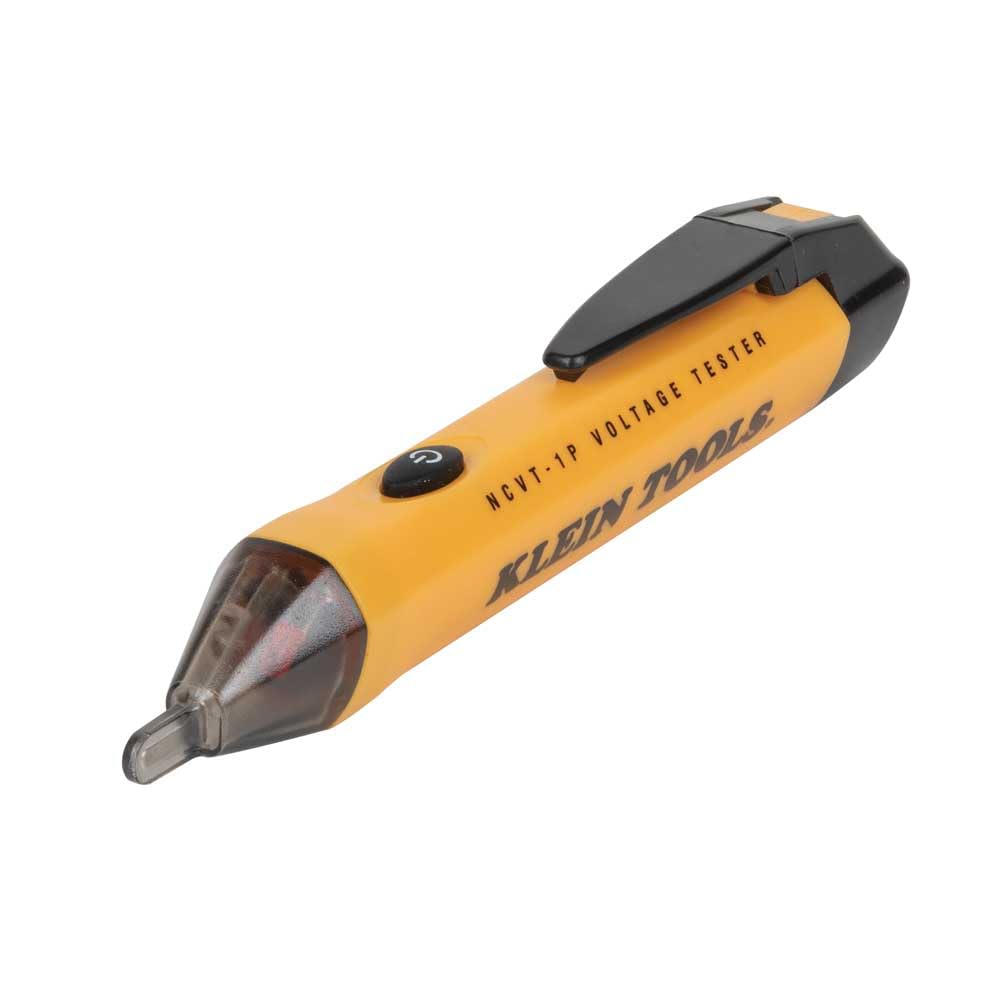
If you don’t need the low-voltage range or the flashlight, the NCVT1P delivers Klein’s core reliability at the lowest branded price, often just under $18.
It’s a single-range tester (roughly 50–1000V AC) with the same audible and flashing LED alerts and the same trusted build.
For a homeowner who wants a tool that simply works when checking outlets and breakers, it’s hard to beat, and thousands of reviewers back that up.
Fluke 1AC II VoltAlert: Best for Professionals
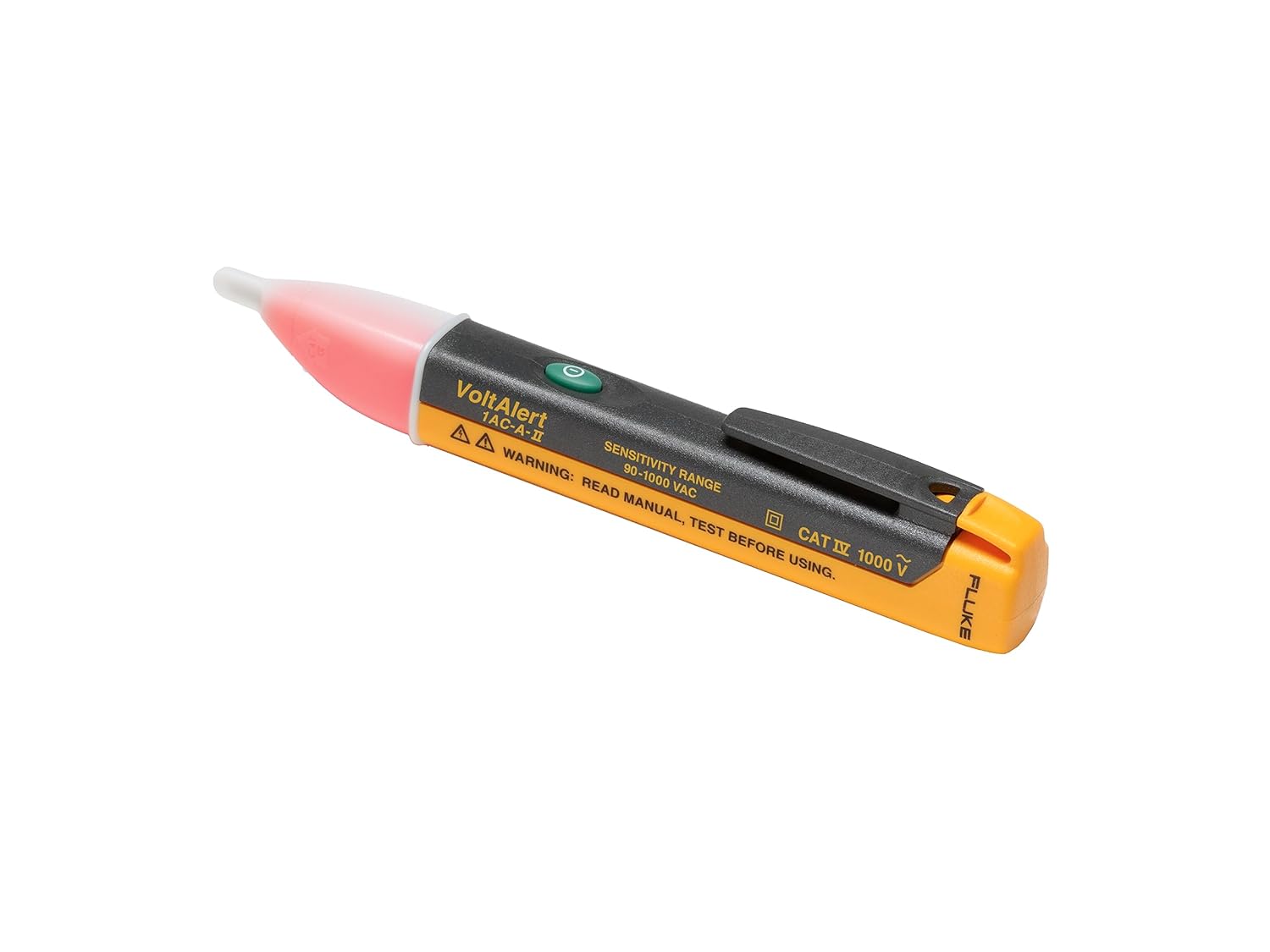
Fluke’s 1AC II is the tester many electricians reach for by default. It covers 90 to 1000V AC, and its standout feature is continuous self-test: it constantly verifies its own circuitry so you always know it’s working, which directly addresses the false-negative risk.
The tip glows red, and the unit beeps when voltage is detected. It’s CAT IV rated, pocket-sized, and shrugs off drops. It costs a few dollars more than the Klein entry models, but for a tool you’re staking your safety on, the decades of proven reliability justify it.
KAIWEETS HT100s: Best Budget with Extras
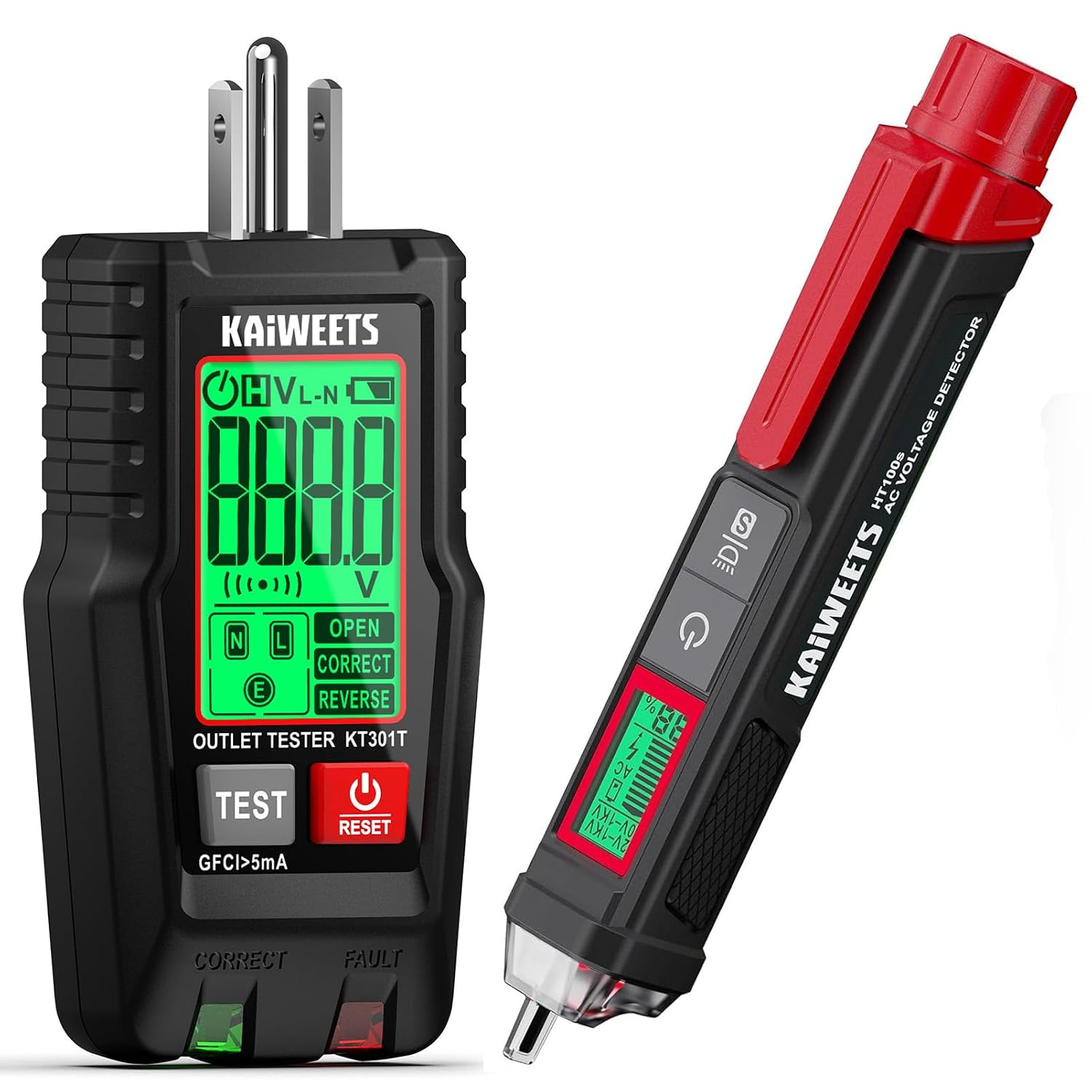
For buyers who want more features per dollar, the KAIWEETS offers dual-range detection plus an LCD, a signal-strength percentage, and a wire-breakpoint finder, all at a price that undercuts the name brands.
It’s a lot of capability for the money and a solid pick for a DIYer building out a kit, provided you verify it against a known-live circuit before trusting it.
Comparison at a Glance
| Model | Range (AC) | Dual-Range | Self-Test | Flashlight | Best For |
|---|---|---|---|---|---|
| Klein NCVT3P | 12–1000V | Yes | No | Yes | Overall use |
| Klein NCVT1P | ~50–1000V | No | No | No | Value |
| Fluke 1AC II | 90–1000 V | No | Continuous | No | Professionals |
| KAIWEETS HT100s | 12–1000V | Yes | No | No | Budget + features |
Safety: How to Use an NCVT Correctly
A voltage tester is only as trustworthy as your habits with it. The professional rule is live-dead-live:
- Test the NCVT on a circuit you know is energized to confirm it works.
- Test the circuit you intend to work on.
- Test the known-live circuit again to confirm the tester is still working.
A few more things worth knowing:
- NCVTs generally cannot detect voltage through walls, thick conduit, or shielded cable. A “no voltage” result on a buried or sheathed conductor doesn’t guarantee the wire is dead.
- Treat every conductor as live until you’ve proven otherwise.
- For anything high-stakes, confirm with a contact tester or multimeter. NFPA 70E’s test-before-touch requirement exists because no single tool is infallible.
- Replace batteries proactively; a weak battery is the most common cause of a silent tester.
The Bottom Line
For most people, the Klein Tools NCVT3P is the best non-contact voltage tester of 2026. Its dual-range detection, flashlight, and weather sealing cover nearly any job.
Budget-focused buyers get excellent reliability from the Klein NCVT1P, while professionals who want the reassurance of continuous self-testing should choose the Fluke 1AC II VoltAlert.
Whichever you pick, remember that the tool tells you what’s live—your procedure keeps you safe.
Test before you touch, verify on a known source, and never assume a wire is dead just because a pen stayed quiet.
