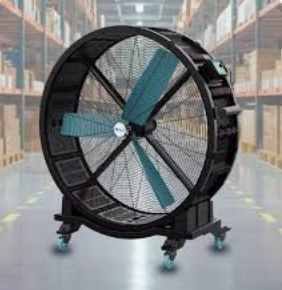
Choosing an industrial fan sounds simple until you realize that a fan rated at 8,000 CFM in a catalog can deliver a fraction of that once it is pushing air through ductwork, a filter, or a hot control cabinet.
Pick the wrong one, and you get hot spots, tripped motors, noisy workspaces, wasted electricity, and in the worst cases, a ventilation system that cannot keep a hazardous atmosphere under control.
This guide walks through every factor that matters when you select an industrial fan: airflow, pressure, fan type, motor, environment, safety, noise, controls, and total cost. For each fan type you will also find a recommended product on Amazon.
Affiliate disclosure
As an Amazon Associate, controlcircuitry.com earns from qualifying purchases. Recommendations are based on the specifications and the application fit described below. Always confirm current specs, voltage, and price on the product page before buying.
How to Choose an Industrial Fan
Define the job
Cooling people, moving air through a space, exhausting fumes, drying surfaces, or cooling equipment are different problems.
Calculate required airflow (CFM)
From room volume and the air changes per hour you need.
Check static pressure
If air must travel through ducts, filters, or louvers, you need a fan that holds its flow against resistance.
Match the fan type to the job
Axial for free air, centrifugal for pressure, and inline for ducts.
Match the motor, enclosure and certification to the environment
Voltage, phase, dust, moisture, temperature, corrosive or explosive atmosphere.
Plan the controls
Speed control, VFD, thermostat, or BMS/PLC integration.
Compare total cost
Not just purchase price.
Understand the Three Numbers That Define Fan Performance
Airflow (CFM)
Airflow is the volume of air a fan moves, measured in cubic feet per minute (CFM) in the US or m³/h in most of the world (1 CFM ≈ 1.7 m³/h). Most catalog CFM figures are measured in free air, with zero resistance. Real installations almost always have some.
Static pressure
Static pressure is the resistance the fan has to overcome, measured in inches of water gauge (in. w.g.) or pascals.
Ducts, bends, filters, screens, dampers, and even a dirty cabinet filter add pressure. A fan with a high free-air CFM but a weak pressure capability will deliver much less airflow once it is connected to a system.
Power and speed
Fan speed (RPM) and motor power determine both performance and cost. This is where the fan affinity laws help:
- Airflow changes in proportion to speed
- Pressure changes with the square of speed
- Power changes with the cube of speed
Reducing fan speed by 20% cuts airflow by 20% but cuts power use by roughly 49%. That relationship is the reason variable speed control pays for itself so often.
Read the fan curve
Every serious fan has a fan curve plotting airflow against pressure. Your system has a system curve (resistance rises with airflow).
The point where the two curves cross is where the fan will actually operate. If a datasheet only lists one CFM number, treat it as a best case.
How to Calculate the Airflow You Need
Method 1: Air changes per hour (ACH)
For general ventilation:
Required CFM = (Room volume in cubic feet × ACH) ÷ 60
Example: a workshop is 40 ft × 30 ft × 12 ft = 14,400 cu ft. At 10 air changes per hour:
14,400 × 10 ÷ 60 = 2,400 CFM
Typical starting points (always verify against local codes and your safety assessment):
| Space | Typical ACH |
|---|---|
| Warehouse / storage | 2 to 6 |
| General workshop | 6 to 10 |
| Welding or paint areas | 10 to 20 or more (code driven) |
| Battery rooms, chemical storage | Set by code and hazard analysis |
| Commercial kitchens | 15 to 30 |
Method 2: Heat removal
For rooms with heat-producing equipment (compressors, drives, transformers):
CFM = (Heat load in watts × 3.16) ÷ ΔT in °F
where ΔT is the allowed temperature rise between supply air and exhaust air. This is a standard sensible heat approximation at sea level.
Example: 3,000 W of heat with an allowed 15 °F rise needs about 3,000 × 3.16 ÷ 15 = 632 CFM.
Method 3: Enclosure and panel cooling
For control cabinets, use the same heat formula with the internal heat dissipation of drives, power supplies, and PLC racks, then add a safety margin of 20 to 30% for filter loading.
Method 4: Spot cooling and drying
For cooling people or drying floors, you care about air velocity at the target (measured in feet per minute) more than total room CFM. A high-velocity fan aimed correctly beats a bigger fan that is placed poorly.
Industrial Fan Types and When to Use Each
Industrial fans split into two physical families:
- Axial fans move air parallel to the shaft. High flow, low to moderate pressure. Used for general circulation, wall exhaust, and enclosures.
- Centrifugal (radial) fans and blowers throw air outward and turn it 90 degrees. Lower flow for the same size, but much higher pressure. Used for ducted systems, drying, and filtration.
Below are the main types, with a recommended product for each.
High-Velocity Floor and Wall-Mount Fans
Best for
Garages, workshops, gyms, light manufacturing, drying wet floors, directed spot cooling.
These are compact axial fans with metal blades and a pivoting head, designed to throw a concentrated stream of air.
Many convert between floor and wall mounting, which saves floor space in busy areas. Look for a steel guard that meets OSHA guarding expectations, a grounded cord, and rubber feet.
Recommended product
Lasko 20″ Max Performance High Velocity Floor Fan, Model 2264QM
- 20-inch metal blades, 3 speeds, pivoting head
- QuickMount bracket for floor or wall use
- Published at roughly 2,750 CFM
Why it works
Strong value for light-duty spot cooling and floor drying. It is not a continuous-duty, three-shift fan, so for 24/7 environments, step up to a pedestal or drum fan with a larger motor.
Check it on Amazon: Lasko 2264QM 20″ High Velocity Fan
Pedestal Fans (Oscillating)
Best for
Gyms, warehouses, assembly lines, event spaces, anywhere you want broad coverage of a work area at head height.
Pedestal fans combine a large-diameter blade (24 to 30 inches) with an adjustable stand and often an oscillating head.
Larger diameter means more air at a lower speed and lower noise than a small high-speed fan moving the same air.
Recommended product
Air King 9135 30″ 1/4 HP Oscillating Pedestal Fan (industrial grade)
- 30-inch blade, 1/4 HP totally enclosed, permanently lubricated motor
- Industrial grade construction, ETL listed, OSHA-compliant guard per manufacturer
- Alternate: the HiCFM 30″ heavy duty oscillating pedestal fan (1/3 HP, advertised at around 8,300 CFM)
Why it works
The totally enclosed motor and ball bearings tolerate dusty environments, and oscillation reduces dead zones.
Check it on Amazon
Air King 9135 30″ Industrial Oscillating Pedestal Fan | HiCFM 30″ Heavy Duty Pedestal Fan
Drum (Barrel) Fans
Best for
Large workshops, greenhouses, loading docks, agricultural buildings, construction sites, long-throw air movement.
A drum fan puts the blade inside a cylindrical housing. The housing tames the airflow into a tighter, longer stream and protects people from the blades.
Drum fans typically use more powerful motors and are built for harder duty cycles than consumer floor fans.
Recommended product
Hurricane Pro Heavy Duty Adjustable Tilt Drum Fan (24″ or 30″)
- All-metal housing, aluminum blades, 3 speeds, adjustable tilt
- Published figures of about 7,195 CFM (24″) and 9,295 CFM (30″) at 850 RPM
Why it works: Excellent for moving large volumes of air in open buildings. Choose 30″ or larger for big bays; choose 24″ for tighter work cells.
Check it on Amazon: Hurricane Pro Heavy Duty Adjustable Tilt Drum Fan
Air Movers and Centrifugal Blowers (Carpet Dryers, Confined Spaces)
Best for
Drying floors and structures after water damage, spot ventilation, moving air through short flexible ducts, confined-space ventilation support.
Air movers are compact centrifugal-style blowers that generate high velocity across the floor or through a duct. They are stackable, portable and have rugged rotomolded housings.
Recommended product
XPOWER P-230AT Pro Air Mover (1/3 HP)
- Multi-position housing (floor, angled, ducted)
- Rugged molded housing, built-in outlets on many models for daisy chaining
Why it works
It delivers pressure that an open axial fan cannot, so it works with short duct runs and gives focused airflow.
Safety note
A portable blower is not a substitute for a confined-space entry program. If workers will enter a tank, vessel or pit, ventilation must be paired with continuous atmospheric monitoring and a proper permit system.
Check it on Amazon: XPOWER P-230AT Air Mover
Inline Duct Fans
Best for
Exhausting fumes or heat from a room through ducting, supplying fresh air, ventilating small enclosures, battery or equipment rooms (where code permits non-hazardous fans).
An inline fan sits in the duct run. Mixed-flow designs balance pressure and flow, which suits real duct systems with bends and filters.
Because they handle static pressure far better than an open wall fan, they are the right choice whenever ducting is involved.
Recommended product
AC Infinity CLOUDLINE series inline duct fan (EC motor with speed controller)
- EC motor with variable speed control and a temperature/humidity-capable controller on the Cloudline T models
- Available in 4, 6, 8, 10 and 12-inch duct sizes
Value alternative
VIVOSUN inline duct fan (6″ or 8″)
- Lower purchase price, basic speed controller
Why it works
Speed control lets you tune airflow instead of oversizing and throttling with a damper. Match the duct diameter to the CFM you calculated, and keep duct runs short with gentle bends.
Check it on Amazon: AC Infinity CLOUDLINE Inline Duct Fan | VIVOSUN Inline Duct Fan
Control Panel and Enclosure Cooling Fans
Best for
PLC cabinets, VFD enclosures, motor control centers, junction boxes, power supply cabinets, server and network racks in plants.
Heat is the silent killer of drives, power supplies and PLC I/O. As a rule of thumb, electronic component life shortens substantially with sustained high temperature, so enclosure cooling is a reliability decision, not a comfort one.
Cabinet fans are small axial or blower fans, in AC or DC versions, usually with a filter on the intake.
What to look for:
- Voltage match: 24 VDC is convenient in control panels; 120/230 VAC fans are common for larger enclosures.
- Ball bearings for long life at high temperature
- Filtered intake and an exhaust vent positioned high on the cabinet
- Ingress protection: a fan with a filter does not make the enclosure NEMA 4X or IP66. If you need sealed enclosures, look at heat exchangers or air conditioners instead.
Recommended product (DC cabinet cooling)
Noctua NF-A12x25 PWM 120 mm fan
- Premium 12 V DC axial fan, high static pressure for its size, long rated life
- Needs a 12 V supply (use a DC/DC converter from your 24 V rail)
Recommended product (AC cabinet cooling)
AC Infinity AXIAL series or a 120 V 120 mm AC axial fan
- Direct 120 V operation, suitable for larger cabinets without a DC supply
Why it works
Both give strong airflow in a small footprint. Check your enclosure’s heat load, add a thermostat, and monitor temperature as an alarm input in your PLC.
Check it on Amazon: Noctua NF-A12x25 PWM | AC Infinity AXIAL 120 mm AC fan
Explosion-Proof and Hazardous-Location Fans
Best for
Paint booths, chemical storage, fuel handling, battery charging rooms with hydrogen risk, solvent areas, anywhere a classified hazardous area exists.
This is the one category where you should not buy based on price or a consumer marketplace listing.
A fan used in a classified area must be certified for that area’s classification (for example NEC Class I Division 1 or 2, Group, and temperature class in North America, or ATEX/IECEx zone ratings elsewhere). A general-purpose fan has an ignition source: brushes, switches, a hot motor surface, or a blade that can spark.
What to do:
- Get the area classification from your safety engineer or hazardous-area drawing.
- Specify a fan with a matching certified motor and non-sparking blade and housing.
- Buy through an industrial distributor that supplies certificates and documentation.
Amazon note
Certified explosion-proof fans are generally sold through industrial suppliers rather than Amazon, and I do not recommend buying a safety-critical certified product from a general marketplace listing without verifying the certification label and documentation.
If you do browse, search for the certification, not just the keyword: explosion proof fan Class I Division 1
HVLS (High-Volume Low-Speed) Ceiling Fans
Best for
Warehouses, distribution centers, gyms, hangars, large agricultural buildings with 20+ ft ceilings.
HVLS fans move huge volumes of air at low speed, giving a gentle breeze across a very large footprint and helping to destratify warm air near the ceiling.
They are a facility-level investment: structural mounting, VFD or controller, and installation by qualified technicians.
Motor, Voltage and Drive Considerations
Voltage and phase
Small fans run on single-phase 120 V (North America) or 230 V. Larger industrial fans use three-phase 208, 230, 460 or 575 V. Verify what your facility has before you buy.
Motor type
- PSC (permanent split capacitor): common, reliable, modest efficiency, limited speed range.
- Three-phase induction: the workhorse for larger fans, ideal with a VFD.
- EC (electronically commutated): high efficiency and built-in speed control, and common in modern inline and cabinet fans.
- DC brushless: compact fans for panels and enclosures.
Enclosure and cooling
TEFC (totally enclosed fan cooled) motors suit dusty environments. Open drip-proof motors are only for clean, dry areas.
Duty rating
A fan that runs 24/7 needs a continuous-duty motor and quality bearings. Consumer-grade fans are not rated for that.
Thermal protection
Look for built-in thermal overload protection on motors.
Bearings
Ball bearings tolerate heat and heavy duty better than sleeve bearings.
Environment, Enclosure and Materials
Dust and debris
Choose enclosed motors and consider guards with finer mesh. Accumulated dust unbalances blades and overheats motors.
Moisture and washdown
Look for IP/NEMA ratings that match the exposure. Food plants may need stainless steel and washdown-rated motors.
High temperature
Check the motor’s maximum ambient temperature and the insulation class, especially near ovens, furnaces and rooftops.
Corrosive atmospheres
Chemical plants, coastal sites and wastewater facilities need coated, stainless, or fiberglass-reinforced plastic (FRP) fans.
Altitude
Air is thinner at altitude, so the same fan delivers less mass flow and its motor cools less effectively.
Outdoor use
Confirm the fan’s weather rating, UV resistance and cord type.
Hazardous Areas and Safety Compliance
Fan selection is a safety decision in several situations:
Guarding
Rotating blades must be guarded. In the US, OSHA’s machine guarding rules require guards that prevent contact with moving parts; guard openings are commonly specified as 1/2 inch or smaller for fans within reach (confirm the current requirements with your safety team).
Listings
Look for UL, ETL or CSA listings for electrical safety, and CE/UKCA marks in other markets.
Hazardous locations
See the explosion-proof discussion above. A ventilation fan is not a gas detector, and a gas detector is not a ventilation system.
Where flammable or toxic gases can accumulate, ventilation and fixed gas detection should work together, for example with a detector alarm that starts or ramps up exhaust fans.
For more on how detection is designed in industrial plants, read our sister site Safeguard Sense.
Confined spaces
Portable blowers support confined-space entry but never replace atmospheric testing, permits and rescue planning.
Fire
In some buildings, exhaust fans must integrate with the fire alarm system (shutdown or smoke-control operation). Check local fire code.
Noise, Vibration and Placement
Noise
Larger diameter fans at lower RPM are quieter than small fans at high RPM for the same airflow. Look for dBA ratings where available.
Workers exposed to high noise levels over a shift may require hearing protection, so noise is also an occupational health issue.
Vibration
Blade imbalance from dust or damage causes bearing wear. Use vibration-isolating mounts for fixed installations.
Placement
Don’t place a fan where it recirculates the same hot air. For exhaust, put the fan at the high point; for supply, make sure make-up air has a clear, clean path.
A building that has exhaust fans but no make-up air creates negative pressure, which reduces fan performance and can pull in dust or backdraft combustion appliances.
Airflow direction
Push-pull layouts (supply on one side, exhaust on the opposite side) clear a space more effectively than a single fan.
Controls and Automation
Since this is a controls and automation site, this is where the upgrade path matters.
Basic controls
Multi-speed switches, thermostats, timers and humidistats.
Variable frequency drives (VFDs)
For three-phase motors, a VFD gives soft starting, variable airflow and big energy savings thanks to the affinity laws. If you work with VFDs, see our guide on VFD fault codes and how to fix them .
EC and PWM fans
Many EC fans accept a 0-10 V or 4-20 mA analog signal, or a PWM signal, so a PLC or controller can modulate speed directly.
Some also support Modbus RTU. Compare Modbus RTU vs TCP when planning network integration.
BMS integration
In commercial and industrial buildings, fans are often controlled from a BMS using BACnet or Modbus points: run command, speed reference, status feedback, and fault alarm. See our BACnet and BMS guides.
Monitoring
Add airflow or differential-pressure sensors on critical fans so you can detect belt failure, blocked filters or a stopped motor, rather than finding out when equipment overheats.
Energy Use and Total Cost of Ownership
Purchase price is often the smallest part of what a fan costs over its life. For a fan that runs many hours a year:
Annual energy cost = kW × hours per year × electricity rate
Example: a 0.75 kW fan running 6,000 hours a year at $0.12/kWh costs 0.75 × 6,000 × 0.12 = $540 per year.
If a higher-efficiency EC fan or VFD reduces average power by 30%, you save roughly $160 a year on a single fan, and the savings multiply across a facility.
Also consider:
- Maintenance (bearing lubrication, belt replacement, cleaning)
- Expected service life and warranty
- Spare parts availability
- Downtime cost if a critical fan fails
Comparison Table: Industrial Fan Types at a Glance
| Fan type | Best for | Pressure capability | Typical airflow | Noise | Notes |
|---|---|---|---|---|---|
| High-velocity floor/wall | Spot cooling, drying | Low | 2,000 to 5,000 CFM | Moderate to loud | Budget friendly, not for 24/7 duty |
| Pedestal (oscillating) | Wide area cooling | Low | 4,000 to 9,000 CFM | Moderate | Good coverage at head height |
| Drum / barrel | Large open bays | Low to moderate | 7,000 to 18,000 CFM | Moderate | Long throw, rugged |
| Air mover / blower | Drying, short ducts | Moderate to high | Varies | Loud | Portable, stackable |
| Inline duct fan | Ducted exhaust/supply | Moderate | 100 to 2,000 CFM | Low to moderate | Needs proper duct sizing |
| Panel / enclosure fan | Cabinet cooling | Low to moderate | 10 to 300 CFM | Low | Use filters, monitor temperature |
| Explosion-proof | Classified areas | Varies | Varies | Varies | Must carry correct certification |
| HVLS ceiling | Large buildings | Very low | Very large coverage | Very low | Installed by specialists |
Industrial Fan Selection Checklist
Before you buy, make sure you can answer every one of these:
What is the purpose: cooling people, ventilating air, exhausting contaminants, cooling equipment, drying?
What airflow (CFM) is required, and how did I calculate it?
Is there ducting, filtering or other static pressure to overcome?
Which fan type fits (axial, centrifugal, inline, drum, panel)?
What voltage, phase and frequency does the site provide?
Is the duty continuous or intermittent?
What are the dust, moisture, temperature and corrosion conditions?
Is the area classified as hazardous, and does the fan carry the right certification?
Is the guarding compliant with local safety rules?
What noise level is acceptable at the work position?
How will it be controlled (switch, thermostat, VFD, BMS/PLC)?
What is the total cost of ownership over the expected life?
Top Picks Summary
| Need | Our pick | Where to check it |
|---|---|---|
| Garage / workshop spot cooling | Lasko 20″ 2264QM High Velocity Fan | Amazon |
| Warehouse / gym air circulation | Air King 9135 30″ Oscillating Pedestal Fan | Amazon |
| Large bays, long throw | Hurricane Pro Heavy Duty Drum Fan | Amazon |
| Drying / high velocity blowing | XPOWER P-230AT Air Mover | Amazon |
| Ducted exhaust / supply | AC Infinity CLOUDLINE Inline Fan | Amazon |
| Control panel cooling (DC) | Noctua NF-A12x25 PWM | Amazon |
| Control panel cooling (AC) | AC Infinity AXIAL 120 mm AC Fan | Amazon |
| Hazardous areas | Certified explosion-proof fan from an industrial supplier | Specify by classification, not by price |
Frequently Asked Questions
What is the difference between an axial fan and a centrifugal fan?
An axial fan moves air in a straight line along the shaft and is best for high airflow at low resistance, such as general circulation.
A centrifugal fan throws air outward and turns it, creating higher pressure for ducted systems, filters and drying applications.
How many CFM do I need for an industrial fan?
Multiply room volume in cubic feet by the air changes per hour you need and divide by 60.
For heat removal, divide the heat load in watts times 3.16 by the allowed temperature rise in °F. Then add a margin for filters, ducting and dirt buildup.
Is a drum fan better than a pedestal fan?
It depends on the space. Drum fans produce a tighter, longer-reaching airflow and are usually more rugged, so they suit large open areas.
Pedestal fans spread air over a wider area at head height, which suits gyms, assembly floors and offices.
Can I use a regular fan in a hazardous location?
No. A standard fan can create sparks or hot surfaces that ignite flammable gases, vapors or dust.
In classified areas, use a fan certified for the area classification (such as Class I Division 1/2 or ATEX/IECEx zone ratings), and verify the certification documents.
How do I cool a control panel with a fan?
Calculate the heat load of the components, determine the allowed internal temperature rise, and size the fan using the heat-removal formula with a margin for filter loading.
Use a filtered intake, a high exhaust vent, a thermostat, and consider wiring a temperature input to your PLC for alarms.
Should I use a VFD on my industrial fan?
For three-phase motors on fans with variable load, usually yes. Because fan power changes with the cube of speed, even a modest speed reduction produces large energy savings, and you also get soft starting and better process control.
How loud are industrial fans?
Noise varies widely. Large-diameter fans running at lower speeds are quieter than small, high-speed fans moving the same air.
Look for dBA ratings, and if the fan will run next to workers, check your local occupational noise requirements.
How often should industrial fans be maintained?
Inspect guards, mounts and blades regularly, clean dust buildup, check for vibration or unusual noise, and lubricate bearings according to the manufacturer’s schedule.
Cabinet fan filters often need monthly or quarterly cleaning depending on the environment.
Final Thoughts
The right industrial fan is the one that matches the job, not the one with the biggest CFM number.
Start with the application, calculate the airflow, check static pressure, pick the fan type that suits it, then verify motor, environment, safety rating, noise and controls.
In hazardous areas, treat the fan as part of your safety system and specify it properly.
If you are building automation around your ventilation, from VFD speed control to BMS integration, keep exploring the guides on controlcircuitry.com.
Disclosure
This article contains affiliate links. If you buy through them, controlcircuitry.com may earn a commission at no extra cost to you.
This article is general guidance and does not replace a site-specific engineering or safety assessment.
