Walk into any modern office tower, hospital, or manufacturing plant, and there’s an invisible system quietly making thousands of decisions every hour, adjusting chilled water valves, dimming lights in empty corridors, and flagging a failed exhaust fan before anyone notices the smell.
That system is the building management system (BMS), and it’s the closest thing a facility has to a central nervous system.
I’ve spent over a decade working in industrial automation and control systems, including years designing and commissioning safety and detection systems that integrate directly with BMS platforms.
In this guide, I’ll break down what a BMS actually is, how it works under the hood, and what you need to know whether you’re a facility manager, an engineer entering the field, or a building owner deciding whether the investment is worth it.
What Is a Building Management System?
A building management system (BMS), sometimes called a building automation system (BAS), is a computer-based control system that monitors and manages a building’s mechanical, electrical, and electromechanical services. That typically includes:
- HVAC (heating, ventilation, and air conditioning)
- Lighting control
- Power and energy monitoring
- Fire and life safety system interfaces
- Access control and security integration
- Elevators and vertical transport
- Plumbing and water systems (pumps, tanks, leak detection)
The core idea is simple: instead of dozens of standalone controllers each doing their own thing, a BMS ties everything into one supervised network.
Operators get a single interface, usually a graphical dashboard, where they can see the entire building’s status in real time, adjust setpoints, schedule equipment, and respond to alarms.
In practice, HVAC dominates. Roughly 60–70% of a typical BMS’s points and programming effort relate to heating and cooling, because HVAC is both the largest energy consumer in most commercial buildings and the system with the most complex control logic.
BMS vs. BAS vs. EMS: Clearing Up the Terminology
These terms get used interchangeably, but there are subtle distinctions worth knowing:
| Term | What It Emphasizes | Typical Scope |
|---|---|---|
| BMS (Building Management System) | Monitoring and management of building services | HVAC, lighting, fire interface, security, energy |
| BAS (Building Automation System) | Automated control logic and field devices | Often used synonymously with BMS, sometimes more control-focused |
| EMS (Energy Management System) | Energy consumption tracking and optimization | Metering, demand response, utility analytics — often a layer within a BMS |
| BEMS (Building Energy Management System) | Energy-focused BMS | Common term in the UK and Europe |
In North America, “BAS” is slightly more common in the controls contracting world, while “BMS” is the term you’ll hear from facility management and consulting engineers.
Functionally, most people mean the same thing. If a vendor tries to charge you extra because you said “BMS” instead of “BAS,” find another vendor.
How a Building Management System Works: The Three-Layer Architecture
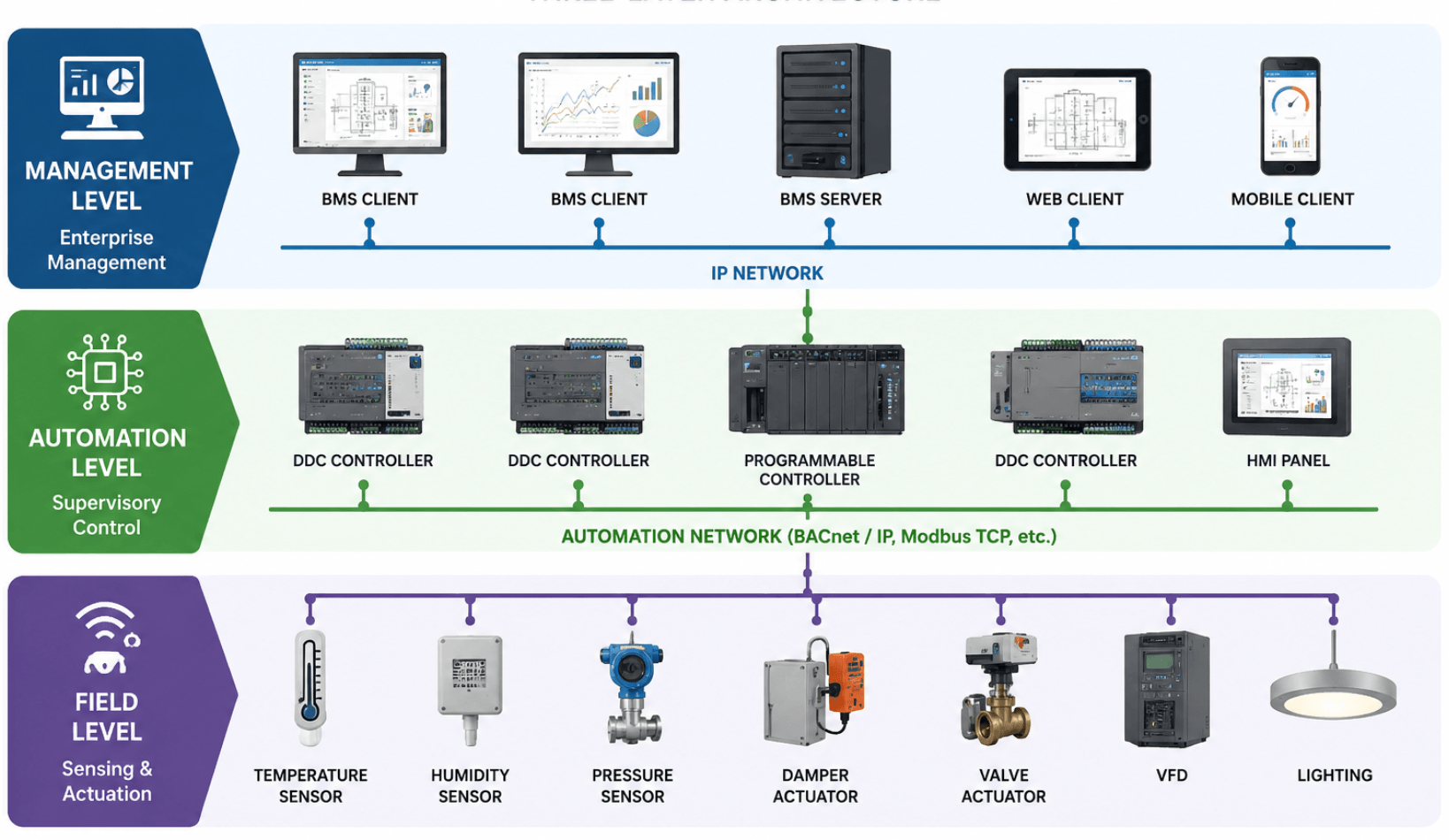
Nearly every BMS, regardless of manufacturer, follows a three-tier architecture. Understanding these layers is the fastest way to make sense of any system you encounter.
Field Layer (Sensors and Actuators)
This is where the system touches the physical world:
- Sensors measure conditions: temperature, humidity, CO₂, occupancy, differential pressure, water flow, and energy consumption.
- Actuators change conditions: valve actuators, damper motors, variable frequency drives (VFDs), and relays for lighting and pumps.
Field devices are the eyes and hands of the BMS. A poorly placed or uncalibrated sensor will sabotage even the most sophisticated control logic; garbage in, garbage out applies ruthlessly here.
Automation Layer (Controllers)
Direct digital controllers (DDCs) are the workhorses of the automation layer. These are microprocessor-based devices that:
- Read inputs from field sensors
- Execute programmed control logic (PID loops, schedules, interlocks)
- Command actuators accordingly
- Communicate status upward to the supervisory level
Controllers come in two broad flavors: programmable controllers for complex equipment like air handling units and chiller plants and application-specific controllers (ASCs) with pre-built logic for common equipment like VAV boxes and fan coil units.
Critically, a well-designed automation layer keeps running even if the head-end server goes down.
Control decisions happen locally at the controller; the supervisory layer is for monitoring and coordination, not moment-to-moment control.
Management Layer (Supervisory and User Interface)
At the top sits the head end: servers and workstations running the BMS software where operators interact with the system. This layer provides:
- Graphical dashboards with floor plans and equipment schematics
- Alarm management and notification routing (email, SMS)
- Trending and data logging for diagnostics and energy analysis
- Scheduling for occupancy-based operation
- Historical reporting for compliance and optimization
Modern management layers are increasingly browser-based and cloud-connected, allowing facility teams to monitor multiple buildings from anywhere.
Communication Protocols: The Language of the BMS
For decades, the biggest problem in building automation was proprietary lock-in; each vendor’s devices only spoke their own language. Open protocols changed that.
BACnet
BACnet (Building Automation and Control Networks) is the dominant open protocol in commercial buildings, developed by ASHRAE and standardized as ISO 16484-5.
It defines standard object types (analog inputs, binary outputs, schedules, trend logs) and services that let devices from different manufacturers interoperate.
You’ll encounter it in two main forms: BACnet/IP over Ethernet networks and BACnet MS/TP over RS-485 twisted-pair wiring at the field level.
Modbus
Modbus is an older and simpler, register-based protocol common in power meters, VFDs, chillers, and generators.
It lacks BACnet’s rich object model, but its simplicity makes it nearly universal in industrial and electrical equipment.
Most BMS installations use gateways or native drivers to pull Modbus devices into the system.
KNX and LonWorks
KNX is widespread in Europe, especially for lighting, shading, and room control. LonWorks had significant market share in the 1990s and 2000s and still exists in legacy installations, though new projects rarely specify it.
MQTT and the IoT Layer
As buildings get smarter, MQTT, a lightweight publish/subscribe protocol from the IoT world, is increasingly used to push BMS data to cloud analytics platforms.
It doesn’t replace BACnet at the control level, but it’s becoming the standard bridge between building systems and cloud-based energy management and fault detection tools.
Core Functions of a Modern BMS
HVAC Control and Optimization
The bread and butter. The BMS manages air handling units, chillers, boilers, cooling towers, VAV boxes, and pumps, maintaining comfort while minimizing energy use through strategies like
- Optimal start/stop (starting equipment at the last possible moment to reach setpoint by occupancy)
- Economizer control (using free outdoor air for cooling when conditions allow)
- Demand-controlled ventilation (modulating fresh air based on CO₂ levels)
- Chilled water and supply air temperature reset (relaxing setpoints when full capacity isn’t needed)
Energy Management
With energy metering integrated into the BMS, facility teams can track consumption by system, floor, or tenant, identify waste, verify utility bills, and participate in demand response programs.
Energy savings of 10–25% are commonly achievable when a BMS is properly commissioned and actively managed and just as commonly lost when it’s neglected.
Alarm Management and Fault Detection
The BMS is the first line of defense against equipment failure. A properly configured alarm system tells the right person about the right problem at the right time.
Increasingly, fault detection and diagnostics (FDD) software layers on top of the BMS to automatically identify issues like simultaneous heating and cooling, stuck dampers, or sensor drift problems that traditional alarms miss.
Life Safety Integration
The BMS typically monitors fire alarm and gas detection systems rather than controlling them.
Life safety systems must remain independent per codes like NFPA 72. But integration matters: on a fire alarm, the BMS coordinates smoke control sequences, shuts down air handlers, and releases access-controlled doors. In facilities with fixed gas detection, the BMS can trigger emergency ventilation when sensors detect a hazardous atmosphere.
This is the intersection where I’ve spent much of my career ensuring detection systems and building controls work together reliably, because the consequences of getting it wrong aren’t measured in kilowatt-hours.
Benefits of a Building Management System
Lower energy costs
Scheduling, setpoint optimization, and eliminating simultaneous heating/cooling routinely cut HVAC energy 10–25%.
Longer equipment life
Smooth control, staged operation, and runtime balancing reduce mechanical wear.
Fewer emergency callouts
Early alarms and trend data let teams fix small problems before they become failures.
Better occupant comfort
Consistent temperatures and air quality mean fewer complaints and, in commercial settings, more productive tenants.
Regulatory compliance and reporting
Automated logging supports energy codes, indoor air quality documentation, and ESG reporting requirements.
Centralized visibility
One operator can supervise what would otherwise require constant physical rounds.
Challenges and Limitations
A BMS isn’t a magic box, and it’s worth being honest about the failure modes.
Poor commissioning
A shocking number of systems are handed over with overridden points, disabled alarms, and untested sequences. The BMS only performs as well as its commissioning.
Drift and neglect
Sensors fall out of calibration, operators apply “temporary” overrides that last for years, and savings quietly evaporate.
Proprietary lock-in
Even with open protocols, some vendors restrict programming tools or charge heavily for access, trapping owners in expensive service contracts. Insist on open protocols and owner access rights in your specifications.
Cybersecurity
As BMS platforms connect to IT networks and the cloud, they become attack surfaces. Network segmentation, credential management, and patching are no longer optional.
Skills gap
The industry has a real shortage of technicians who understand both controls and mechanical systems.
Who Needs a BMS?
As a rule of thumb, a full BMS makes economic sense for buildings above roughly 5,000 m² (about 50,000 ft²) or smaller facilities with critical environments such as hospitals, laboratories, data centers, pharmaceutical plants, and cleanrooms where conditions must be documented and tightly maintained.
For smaller commercial buildings, lighter-weight cloud-based solutions and smart thermostat platforms now fill the gap that a traditional BMS was too expensive to serve.
The Future: Smart Buildings and Analytics
The BMS is evolving from a control system into a data platform. Key trends shaping the next decade.
- Cloud analytics and AI-driven optimization that continuously tune setpoints beyond what static programming can achieve
- Digital twins that model building performance for scenario testing
- Convergence with IT building networks managed with the same rigor as corporate networks
- Grid interactivity: buildings that shift loads in response to utility pricing and renewable availability
- Health-focused monitoring: indoor air quality tracking became mainstream after 2020 and isn’t going away
The buildings that win over the next decade won’t just have a BMS; they’ll have teams that actually use the data it produces.
Frequently Asked Questions
What is the difference between a BMS and a BAS?
Functionally, almost nothing; both terms describe centralized systems that monitor and control building services. “BAS” is more common among controls contractors in North America, while “BMS” is favored in facility management and international contexts.
Some purists say a BAS emphasizes automated control while a BMS emphasizes supervision, but in practice they’re interchangeable.
How much does a building management system cost?
Installed costs typically range from $2 to $8 per square foot for commercial buildings, depending on the scope of systems integrated, the density of control points, and whether it’s new construction or a retrofit.
A small office building might spend $50,000–$150,000, while a large hospital campus can run into the millions. Ongoing costs include service contracts, software licenses, and periodic upgrades.
What protocol should I specify for a new BMS?
For commercial buildings, BACnet/IP at the supervisory level and BACnet MS/TP or BACnet/IP at the field level are the safest open-protocol choices, with Modbus integration for electrical and mechanical packaged equipment.
Equally important: specify that the owner receives full programming access and documentation, so you’re never captive to a single service provider.
Can a BMS control fire alarm systems?
No, and it shouldn’t. Fire alarm and life safety systems must operate independently under standards like NFPA 72.
The BMS monitors the fire alarm system and executes coordinated responses (smoke control, fan shutdown, door release), but detection and notification remain the fire alarm panel’s job.
How long does a BMS last?
Field controllers typically last 15–20 years, while head-end servers and software need refreshing every 5–10 years.
Sensors and actuators wear at different rates and should be recalibrated or replaced on a preventive schedule. Plan for a major system upgrade roughly every 15 years.
Is a BMS worth it for a small building?
Below roughly 50,000 ft², a full traditional BMS is often hard to justify. Cloud-based light-commercial platforms, networked smart thermostats, and standalone lighting controls can capture much of the benefit at a fraction of the cost unless the building houses critical environments that demand documented, tight control.
Final Thoughts
A building management system is the difference between a building that’s operated and a building that’s merely occupied.
Done right, specified with open protocols, commissioned thoroughly, and actively managed, a BMS pays for itself in energy savings alone while extending equipment life and keeping occupants comfortable.
If you’re new to the field, start by learning the three-layer architecture and getting comfortable with BACnet.
It’s the foundation everything else builds on. And if you’re an owner or facility manager evaluating a system, remember: the technology matters less than the commissioning and the team behind it.

2 thoughts on “Introduction to Building Management System (BMS)”