Vibration sensors are the primary diagnostic tool for industrial machinery health and autonomous robotics.
These sensors play a critical role in modern engineering systems. They enable the detection, measurement, and analysis of mechanical oscillations.
These oscillations may indicate normal operating conditions. They may also indicate early signs of faults.
Examples include imbalance and misalignment. Also include looseness and/or bearing wear.
In recent years, industries have increasingly adopted predictive maintenance strategies. This is why the vibration sensors have become indispensable. They are widely used in manufacturing and power generation.
They are also found in automotive engineering, aerospace, and civil infrastructure. Different applications demand different sensing principles.
They also require different ranges and sensitivities. They also need opposite mounting methods.
This article explores the main types of vibration sensors. It explains their operating principles, advantages, and limitations. Typical applications are also discussed.
Fundamentals of Vibration Measurement
Vibration is a mechanical oscillation about an equilibrium position. It can be described in terms of displacement, velocity, or acceleration. The description depends on the application and frequency range of interest.
Low-frequency vibrations are often best described by displacement. Medium-frequency vibrations are described by velocity. High-frequency vibrations are described by acceleration.
Mechanical motion is converted into an electrical signal by vibration sensors. The signal is proportional to one of these quantities. The choice of sensor depends on several factors.
These include frequency range, amplitude, environmental conditions, required accuracy, and cost. Most vibration sensors consist of a mechanical sensing element. A common example is a mass-spring system.
They also include a transduction mechanism. This mechanism converts motion into an electrical output.
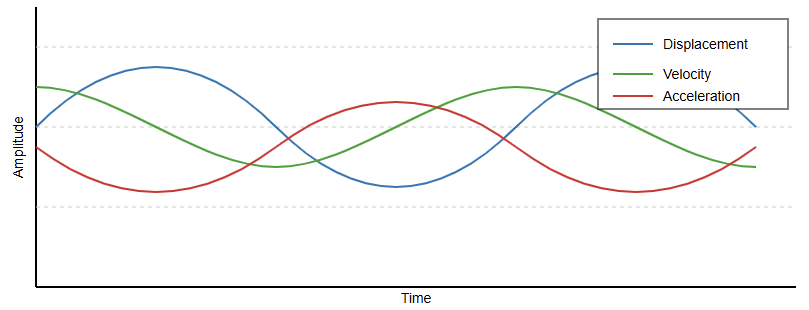
The following figure indicates basic vibration measurement concepts showing displacement, velocity, and acceleration versus time.
Core Classification by Measured Quantity
Vibration sensors are categorized by what they measure. They may measure acceleration, velocity, or displacement.
Accelerometers
These are the most versatile sensors. They measure the rate of change of velocity. They are ideal for high-frequency vibrations. These vibrations are associated with bearing wear or gear defects.
Velocity Sensors
These measure the absolute speed of vibration. They are primarily used for low-to-medium frequency monitoring. Rotating machinery, like electric motors and pumps, are the notably applications.
Displacement Sensors (Proximity Probes)
In many applications, it is necessary to know physical distance. The distance between the sensor and a moving target. This can easily be measured by these kinds of sensors.
They are indispensable for monitoring shaft motion. This is especially true in heavy turbomachinery. Steam turbines are a common example.
Accelerometers
Accelerometers are the most widely used vibration sensors. They are used in industrial and commercial applications. They measure acceleration directly.
They are suitable for a wide frequency range measurement, distinguishing these sensors. A few hertz to several kilohertz is the frequency range that can be accomplished.
Piezoelectric Accelerometers
Piezoelectric materials are applied in piezoelectric accelerometers. Common examples include ceramic crystals or quartz.
These materials generate an electric charge. The charge appears when they are subjected to mechanical stress.
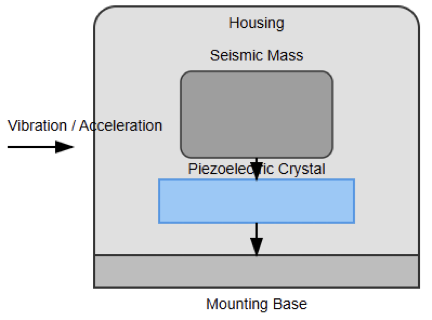
Inside the sensor, a seismic mass applies force. This force acts on the piezoelectric element. It occurs when vibration is present. The resulting charge is proportional to acceleration.
These sensors are highly robust, and they have excellent frequency response. They are well-suited for high-frequency vibration measurement. They are commonly used in machinery condition monitoring.
They are also used in aerospace testing and structural analysis. However, piezoelectric accelerometers cannot measure static acceleration.
They also struggle with very low-frequency acceleration. This is because the generated charge leaks away over time.
Piezoresistive Accelerometers
Piezoresistive accelerometers use strain-sensitive resistors. These resistors change resistance when deformed. The deformation is caused by vibration-induced forces. They can measure static acceleration.
They can also measure dynamic acceleration. They perform well in low-frequency applications.
These sensors are often used in shock measurement. They are also used in crash testing and aerospace applications.
These environments may involve large accelerations. However, they are more sensitive to temperature variations. This sensitivity is higher than in piezoelectric sensors.
The next figure illustrates a cross-sectional diagram of a piezoelectric accelerometer. It shows seismic mass, a piezoelectric crystal, and housing.
Micro Electro Mechanical Systems
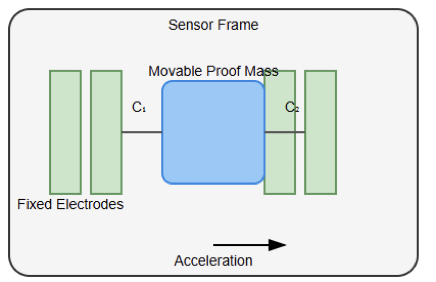
MEMS accelerometers are fabricated using semiconductor manufacturing techniques. They typically consist of a tiny proof mass.
This mass is suspended by micro-scale springs. They include capacitive, piezoresistive, or thermal sensing elements.
MEMS accelerometers are compact and low-cost. They are capable of measuring static and dynamic acceleration. They are widely used in consumer electronics.
Automotive systems and IoT-based condition monitoring also use them. Their frequency range is generally lower. They contain lower sensitivity compared to piezoelectric accelerometers.
However, technological advancements continue to improve their performance. The upcoming figure depicts a simplified diagram of a capacitive MEMS accelerometer with movable mass and fixed electrodes.
Capacitive MEMS Accelerometer: Simplified Diagram
Velocity Sensors
Velocity sensors measure vibration velocity directly. They are particularly useful for monitoring rotating machinery. These machines often operate at low to medium frequencies.
Electromagnetic Velocity Sensors
Electromagnetic velocity sensors are also called seismic velocity pickups. They operate based on Faraday’s law of electromagnetic induction.
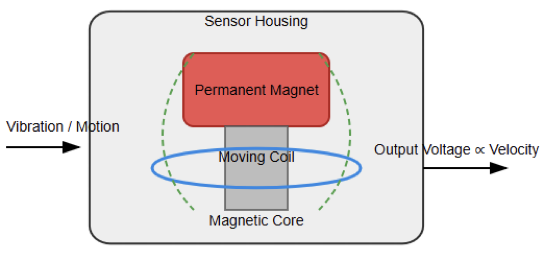
They consist of a coil suspended within a magnetic field. When vibration causes relative motion, the coil moves.
The magnet remains fixed, and a voltage proportional to velocity is induced. These sensors are rugged.
They provide good sensitivity at low frequencies. This makes them suitable for large machines such as turbines. Also, for electric motors and pumps.
However, they are relatively bulky, and they are also less effective at high frequencies. The figure below specifies the operating principle of an electromagnetic velocity sensor, showing the coil and the permanent magnet.
Electromagnetic Velocity Sensor: Operating Principle
Displacement Sensors
Displacement sensors measure the physical movement of a vibrating object. The movement is relative to a reference point.
They are commonly used for low-frequency vibration monitoring. They are also used for shaft motion monitoring.
Linear Variable Differential Transformers
LVDTs are inductive displacement sensors used to measure linear motion. They use a movable ferromagnetic core and transformer windings.
Vibration causes the core to move. This motion changes the induced voltage. The change occurs in the secondary windings.
LVDTs are known for high resolution. They also offer excellent repeatability and durability. They are commonly used in structural testing.
Machine tools and laboratory vibration measurements also use them. Their size can be a limitation. The need for signal conditioning can also limit compact applications.
Non-Contact Sensors
Eddy Current Proximity Probes
Eddy current sensors are non-contact displacement sensors. They measure the distance between the probe tip and a target. The target must be conductive. An alternating magnetic field induces eddy currents.
These currents form in the target material. They affect the impedance of the probe. These sensors are widely used in rotating machinery. They monitor shaft vibration, position, and runout. They offer high accuracy.
They also provide excellent reliability in harsh environments. Their main limitation is material compatibility. They only work with conductive materials. They also have a limited measurement range.
The figure below designates a diagram of an Eddy current proximity probe. It measures shaft displacement in a rotating machine.
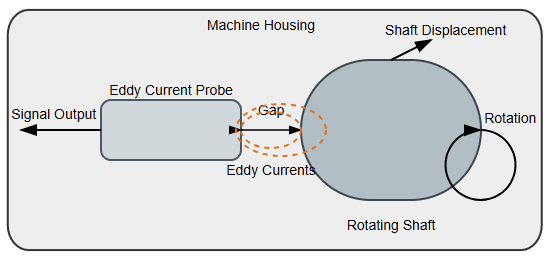
Eddy Current Proximity Probe Measuring Shaft Displacement
Optical Vibration Sensors
This section deals with different types of optical vibration sensors
Laser Doppler Vibrometers
The main application of these kinds of sensors is to measure vibration velocity. This process is possible thanks to the detection of the Doppler shift of laser light.
The light is reflected from a vibrating surface. They offer non-contact measurement. They also provide extremely high precision.
LDVs are widely used in research. They are also used in product development and modal analysis. These applications often involve complex structures.
Their main disadvantages include high cost. They are sensitive to surface reflectivity. Precise alignment is also required.
Fiber Optic Vibration Sensors
Fiber optic sensors detect vibration through light changes. These changes may involve intensity, phase, or polarization. They occur within an optical fiber.
Electromagnetic interference (EMI) does not affect these sensors. They are also designed to operate in harsh environments.
They are also suitable for explosive environments. These sensors are increasingly used in structural health monitoring. Oil and gas pipelines also benefit from their use.
Power systems are another application area. However, they often require complex signal processing. Specialized equipment is also needed.
Resonant and Tuned Vibration Sensors
Resonant vibration sensors are designed to respond strongly. They focus on a specific frequency. They often use a tuned mechanical structure.
This structure resonates at a known frequency. The resonance amplifies the vibration signal.
Tuned sensors are useful for detecting specific fault frequencies. These faults occur in machinery. Examples include bearing defects or gear mesh issues.
They provide high sensitivity at the target frequency. However, they are not suitable for broadband vibration analysis.
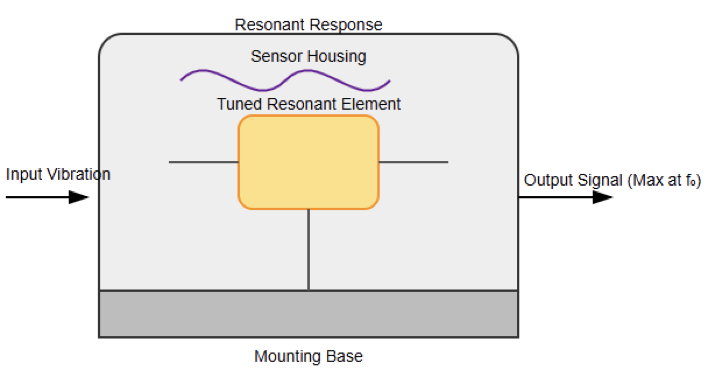
Resonant vibration sensor with a tuned mechanical element
Smart and Wireless Vibration Sensors
Recent advancements in electronics have driven innovation. Communication technologies have also contributed. Together, they have enabled smart vibration sensors.
These devices integrate sensing elements. They also include signal conditioning and data processing.
Wireless communication is included in a single package. Smart sensors can perform on-board feature extraction.
Examples include RMS value and crest factor. Frequency spectrum analysis is also possible.
Wireless vibration sensors are useful in hard-to-reach locations. They are ideal for large-scale monitoring systems.
Industrial plants and infrastructure networks are common examples. Their limitations include battery life. Data bandwidth and latency are also concerns.
Specialized and Emerging Technologies
Strain Gauges
These are directly bonded foils. They measure material strain through resistance changes.
They are used in 2026 for structural analysis. Bridges and large frames are common applications.
Triboelectric Sensors
These are a self-powered option. They emerged in 2026. They generate energy from vibration itself. They are suitable for long-life nodes. Remote locations benefit the most.
Acoustic (Microphone) Sensors
These capture high-frequency sound waves. The frequencies are beyond human hearing. They help detect early mechanical friction.
Selection Criteria for Vibration Sensors
Choosing the right vibration sensor requires careful consideration. Application requirements must be evaluated.
Frequency range and sensitivity are important factors. Environmental conditions must also be considered.
Mounting method and cost play important roles. Piezoelectric accelerometers are ideal for high-frequency diagnostics.
Eddy current probes are preferred for shaft vibration monitoring. MEMS accelerometers suit cost-sensitive applications.
They are also effective in distributed monitoring systems. Understanding operating principles is essential. Knowing sensor limitations is equally important.
Together, they ensure accurate measurements. They also ensure reliable diagnostic results. The table below compares various types of vibration sensors.
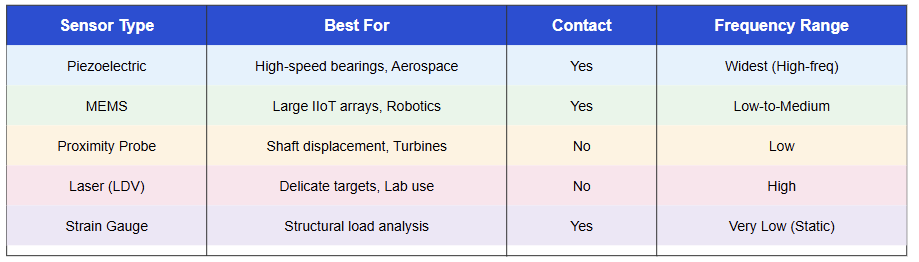
Vibration Sensor Selection: Comparison Table
Key takeaways: Types of Vibration Sensors
The present article reviewed the main types of vibration sensors. It detailed their operating principles, advantages, and limitations. Typical applications were also addressed.
Vibration sensors help evaluate mechanical system performance. Traditional piezoelectric accelerometers remain widely used.
Advanced optical and smart wireless sensors are also available. Each type offers unique advantages.
These advantages match specific measurement needs. Correct selection enables early fault detection. It also reduces downtime.
System reliability is significantly improved. As predictive maintenance expands, vibration sensing will evolve further.
Higher accuracy and greater integration will follow. Enhanced intelligence will also emerge. Understanding vibration sensor types remains fundamental.
Engineers and technicians rely on this knowledge in modern electromechanical systems.
FAQs: Types of Vibration Sensors
Why should one care about a vibration sensor? What is one?
Mechanical vibrations are converted into an electrical signal for evaluation. This is done through a device sensing such vibrations.
Condition monitoring and predictive maintenance rely heavily on this because odd vibrations can sometimes point to gear failures before catastrophic failure occurs.
What are the major categories of vibration sensors?
Accelerometers used to measure acceleration, velocity sensors for vibration speed measurement, and displacement sensors, which are applicable for movement relative to a reference, are the main categories.
How is an accelerometer unlike other vibration sensors?
Accelerometers evaluate the rate of change of velocity; they are perfect for identifying high-frequency faults such as bearing wear and are appropriate across a broad frequency range.
What are Piezoelectric accelerometers?
Using crystals stressed by vibrations, piezoelectric accelerometers create an electrical charge. Often employed in industrial machine monitoring, they are strong and have a great frequency response.
MEMS accelerometers are what?
Compact, low-power form factor MEMS (Micro-Electro- Mechanical Systems) accelerometers are small sensors measuring vibration.
They find extensive use in consumer electronics and IoT gadgets in addition to industrial applications.
