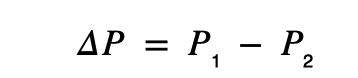
In industrial systems, pressure measurement is a fundamental necessity. Many procedures rely on precise pressure data.
These procedures have to run efficiently and securely. Pressure transmitters offer this data.
They translate physical pressure into an electrical signal. Control systems are able to interpret this indication.
Oil and gas, among other industries, make use of these technologies. Additionally utilized in power generation and water treatment.
They are also essential for manufacturing, and automation absolutely depends on their dependability.
Process control also depends on them greatly. Knowing how a pressure sensor functions helps engineers. It assists them in choosing the ideal gadget.
It also helps to identify flaws. It encourages better system design. The functioning theory of pressure transmitters is discussed in this article.
Moreover, it covers their essential parts. Technologies of sensing are reviewed. Common industrial uses are shown.
What is a pressure transmitter?
A pressure transmitter is an industrial instrument, and it is used to gauge the pressure of fluids or gases.
It senses pressure from a process and changes it to an electrical output signal. The signal then goes to the controllers.
Indicator targets can also get it. Monitoring devices can get it as well. Normally, the output is standardized.
This makes it possible to seamlessly connect with control systems. Typical outputs come in the shape of modern signals.
Voltage signals are utilized as well. Digital communication protocols are common. Transmitters offer continual measurement, unlike basic pressure gauges. They fit remote monitoring. Moreover, they support automation.
Basic Theory of Pressure Measurement
Pressure is defined as a force applied over a surface area. This force is supplied by liquids in industrial systems.
Pipes, tanks, or containers hold these fluids. Their movement results from pressure applied to a transmitter surface.
Mechanical and very little, this movement is It is also remarkably exact. The transmitter is intended for this detection. It turns the motion into an electric signal.
The signal has to be measurable. The accuracy of this conversion is important. It affects the accuracy of the pressure measurement.
Pressure Transmitter: Main Components
A pressure transmitter consists of several key components. These components work together. The pressure port allows the process fluid to enter.
The fluid enters the transmitter through this port. This port directs pressure toward a sensing element.
The sensing element is usually a thin diaphragm. It reacts to applied pressure. As pressure changes, the diaphragm deflects slightly.
Attached to the diaphragm is a sensor element. This sensor converts mechanical deformation.
The deformation becomes an electrical change. The electrical signal produced is very small. It is also unstable. Signal conditioning electronics amplify the signal. They also stabilize it.
The final stage converts the signal. It becomes a standardized output. This output is suitable for transmission. It is sent to control systems.


Block diagram showing pressure port, diaphragm, sensor, signal conditioning, and output stage
Diaphragm Operation
The diaphragm is the core mechanical element. It is part of a pressure transmitter. It is designed to flex under pressure.
Hence, permanent deformation must not occur. Upon application of pressure, the diaphragm bends proportionally to the pressure level.
Then comes the time when pressure drops. In this case, the diaphragm returns to its initial form.
Choosing the right material matters a great deal here. Because it must resist corrosion. Also, it must resist fatigue, and high temperatures must also be tolerated.
Common materials include stainless steel. Silicon-based structures are also used. The consistent movement of the diaphragm is important. It ensures repeatable measurements. It also ensures accurate measurements.
Strain Gauge Pressure Transmitters
Strain gauge pressure transmitters operate by detecting resistance changes. These changes occur in electrical resistance.
Strain gauges are bonded to the diaphragm surface. When the diaphragm bends due to pressure, strain occurs.
The strain gauges stretch or compress. This mechanical strain changes resistance. A bridge circuit is employed to hold and arrange the strain gauges. This circuit converts resistance changes. The output becomes a voltage signal.
This signal is proportional to applied pressure. After amplification, conditioning occurs. The signal is then transmitted.
It is sent to the control system. Strain gauge transmitters are known for durability. This explains their broad adoption in industrial environments.

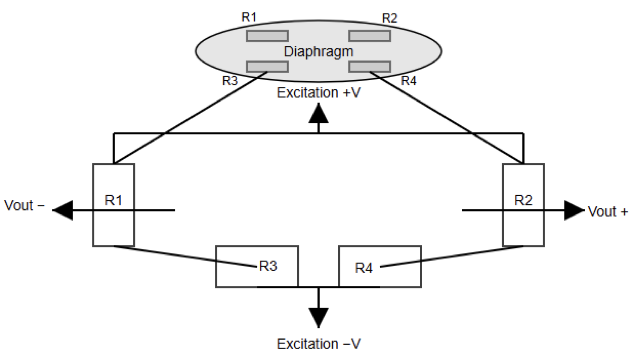
Wheatstone bridge containing a diaphragm with strain gauges
PiezoresistivePressureTransmitters
These transmitters rely on the piezoresistive effect within semiconductor technology. This effect is found in silicon materials.
When mechanical stress is applied to silicon, resistance changes. Electrical resistance changes as a result.
In these transmitters, a silicon diaphragm that contains embedded resistors is used. Pressure causes the diaphragm to deform. This deformation stresses the resistors. The stress produces an electrical output.
This output is measurable. Piezoresistive transmitters offer high sensitivity. They also provide good accuracy.
They are compact and cost-effective. This makes them popular. Many industrial applications use them.
Capacitive Pressure Transmitters
Capacitive pressure transmitters operate by detecting capacitance changes. The diaphragm acts as one capacitor plate.
A fixed plate acts as the other. A small gap exists between them, and when pressure is applied, the diaphragm moves.
It may move closer or farther away. The fixed plate remains stationary. This movement changes the capacitance value.
This change is then detected by electronic circuits and converted into an electrical signal.
Capacitive transmitters are effective at low pressures. They offer excellent resolution. They also provide good stability.
Piezoelectric Pressure Transmitters
These types of transmitters use special crystals that can generate an electrical charge when stressed.
When pressure is applied to the crystal, voltage is produced. This voltage appears at the output.
The magnitude of voltage corresponds to pressure. These sensors respond very quickly. They are ideal for dynamic measurements. Rapid pressure changes can be detected. They are commonly used in shock analysis.
Vibration analysis also uses them. They are not suitable for static pressure measurement. Long-term measurement is not recommended. The signal gradually decays over time.
Signal Conditioning and Processing
The raw signal generated by the sensor is weak. It is also sensitive to noise. Signal conditioning circuits enhance signal quality.
These systems also boost the signal. They remove unwanted noise. Temperature compensation is also applied.
Sensor characteristics change with temperature. Modern transmitters often use microprocessors. These handle signal processing tasks.
This improves measurement accuracy. Advanced features are enabled. Diagnostics and self-calibration are included.
Output Signal Transmission
After conditioning, the signal is converted. It becomes a standardized output. The most common industrial output is 4–20 mA.
This is a current signal. This format is reliable. It is resistant to electrical noise. Voltage outputs are also used.
Some applications prefer voltage signals. Digital communication protocols are supported. Additional information can be transmitted.
Device status can be included. Configuration data can also be sent. These outputs support system integration. Modern control systems benefit from this.
Types of Pressure Measurement
Pressure transmitters are classified by reference pressure. Absolute pressure transmitters measure pressure.
Pressure transmitters measure pressure relative to a reference point. That reference can be either a perfect vacuum or the surrounding atmospheric pressure.
A differential pressure transmitter measures two pressure points and outputs their difference. Each type serves specific applications.
Differential pressure transmitters are commonly used. Flow measurement uses them often. Filter monitoring also relies on them.
Applications of Pressure Transmitters
Pressure transmitters are used across many industries. In oil and gas systems, they monitor pipelines.
They also protect equipment. In power plants, they control boilers. Steam systems are monitored as well.
In water treatment facilities, pumps are regulated. Leaks can be detected. In the food and pharmaceutical industries, hygiene is ensured.
Precise process control is maintained. Their versatility is important. They are essential components. Modern automation systems depend on them.
Conclusion
This article details the working principle of pressure transmitters. It explained how physical pressure is converted.
The result is a standardized electrical signal. Pressure transmitters are critical instruments. They are used in industrial measurement. They are also used in control systems.
They convert physical pressure into electrical signals. Mechanical and electronic processes are involved.
The diaphragm senses pressure. The sensor converts movement. Electronics condition the signal. It is prepared for transmission.
Different sensing technologies serve different applications. Each technology has unique advantages. Understanding these principles helps engineers.
System design can be improved. Safety can be enhanced. Accurate process control is achieved. Pressure transmitters will remain essential. Industry continues to move toward automation.
Frequently Asked Questions
A pressure transmitter is and how does it function?
An electric signal results from a pressure transmitter’s transformation of fluid pressure. A diaphragm and a sensor, such as a piezoresistive element or strain gauge, are examples of its sensors.
The mechanical deflection is transformed into a tiny electrical signal that is thereafter adjusted to a conventional output, such as 4–20 mA or a digital signal.
Pressure sensors can be used to measure both liquids and gases
Certainly. Pressure sensors may measure gas as well as liquid pressure. For a great many industrial uses, this fits their profiles.
External power source needed by pressure transmitters?
Absolutely. To run their internal electronics and create an output signal, pressure transmitters need a source of electrical power. Unlike mechanical pressure gauges, they are active devices.
What kinds of output signals do pressure transmitters deliver?
Voltage signals and 4–20 mA current signals are among the typical outputs. Many contemporary pressure transmitters additionally handle digital communication standards, including HART, PROFIBUS, or Foundation Fieldbus.
Can pressure transmitters run in hostile or extreme conditions?
Many pressure transmitters are made to survive difficult circumstances. These include high temperatures, vibration, moisture, and corrosive surroundings. Operating boundaries vary according to the particular model.
Can pressure transmitters be used in sanitizing situations?
Yes. Food, beverage, and pharmaceutical companies may get special hygienic pressure sensors. For simple cleaning, these patterns use sanitary materials and smooth surfaces.