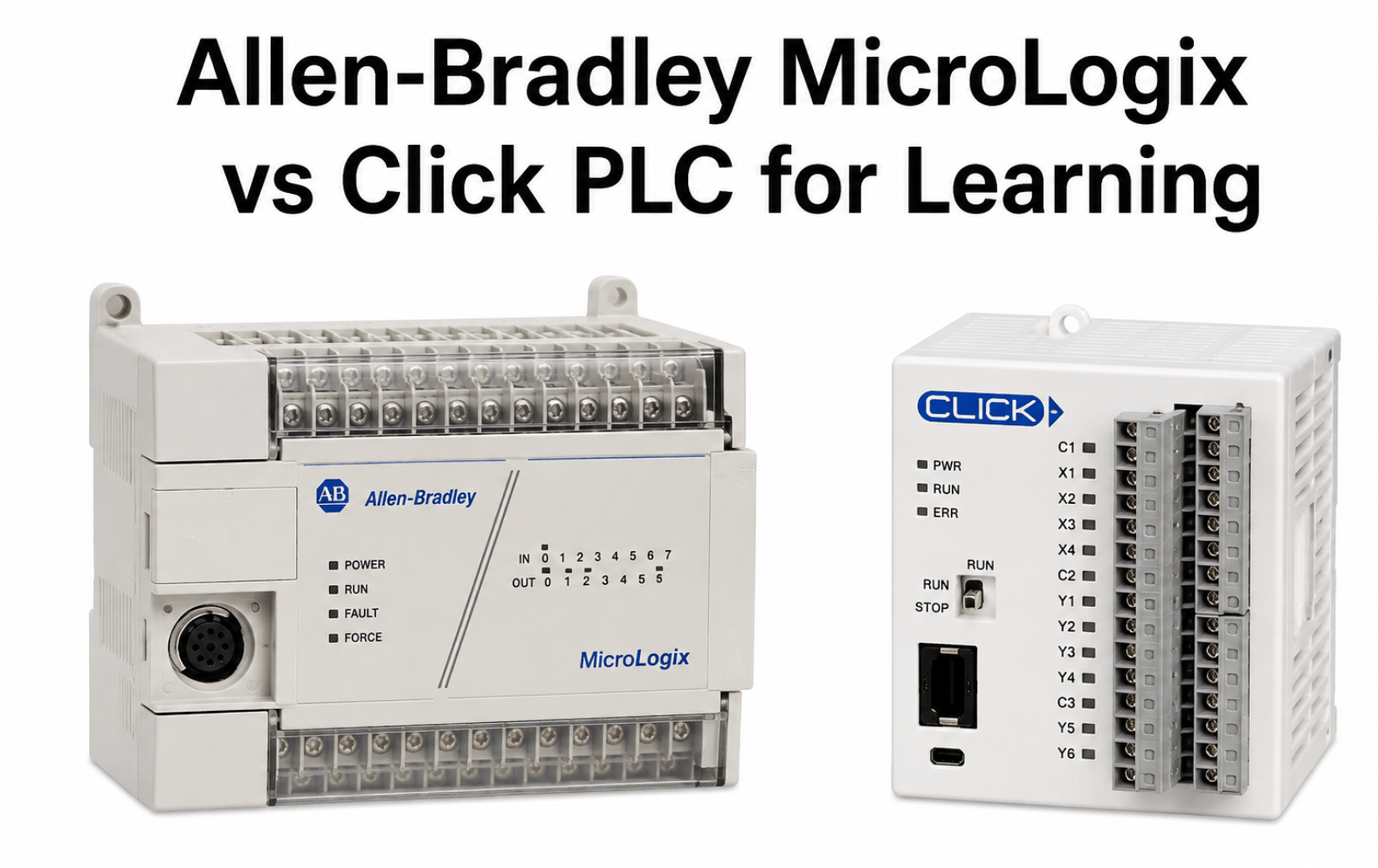
If you’re trying to break into industrial automation, you’ve probably hit the same fork in the road that every self-taught controls tech and engineering student runs into: do you learn on a real Allen-Bradley MicroLogix, or do you start with the cheap, wildly popular Click “PLC” from AutomationDirect?
I’ve spent years working with gas detection and industrial safety systems where Allen-Bradley hardware is the standard on the plant floor, and I still recommend Click to a lot of beginners.
The honest answer is that “best” depends on what you’re optimizing for: job readiness in a specific industry or the fastest, cheapest path to understanding ladder logic. Here’s how the two actually compare.
Allen-Bradley MicroLogix vs. Click PLC: Which is better for learning?
- Choose Allen-Bradley MicroLogix if you want direct exposure to the platform most heavy industry, automotive, food & beverage, and oil & gas plants standardize on in North America.
- Choose Click PLC if you want a nearly free, low-risk way to learn core PLC concepts, I/O wiring, ladder logic, timers, counters, and PID, without committing hundreds of dollars to hardware you might outgrow.
Most people learning on their own get further, faster, with Click. Most people trying to match a specific job posting get more mileage from MicroLogix or its modern replacement, the CompactLogix/Micro800 family.
Allen-Bradley MicroLogix
The MicroLogix line (MicroLogix 1000, 1100, 1200, 1400, 1500) was Rockwell Automation’s small-format PLC family for years.
Rockwell has officially discontinued MicroLogix, pushing customers toward the Micro800 series and CompactLogix, but MicroLogix hardware is still everywhere on the used market and still running in thousands of facilities today.
That’s exactly why it holds value as a learning platform. You’re not learning a museum piece. You’re learning what’s bolted to the wall in a huge number of existing plants.
Programming software
RSLogix 500 (for MicroLogix and SLC 500) or the newer Connected Components Workbench for Micro800.
Typical hardware cost
$80–$250 for a used MicroLogix 1100 or 1400 with a training cable, depending on condition and I/O count.
Strengths for learning
- Real exposure to Rockwell’s tag/addressing conventions and instruction set, which transfers conceptually to ControlLogix and CompactLogix, the platforms running in most large North American plants
- Widely documented online, with decades of forum threads, YouTube walkthroughs, and used program examples
- RSLogix 500 experience gives you a mental model that carries over reasonably well to Studio 5000, the software used on modern Rockwell systems
Weaknesses for learning
- Discontinued product line. Software licensing (RSLogix 500) can be a headache to source legally, and Rockwell software historically comes with licensing costs and dongle requirements
- Used hardware quality is a gamble; you’re buying industrial surplus, not new gear with a warranty
- Learning materials assume some baseline vocabulary already, since most MicroLogix content is written for working technicians, not total beginners
Click PLC: Overview
The Click PLC, made by AutomationDirect, was built almost specifically for this exact use case.
Small businesses, hobbyists, and students who need real, functional ladder logic experience without an industrial budget.
It’s not a toy; Click units run real production lines, especially in smaller machine shops and O.E.M. equipment.
Programming software
Click “Programming Software,” completely free to download, no license key, no dongle, no expiration.
Typical hardware cost
A basic Click PLC starter unit runs roughly $60–$100 new, with expansion I/O modules priced similarly low. AutomationDirect sells it new, with documentation and support, not as surplus.
Strengths for learning
- Free software with zero licensing friction. Install it today and be building ladder logic in minutes
- New hardware with a real warranty and AutomationDirect’s well-regarded technical support line
- Simulator mode lets you write and test ladder logic without any hardware at all
- Clean, beginner-friendly interface that doesn’t bury core concepts under decades of legacy software design
- Handles the fundamentals well: digital and analog I/O, timers, counters, math, PID, data logging, and even basic HMI integration through AutomationDirect’s C-more panels
Weaknesses for learning
- It’s not what most large industrial employers run in production. You won’t see “Click PLC” nearly as often on job postings as Allen-Bradley, Siemens, or even AutomationDirect’s own larger Productivity series
- The instruction set and tag structure are simpler than Rockwell’s, so some advanced concepts (structured tags, add-on instructions, more complex data typing) aren’t part of the experience
Side-by-Side Comparison
| Factor | Allen-Bradley MicroLogix | Click PLC |
|---|---|---|
| Typical cost to start | $80–$250 (used) | $60–$100 (new) |
| Programming software | RSLogix 500 / Connected Components Workbench | Click Programming Software (free) |
| Software licensing | Often requires a license or activation | None, free, unrestricted |
| Hardware condition | Used/surplus, no warranty | New, full manufacturer warranty |
| Job market recognition | High in large industrial plants | Lower, but growing in OEM/small machine builders |
| Learning curve | Steeper, assumes some background | Beginner-friendly |
| Simulator available | Limited/unofficial | Yes, built into the software |
| Transfers to modern platforms | Strong bridge to ControlLogix/CompactLogix concepts | Strong bridge to general ladder logic fundamentals |
| Community support | Large, but scattered across old forums | Active AutomationDirect forums, responsive tech support |
Which One Should You Actually Buy?
Think about this less like a brand loyalty question and more like a sequencing question.
If you’re a complete beginner, start with Click. The free software removes all friction, and AutomationDirect’s documentation is written for people who don’t already know the jargon.
You’ll learn the actual concepts. Normally open and normally closed contacts, rungs, timers, counters, and addressing without fighting a licensing dongle or guessing whether your used MicroLogix unit is actually functional.
If you already know ladder logic basics and want to target a specific job, look at what the employer runs.
A posting that says “Allen-Bradley experience required” or “ControlLogix/CompactLogix” is telling you to get hands-on with Rockwell gear, even secondhand.
In that case, a used MicroLogix 1400 with RSLogix 500 is a reasonable, low-cost way to get your hands on real Rockwell addressing and instruction conventions before you’re in front of a $15,000 CompactLogix system on the job.
If your budget is genuinely tight, Click wins outright. New hardware with a warranty and free software beats gambling on a used MicroLogix unit of unknown history, especially when you’re also trying to learn the concepts for the first time.
A workflow I’ve seen work well for people transitioning into controls from another trade: learn the fundamentals on Click first because the cost of experimentation is near zero, then move to a used MicroLogix or a Micro800 kit once you understand ladder logic well enough that Rockwell’s addressing conventions and software quirks aren’t fighting you at the same time you’re trying to learn timers and counters for the first time.
FAQ
Is Click PLC good enough to get a job in industrial automation?
On its own, probably not for a large industrial plant, but it’s genuinely good enough to learn the fundamentals that transfer to any PLC brand.
Employers care more about whether you understand ladder logic, I/O wiring, and troubleshooting than which specific brand you first learned on, though brand-specific experience does matter for some postings.
Can I learn on a Click PLC and then move to Allen-Bradley later?
Yes, and this is a common and sensible path. The core concepts, rungs, contacts, coils, timers, counters, and addressing logic transfer across brands. What changes is the software interface and some brand-specific instruction naming.
Is RSLogix 500 still available to download legally?
Rockwell has discontinued MicroLogix and shifted support toward Micro800 and CompactLogix. RSLogix 500 licensing can be difficult to source for individuals; check current availability directly with Rockwell or an authorized distributor before assuming you can get a legal copy.
Does Click PLC support analog I/O and PID control?
Yes. Click supports analog input/output modules and has built-in PID instructions, which makes it capable of more than basic on/off digital logic despite its low price point.
What’s the difference between MicroLogix and Micro800?
Micro800 is Rockwell’s current small-PLC family and the intended replacement for MicroLogix. It uses Connected Components Workbench instead of RSLogix 500 and has a different, more modern instruction set, though the underlying ladder logic concepts are the same.
Seki Hudson is an industrial automation engineer working in gas detection and industrial safety systems, with hands-on experience across Allen-Bradley and other major PLC platforms in production environments.
