Dependable signal transmission across complicated buildings and precise instrumentation are really important for industrial automation systems.
Coordinated regulatory structures comprising sensors, transmitters, controllers, and final control elements are created by control loops.
Each loop must function precisely within defined operational and safety boundaries at all times.
Even minor wiring mistakes or configuration mismatches can generate serious startup disruptions. Improper scaling or polarity errors may create unsafe operating conditions quickly.
Loop checking is the structured verification process performed before full commissioning activities begin.
It ensures that every signal path operates according to approved engineering documentation.
Technicians validate measurements, signal continuity, and actuator responses under controlled testing conditions.
This disciplined procedure reduces uncertainty during plant energization and startup phases.
This article reviews the principles of loop checking and explains why it remains essential for safety, reliability, and successful commissioning.
Understanding Loop Checking
Loop checking is a systematic commissioning activity conducted after installation completion.
It focuses on verifying the integrity of individual instrumentation control loops. A control loop generally includes measurement, transmission, processing, and actuation components.
These components must operate together without signal distortion or interruption. Signals may be analog, digital, or discrete types depending on application requirements. Analog loops often use standardized four-to-twenty milliamp signals.
Digital loops may use network-based industrial communication protocols. During loop checking, technicians apply known reference signals carefully.
The control system reading is compared against expected engineering values. Output commands are issued from controllers to final elements.
Valves, relays, and motors must respond proportionally and correctly. Any deviation between expected and actual behavior requires investigation.
This structured verification confirms alignment between design documentation and field installation. It bridges the gap between construction activities and operational readiness.
Components Involved in Loop Checking
Every instrumentation loop contains interconnected electrical and mechanical components.
The primary sensing element measures process variables such as pressure or temperature. A transmitter converts the measured variable into electrical signals.
These signals travel through electric cables. Also, they run across junction boxes and even terminal panels.
Proper shielding and grounding practices must be verified during inspection. Within the control system, input modules receive transmitted signals accurately.
The controller processes data according to programmed logic sequences. Output modules generate commands toward the final control devices. Final elements may include control valves, dampers, or motor starters.
Loop checking verifies continuity between every terminal connection point. Channel assignments must match engineering drawings and tag lists.
Human-machine interface displays should present correct process values. Alarm thresholds and scaling parameters require careful validation.
The following figure illustrates the complete signal path within a typical instrumentation control loop.
It visually demonstrates how a physical process variable is measured by a sensor. Then converted into an electrical signal by a transmitter.
Furthermore, it is transmitted through wiring infrastructure, processed by the controller, and finally used to actuate a control element.
The diagram supports the discussion by showing why every connection point must be verified during loop checking.
It emphasizes that a failure at any stage can compromise overall system performance and safety.

Typical Instrumentation Control Loop Architecture
Procedure for Performing Loop Checking
Loop checking begins only after confirming mechanical installation completion. Instruments must be mounted securely and identified clearly with tags. All cables should be terminated according to approved wiring diagrams.
Commissioning teams prepare detailed loop check sheets before testing begins. These documents reference signal ranges, alarm limits, and device addresses. Safety permits and isolation procedures must be implemented properly.
Technicians connect calibrated simulation equipment to transmitter circuits. A known test signal is injected into the loop wiring.
The corresponding value displayed in the control system is observed. Differences indicate configuration errors or calibration discrepancies immediately.
Necessary adjustments are performed to correct identified deviations. Output testing is followed by issuing commands from the control interface.
Actuators must respond correctly to varying signal magnitudes. Valve stroke position or motor rotation confirms mechanical functionality.
Feedback signals are compared with commanded values carefully. All results are recorded systematically on verification documentation sheets. Only successfully validated loops proceed toward integrated functional testing.
The logical order followed during loop checking exercises is shown by this diagram. It logically structures the verification procedure from installation confirmation up to signal simulation, system validation, actuator response testing, and paperwork.
The flowchart draws attention to the systematic nature of loop checking as well as the decision points needing corrective action.
Visual representation of the workflow helps to clarify the figure and backs up the procedural explanation given in the book.
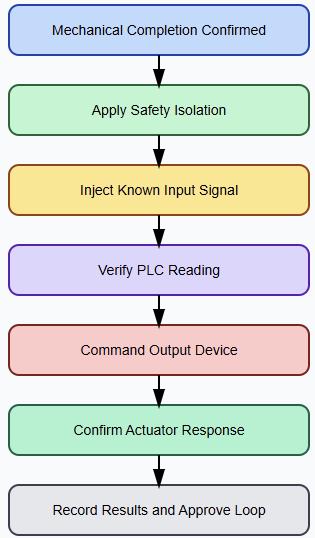
Loop Checking Verification Workflow
Importance of Loop Checking in Safety
Safety considerations make loop checking critically important in industrial environments. Many facilities are likely to handle high pressures.
In addition, they manage extreme temperatures and hazardous materials. Incorrect measurement signals may disable protective shutdown functions unintentionally.
Reversed polarity wiring could prevent emergency interlocks from activating. Misconfigured alarms might fail during abnormal operating conditions.
Loop checking ensures protective devices operate exactly as engineered. Safety instrumented functions depend on precise and reliable signal transmission.
Verification reduces risks associated with human installation errors significantly. Regulatory authorities frequently require documented commissioning evidence for approval.
Inspection bodies review loop check records during compliance audits. Comprehensive verification strengthens overall plant safety management strategies.
Operational Reliability and Performance Benefits
Accurate control depends on stable and verified measurement signals. Wiring faults can introduce noise and distort transmitted values.
Incorrect scaling may produce oscillatory or unstable control behavior. Loop checking eliminates many hidden uncertainties before startup. Controllers receive validated data for precise regulation actions.
Stable signals improve product quality and process consistency. Energy consumption decreases when control loops operate efficiently. Verified baseline readings support future troubleshooting and diagnostics.
Maintenance teams benefit from documented commissioning reference values. This structured verification approach enhances long-term operational reliability.
Loop checking also reduces unplanned downtime during early operation. Early detection of faults prevents costly production interruptions later.
Contractors and clients both benefit from minimized startup risks. The time invested in verification yields significant operational returns.
Common Errors Detected During Loop Checking
Loop checking frequently uncovers wiring termination mistakes in panels. Crossed conductors may connect signals to incorrect controller inputs.
Open circuits can interrupt signal transmission completely. Short circuits may damage sensitive input modules permanently. Incorrect terminal labeling complicates future maintenance activities unnecessarily.
Configuration errors also appear during systematic verification procedures. Engineers may enter incorrect measurement ranges during setup.
Unit conversion mistakes distort displayed engineering values significantly. Digital systems sometimes experience duplicate device addressing conflicts.
Incorrect network parameters can disrupt communication reliability. Identifying these issues before dynamic startup prevents costly delays.
Equipment damage risks decrease when faults are corrected early. Thorough verification, therefore, protects both schedule and investment.
Relationship with Commissioning and Startup
Loop checking represents a major milestone within the project commissioning phases. It is typically completed before integrated functional testing begins.
Verified loops provide confidence in instrumentation signal integrity. Without this validation, system-level tests may produce misleading results.
Startup teams rely heavily on accurate instrumentation feedback. Operators must trust displayed values during initial energization.
Incorrect readings can lead to improper operational decisions quickly. Loop checking builds confidence among engineers and plant operators.
Early detection of discrepancies reduces rework during critical schedules. Projects progress more smoothly when loops are validated systematically. Effective loop checking contributes directly to successful plant startup.
Conclusion
This article introduced the concept of loop checking and described its structured verification process in industrial automation projects.
It explained how individual instrumentation loops are validated before commissioning and startup activities begin.
The discussion highlighted safety benefits, operational reliability improvements, and common errors detected during verification.
Loop checking ensures alignment between engineering documentation and physical installation conditions.
Confirming signal integrity lessens starting risks and avoids expensive operating interruptions.
Published verification also meets regulatory compliance requirements and quality assurance needs.
In the end, regular loop checking boosts trust in control systems and encourages secure, effective, and dependable industrial activities.
FAQs
What is loop checking?
It is the verification activity that confirms a control loop’s complete signal path functions correctly from sensor to controller and back.
When is loop checking performed?
Loop checking is carried out after installation and wiring of instruments, but before full system commissioning begins.
What components are tested during a loop check?
Verification procedures confirm the accuracy and continuity of field instruments, cabling, junction points, and control elements.
Why is loop checking important?
It ensures measurements, signal continuity, and configuration are correct, preventing unsafe conditions and startup failures.
Does the loop checking test alarms and trips?
Yes, loop checks often include verifying alarm, trip, and interlock signals at the control system.
Is loop checking the same as a function test?
No, loop checking verifies signal integrity, whereas function testing validates control logic and actual process responses.
Can loop checks detect wiring mistakes?
Yes, loop checking is specifically designed to uncover wiring errors. It is also in charge of discovering polarity issues and termination faults.
What types of signals are checked?
Analog signals like 4–20 mA, digital communications, and discrete on/off signals can all be included in loop checks.
Is loop checking only done on new installations?
No, loop checking may also be done during maintenance, upgrades, or after repairs to ensure ongoing system integrity.
What documentation supports loop checking?
Loop diagrams, P&IDs, cable schedules, tag lists, and formal check sheets are commonly used as references.
